
Livraison le jour même ou le lendemain

Qualité garantie

Débloquez vos offres de bienvenue: Livraison GRATUITE | Jusqu'à -80 % | 30 jours d'essai gratuits à JoyPlus
Téléchargez l'application
Buying a Type 2 electric car charger isn’t just about comparing power ratings and cable lengths. In the UK, the right choice depends on your vehicle’s socket, your electrical installation, the number of phases available, and your parking habits.
A poorly chosen model can mean slower charging than expected, a cable that’s too short, or an installation that’s unsuitable for a domestic socket. Here are the criteria to check before buying a Type 2 charging cable, a portable EV charger, or a wall box.
A cable advertised at 22 kW won’t automatically let your car charge at 22 kW. The actual power delivered depends primarily on your vehicle’s onboard charger, the charging point, and the available electrical supply.
For example, a car with a 7.4 kW single-phase onboard charger won’t charge any faster with a 22 kW three-phase cable. That said, a three-phase cable can still be useful for compatibility with different public charging points, provided the connectors and technical specifications match.
The European standard IEC 62196-2 generally corresponds to the Type 2 socket used by many electric and plug-in hybrid vehicles across Europe. However, it shouldn’t be confused with J1772, CCS1 or CHAdeMO sockets.
A 32 A Type 2 cable can work in single-phase or three-phase mode. This distinction has a direct impact on the power available:
A 5 m charging cable is usually sufficient when the charging point is close to your vehicle’s charging port. A 7 m length gives you more flexibility in public spaces, while a 10 m cable can make parking easier when the charging point is further away.
Bear in mind, though: the longer the cable, the heavier and bulkier it is. So measure the actual distance between the charging point and your vehicle’s socket before placing your order.
For a portable EV charger plugged into a domestic socket, the power must remain compatible with the circuit being used. The feyree 3.5 kW model shown below lets you select 8, 10, 13 or 16 A before starting a charge. Its specification recommends a Schuko socket with earth, in good condition, and a circuit capable of handling the chosen current continuously.
For a 7 kW or 7.4 kW wall box, the installation must be carried out on a dedicated circuit by a qualified electrician. The WOLFBOX AE07 model, for instance, requires a 32 A supply and needs appropriate wiring and residual current protection.
The IP rating indicates how resistant equipment is to dust and water. It doesn’t mean the device can be submerged.
Even with IP65 or IP66 protection, avoid leaving the unit in a puddle, handling connectors with wet hands, or using a portable charger in heavy rain without shelter.
An IEC 62196-2 cable must lock securely on both the vehicle and charging point sides. Also check for a protective cap, a comfortable handle, and a storage bag.
The GONEO cables in this selection feature a TPU sheath and connectors that are advertised as TÜV Rheinland certified. This information is based on the product specifications provided and should be confirmed on the product page before purchase. Always store the cable away from moisture, avoid sharp bends, and never leave it where a vehicle could run over it.
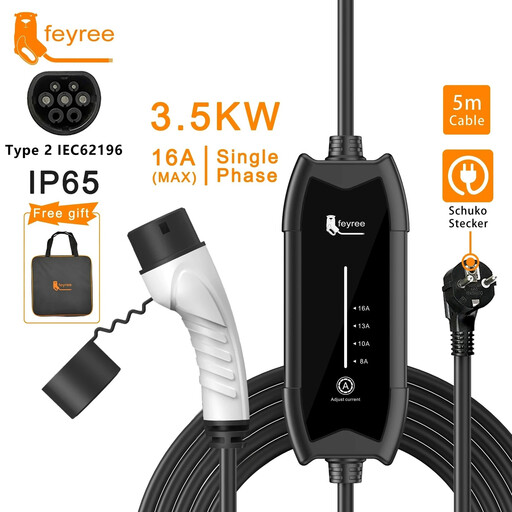
Why this suits this profile: This single-phase portable charger is ideal for drivers who want to charge at home or have a backup solution when travelling. Its 5 m cable and Schuko plug make it easy to connect to a compatible existing installation.
The power is clearly limited to 3.5 kW and the current can be adjusted between 8 and 16 A before connecting. This helps you avoid choosing oversized equipment without checking your circuit’s capacity first.
Adjustable 8/10/13/16 A settings, advertised IP65 protection, control display and 5 m Type 2 cable.
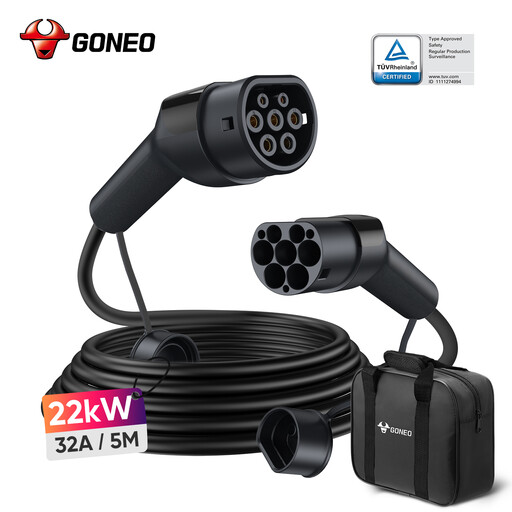
Why this suits this profile: This 32 A, 5 m three-phase cable is suitable for drivers whose vehicle and installation support 22 kW charging, particularly at compatible public charging points.
The specification clearly distinguishes the 22 kW power, 32 A current and three-phase operation. It’s still essential to check your onboard charger’s power rating before buying.
TPU sheath, advertised IP54 protection, carry bag and male-female Type 2 connectors.
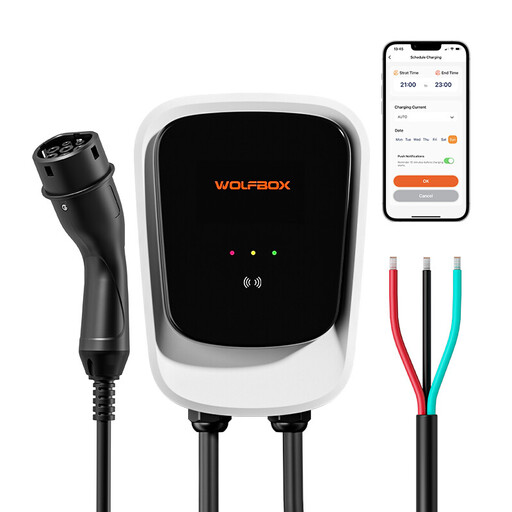
Why this suits this profile: This 7 kW wall box is aimed at drivers who regularly charge their car at home and want to control certain functions via an app or RFID card.
The specification states that installation must be carried out by a qualified electrician, with a separate circuit and appropriate protection. This is an essential precaution to avoid treating a 32 A wall box like a simple domestic socket.
Advertised 7 kW power, app control, RFID card and integrated Type 2 cable.
A 4000 A car battery booster can complement the equipment of a petrol or hybrid vehicle, especially when its 12 V battery is flat. The GOOLOO GT4000S claims a peak current of 4000 A, USB-C charging up to 100 W and an integrated light. This information comes from its product page: always check the voltage, engine type and manufacturer’s instructions before use.
For portable devices, a 100 W USB-C power bank can power some compatible laptops and phones. It won’t directly charge an electric car’s high-voltage battery, but it can come in handy when you’re on the move or waiting at a charging point.
No. The charging speed depends on your vehicle’s onboard charger, the charging point and the number of phases available. A 32 A cable must be paired with an installation and a car that are compatible with the intended power level.
Yes, provided the model is designed for a Schuko socket with earth and the electrical circuit is in good condition. For prolonged use at high current, have the circuit checked by a professional and avoid using extension leads not designed for this load.
Choose 5 m when the charging point is close, 7 m for more flexibility in public spaces, and 10 m when your parking situation is more awkward. Measure the distance before ordering to avoid unnecessary weight and bulk.