
Livraison le jour même ou le lendemain

Qualité garantie

Débloquez vos offres de bienvenue: Livraison GRATUITE | Jusqu'à -80 % | 30 jours d'essai gratuits à JoyPlus
Téléchargez l'application
Are you looking for a Type 2 electric car charger for your electric or plug-in hybrid vehicle? Between the portable cable, the 7 kW Wallbox, three-phase charging and Wi-Fi app control, it’s not always easy to compare the technical specifications. The risk: buying a device that’s too powerful for your installation, too slow for your needs, or lacking essential protection.
Here are the criteria to check before placing your order, along with a selection of models suited to different uses in the UK.
A charger advertised as 7 kW, 11 kW or 22 kW won’t necessarily deliver that power to your car. The charging speed depends on three factors:
For example, a 22 kW charging station generally requires a suitable three-phase supply and a vehicle capable of accepting that power in alternating current. If the car is limited to 7.4 kW, a more powerful station won’t reduce the charging time.
An electric car charger with a Schuko plug connects to a domestic socket that is earthed. But prolonged charging at high current can put strain on the socket, the wiring and the consumer unit. Before using 16 A continuously, check the condition of the circuit and opt for a dedicated line.
An adjustable model lets you reduce the current to 8 A, 10 A or 13 A when the installation or socket isn’t suitable for a 16 A charge. The charger must never be plugged into an ordinary extension lead or a poorly fitted socket.
A rating such as IP65 or IP66 indicates the level of resistance to dust and water under certain conditions. It doesn’t replace proper installation: a sheltered location, clean connectors, the cable kept out of water, and following the manufacturer’s instructions. For a wall-mounted station installed outdoors, also check the wall fixing, circuit protection and the distance to the consumer unit.
The IEC 62196-2 standard, more commonly called Type 2 or Mennekes, equips the majority of electric and plug-in hybrid vehicles sold in Europe. Nevertheless, check that your car actually has a Type 2 inlet. A vehicle with a Type 1, CHAdeMO or North American connector won’t be directly compatible.
Some useful benchmarks:
An EVSE Type 2 with adjustable current lets you adapt charging to your installation’s capabilities. Scheduling can also start charging during periods when electricity is cheaper, depending on your tariff. Connected models typically add voltage, current, power and duration tracking via an app.
Dynamic load balancing goes a step further: it automatically adjusts the charging current based on the consumption of other appliances in the home. However, it must be properly installed and configured.
Check for protection against overcurrent, overvoltage, overheating, earth faults and leakage currents. Some devices advertise 30 mA AC + 6 mA DC detection, usually associated with a Type B residual current device or equivalent integrated protection.
For a wall-mounted station, the installation must be checked by a qualified electrician. It requires a dedicated circuit and the protections required by regulations and the manufacturer’s instructions. The CE, RoHS and other certifications displayed should be verified in the product documentation: they don’t exempt you from following installation rules.
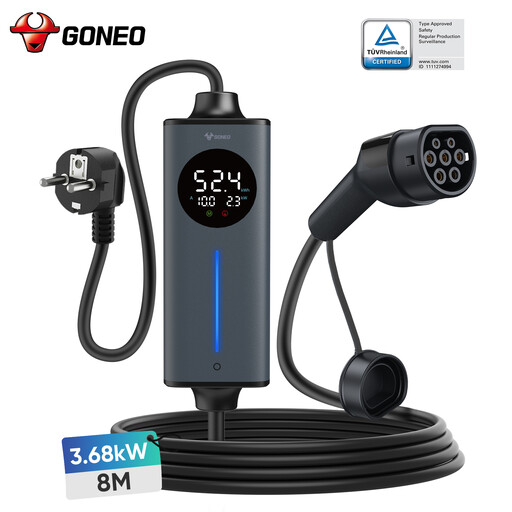
Why this choice suits this profile: This portable charger plugs into a Schuko socket and works well for both home charging and on the go, with its 8 m cable.
The current can reach 16 A, but remains adjustable. The charger also includes earth detection and automatically reduces the current if the temperature gets too high.
Maximum advertised power of 3.68 kW, adjustable timer from 0 to 8 hours, LED display and 30 mA AC + 6 mA DC protection.
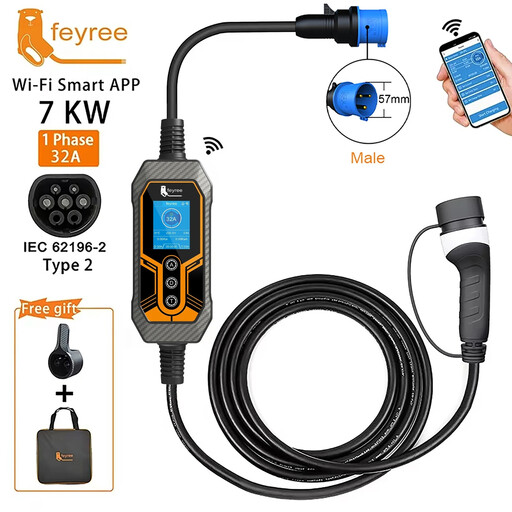
Why this choice suits this profile: It combines portability with connected features to track charging from an app, at home or at a site with a suitable socket.
The advertised power comes with an adjustment range of 8 to 32 A. You can therefore adapt it to the available source, rather than always drawing 32 A.
Wi-Fi and Bluetooth app, 2.8-inch LCD screen, delayed programming and advertised AC/DC leakage protection.
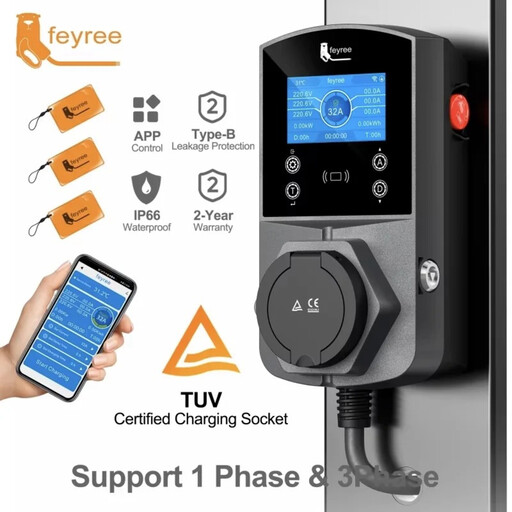
Why this choice suits this profile: This station with a Type 2 socket is aimed at households with an installation compatible with single-phase or three-phase operation.
The power adapts to the installation and the vehicle. However, the circuit must be validated by an electrician before installation.
Advertised power from 1.4 to 22 kW, Wi-Fi and Bluetooth connections, scheduling, current adjustment and integrated Type B residual current device according to the product sheet.
We’ve compiled a complete, real-time updated selection of products that meet these demanding criteria and European safety standards.
Yes, provided you use a model fitted with a Schuko plug and designed for this purpose. The socket must be earthed, in good condition and connected to a suitable circuit. For regular high-current use, have the electrical installation checked.
It all depends on the energy consumed and the rate applied by your supplier. To get an estimate, multiply the amount actually charged in kWh by the price per kWh. Scheduling charging during off-peak hours can reduce the bill, depending on the terms of your contract.
A 7 kW station generally operates on single-phase, while an 11 kW model usually uses three-phase. The choice depends on your consumer unit, your electricity tariff, the wiring and your vehicle’s onboard charger. An electrician must confirm the configuration before installation.