
Same-day & Next-day Delivery

Quality Guaranteed

Unlock Your Welcome Offers: FREE Delivery | Up to 80% OFF | Free 30-day JoyPlus trial
Download the APP
Charging your electric car from a domestic socket may seem straightforward. However, choosing the wrong Type 2 electric car charger can mean endlessly long charging times, an overheating socket or a cable that is too short to reach the vehicle. To make the right choice, electric car and plug-in hybrid owners should focus on distinguishing genuinely useful features from vague marketing claims.
A charger advertised as capable of delivering 7.4 kW will not necessarily provide that power in practice. It depends on the power accepted by the car’s onboard charger, the type of electrical supply and the circuit being used. With a standard Schuko socket, a 3.7 kW electric car charger or 3.68 kW model is often more suitable than a 7 kW model whose output is restricted by the domestic installation.
An old, loose or unearthed socket can become the weak link during several hours of charging. A portable EV charger must be connected directly to a properly earthed Schuko socket, without using a multi-socket adaptor or an extension lead that is not designed for this purpose. For a 7.4 kW, 11 kW or 22 kW electric car charging point, a dedicated circuit and the involvement of a qualified electrician are generally essential.
A 15 or 20 m cable offers greater flexibility, but it is also heavier to handle and more cumbersome to store. Measure the distance between the socket and the charging flap, then allow a reasonable margin. In a typical garage, 5 to 8 m may be more than enough. If the car is parked further from the house, a 10 or 15 m model will probably be more practical.
The Type 2 charging cable must be compatible with your car’s socket. The IEC 62196-2 standard, also known as Type 2 or Mennekes, is used by the vast majority of electric and plug-in hybrid cars sold in Europe. However, check that your vehicle supports AC charging: having a Type 2 connector does not mean that every power level will be supported.
On a 230 V single-phase supply, a 16 A charger reaches approximately 3.68 kW. The 8 A, 10 A, 13 A and 16 A settings allow you to adapt charging to the capacity of the installation. This is particularly useful in a home where several electrical appliances are operating at the same time.
The 7.4 kW models generally require 32 A on a single-phase supply. 11 kW or 22 kW devices require a compatible three-phase installation. The power shown on the charger therefore represents a theoretical maximum: both the car and the installation can reduce the power actually delivered.
Look for an EV charger with residual-current protection, earth-fault detection, temperature monitoring, and protection against overvoltage, undervoltage, overcurrent and short circuits. The specification 30 mA AC + 6 mA DC is a useful technical indication, but it does not remove the need to have the electrical installation checked.
A timer can simplify overnight charging or starting a session during off-peak hours. It limits the charger’s operation to a set time period, but cannot by itself guarantee a lower bill: the cost depends on your electricity tariff and the times set by your supplier.
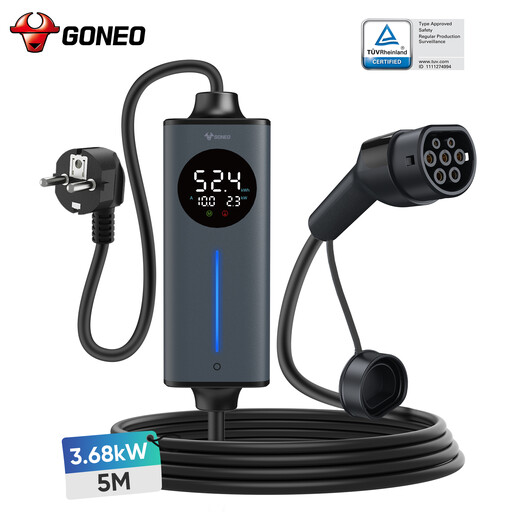
Why we think this model is a good fit : This portable EV charger plugs into a Schuko socket and is suitable for use both at home and on the go. Its 5 m cable and adjustable current of up to 16 A offer plenty of flexibility.
Its power remains suitable for a compatible domestic socket, while the device offers earth detection and temperature monitoring.
8/10/13/16 A settings, control screen, 30 mA AC + 6 mA DC residual-current protection and use without wall installation.
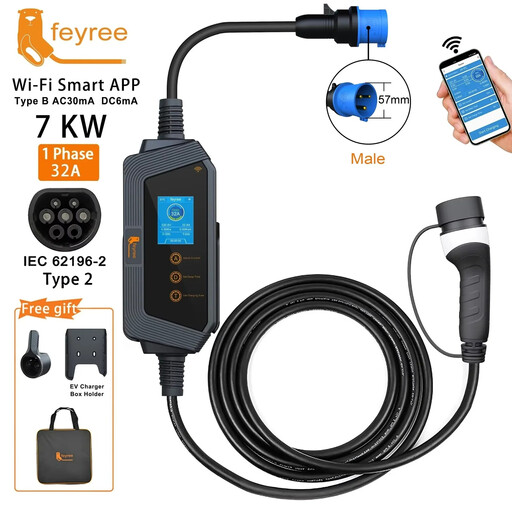
Why we think this model is a good fit : Portable or wall-mountable, this solution is aimed at drivers with a suitable circuit who want to monitor charging remotely.
The current can be adjusted from 8 A to 32 A to suit the available capacity, provided that you have a suitable installation.
Wi-Fi app, scheduling, charging-complete notification, LCD screen and protection against current leakage, overheating and overvoltage.
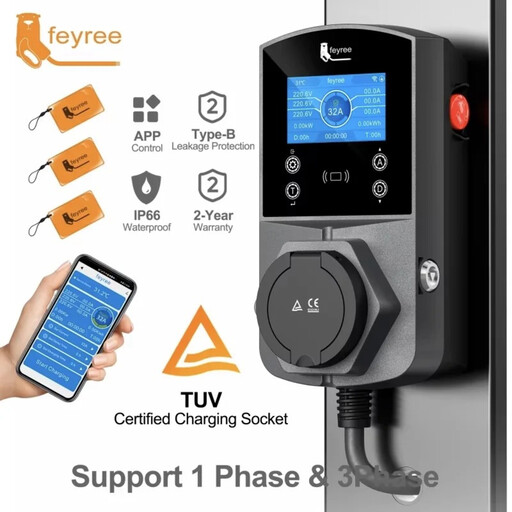
Why we think this model is a good fit : This wall-mounted charging point with a Type 2 socket is designed for households with a single-phase or three-phase installation looking for a fixed solution that can adapt as their needs change.
The power must be matched to the installation and the vehicle. The charging point must therefore be installed on a dedicated circuit by a qualified professional.
Advertised power range from 1.4 to 22 kW, Wi-Fi and Bluetooth connectivity, scheduling and advertised Type B residual-current protection.
Before each session, inspect the socket, cable and Type 2 connector. Once charging is complete, stop the session using the control unit or the car before unplugging. Also avoid leaving the cable tightly coiled while it is operating, and protect the control unit from knocks and moisture.
When using a Schuko socket, start with a moderate current if you are not fully familiar with the circuit’s capacity. An unusually hot socket, a smell of plastic or an error message should prompt you to stop charging immediately. For a fixed charging point, have the protection ratings and cable cross-section checked.
Yes, provided you use a portable charger with a Schuko plug designed for a 230 V single-phase supply. The socket must be in good condition, properly earthed and capable of supporting a prolonged load. Do not use an extension lead or adaptor that is not designed for this purpose.
The cost depends on the energy consumed and the kilowatt-hour price stated in your contract. As a general guide, a 10 kWh session costs ten times the kilowatt-hour rate, excluding any fixed charges. The 3.7 kW power mainly affects charging time, not the direct price of the energy consumed.
It varies according to how often it is used, storage conditions, exposure to the weather and the condition of the connectors. A cable stored under cover, without excessive bending and inspected regularly will generally retain its performance for longer than one left on the ground or exposed to moisture. Always follow the manufacturer’s recommendations and replace the cable at the first sign of cracking, overheating or an intermittent connection.