
Livraison le jour même ou le lendemain

Qualité garantie

Débloquez vos offres de bienvenue: Livraison GRATUITE | Jusqu'à -80 % | 30 jours d'essai gratuits à JoyPlus
Téléchargez l'application
By the Joybuy editorial team, July 4, 2026
So, you've made the switch to an electric or plug-in hybrid vehicle! Now comes the crucial question: what's the easiest, safest, and most cost-effective way to charge your car at home? It's true that the market is flooded with options. Between the different power ratings, current types, and smart features, it's not easy to find your way around.
This guide is here to help you demystify the topic and choose the most suitable Type 2 charging station and accessories. We have selected practical solutions to equip your garage, whether you're setting up for the first time or upgrading your current configuration.
Before diving into our selection, let's review a few technical concepts. This will ensure you make an informed decision that is perfectly suited to your vehicle and your electrical system.
The charging speed depends on three factors: the capacity of your electrical installation, the power of the charging station, and the maximum power accepted by your vehicle's onboard charger (OBC).
Always check the maximum AC charging power your car accepts in its user manual. There's no point in investing in a 22 kW wallbox if your vehicle is limited to 7.4 kW.
Most modern charging stations are equipped with a T2 socket (or Type 2), which is the European standard. Two configurations exist:
Smart charging is an increasingly popular feature. Through a mobile app, it allows you to schedule charging sessions during off-peak hours to save money, monitor your consumption, and control the power output remotely.
We have selected products that tick all the boxes for EV drivers in Europe: safety, performance, and ease of use.
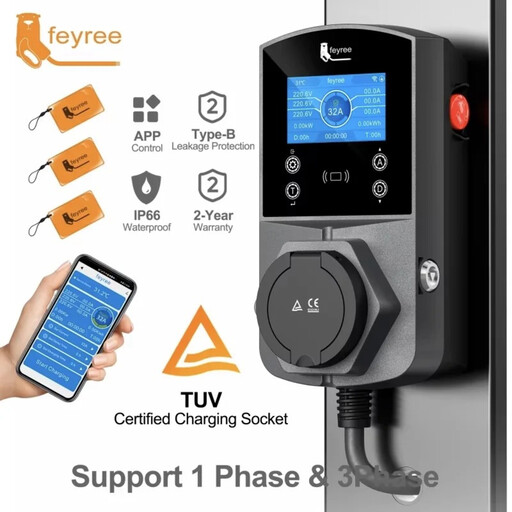
Key Features
This wallbox stands out for its great versatility and connected features. Compatible with both single-phase and three-phase installations, it can deliver power ranging from 1.4 kW to 22 kW, automatically adapting to your vehicle and grid. Its app control (via WiFi and Bluetooth) allows for precise charging management, including scheduling during off-peak hours. Safety is also top-notch, with integrated protection against current leakage (Type B AC/DC) and an IP66 waterproof rating, allowing for a worry-free outdoor installation.
Pros
Who is it for? Ideal for EV owners who want a powerful, future-proof, and connected home charging solution, while retaining the freedom to choose their own cable.
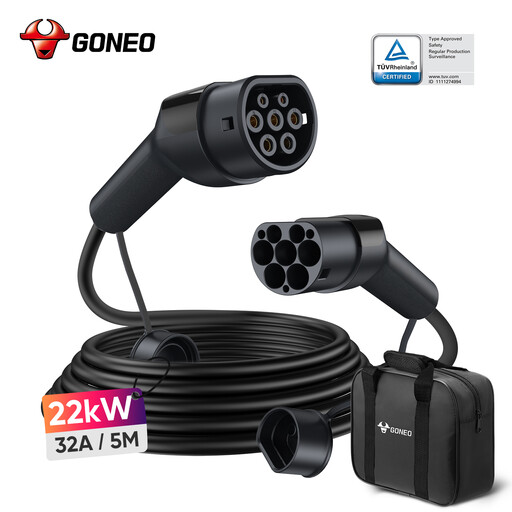
Key Features
This Type 2 charging cable is designed for those who want to get the most out of a three-phase installation. Capable of handling 22 kW (32A) of power, it is perfect for recent electric vehicles equipped with a high-performance onboard charger. The T?V certification attests to its compliance with European safety standards. Its robust design, featuring a TPU sheath tested for over 20,000 bends and ultrasonically welded connectors, ensures excellent durability and perfect conductivity.
Pros
Who is it for? The essential cable for drivers of EVs compatible with 22 kW charging, who often connect to public three-phase stations or own a wallbox with a T2 socket like the Feyree model.
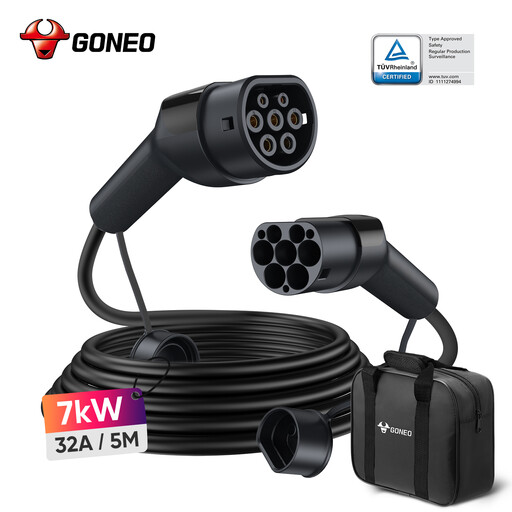
Key Features
This cable is the go-to solution for home charging on a standard single-phase installation. It shares the same manufacturing and safety qualities as its 22 kW counterpart, including T?V certification and a robust construction. With a power rating of 7.4 kW (32A), it is perfectly sized to charge the vast majority of electric and plug-in hybrid vehicles overnight, without requiring costly modifications to your electrical system.
Pros
Who is it for? For the majority of EV and plug-in hybrid users who primarily charge at home or at public stations up to 7.4 kW. It's the sensible, reliable, and safe choice for everyday use.
Our selection covers the most common needs, but you may have specific requirements (cable length, different power rating, etc.). If you need a different length (7m, 10m) or another power level, feel free to explore our full range of T2 charging cables.
1. What's the difference between a single-phase and a three-phase charger? The main difference is the maximum power they can deliver. A single-phase charger is limited to 7.4 kW, which is more than enough for an overnight charge. A three-phase charger can reach 11 kW or 22 kW for much faster charging. However, it requires a suitable electrical installation and subscription, as well as a compatible vehicle.
2. Can I install my charging station myself? In many countries, including France, the installation of a charging station with a power rating above 3.7 kW must be carried out by a qualified and certified electrician (e.g., with an IRVE certification in France). This is a safety guarantee for both your installation and your vehicle, and it is often a prerequisite for receiving government subsidies.