
Livraison le jour même ou le lendemain

Qualité garantie

Débloquez vos offres de bienvenue: Livraison GRATUITE | Jusqu'à -80 % | 30 jours d'essai gratuits à JoyPlus
Téléchargez l'application
A Type 2 charging point for an electric car can make everyday journeys much easier, provided you choose a power rating and connection that are compatible with both your vehicle and your home. Between wallboxes advertised at 22 kW, mobile apps and promises of ‘smart’ charging, certain technical details are still too often overlooked.
Here are the main pitfalls to avoid and the criteria to check before buying a charging point for an electric car or a charger for a plug-in hybrid vehicle.
A Type 2 wallbox advertised at 22 kW will not necessarily deliver 22 kW to your car. The actual power supplied depends on three factors:
A single-phase car limited to 7.4 kW will therefore not charge any faster with a 22 kW electric car charger. Check the vehicle’s technical specifications before choosing a single-phase or three-phase charging point.
A charging point is not simply a device that you plug into a domestic socket. Installation generally requires a dedicated circuit, compliant earthing and suitable residual-current protection. In France, it must be installed by a qualified electrician, particularly to check the available power, consumer unit and conductor cross-section.
Three-phase 400 V can be suitable for a 22 kW charging point, but only if the property has this type of supply and the installation is designed for 32 A. With single-phase 230 V, a power output of around 7.4 kW generally corresponds to a current of 32 A.
An IP65 or IP66 rating indicates the level of protection against dust and water under specific conditions. It does not mean that the enclosure can be submerged, exposed to a high-pressure jet or installed without precautions in a particularly exposed area.
For an outdoor installation, choose a sheltered location, secure the charging point firmly and store the cable after each use. Also check the connector’s protection rating when it is placed on its holder.
The Type 2 connector in accordance with IEC 62196-2 is fitted to most electric and plug-in hybrid vehicles sold in Europe. However, it is still essential to check that your car has a Type 2 socket for AC charging.
Here are the most common power ratings:
An adjustable 6–32 A charging point offers greater flexibility, but it must never be set above the capacity of the circuit.
Wi-Fi app control can be used to schedule charging, monitor consumption and adjust the current. However, these functions depend on the network connection and app compatibility.
Dynamic load balancing can be particularly useful in a home where the heating, hot-water cylinder, hob and charging point are operating at the same time. The system automatically adjusts the charging power according to the available capacity. Check beforehand whether the installation requires an additional meter or measuring module.
Look for precise information about protection against:
An RFID charging point can also restrict access to charging, which is useful in a shared car park or residential development. If the cable is attached to the charging point, check its length and storage options. With a charging point fitted with a socket, make sure you have a Type 2 charging cable compatible with your vehicle.
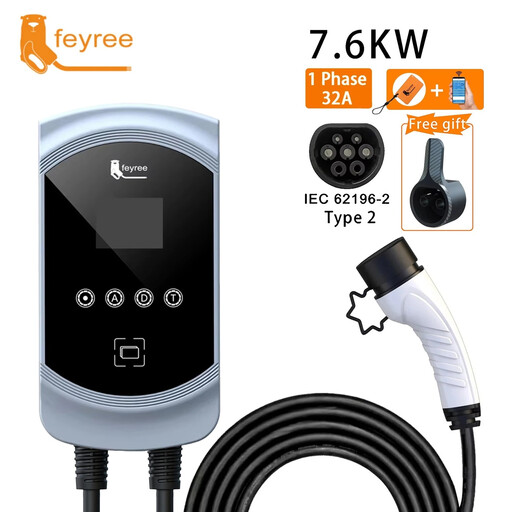
Why it suits this profile : This single-phase charging point is suitable for drivers looking for home charging of up to 7.6 kW, with adjustable current and app control.
Adjustable current helps match charging to the circuit’s capacity, provided it is configured by an electrician.
Power of up to 7.6 kW, Tuya app, scheduling and protection against overheating, voltage surges and leakage currents.
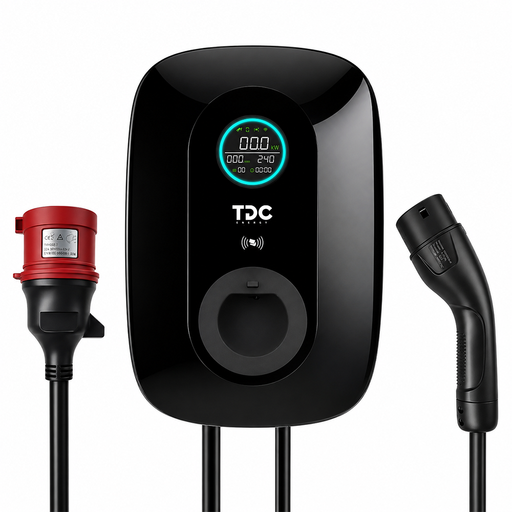
Why it suits this profile : Its display, two RFID cards and Wi-Fi and Bluetooth connections meet the needs of a household with a three-phase supply.
The specifications state the required conditions: 400 V three-phase supply, a suitable CEE connection and installation by a qualified electrician.
Advertised power of 22 kW, 5 m Type 2 cable, LCD screen and protection against overloads, high temperatures and leakage currents.
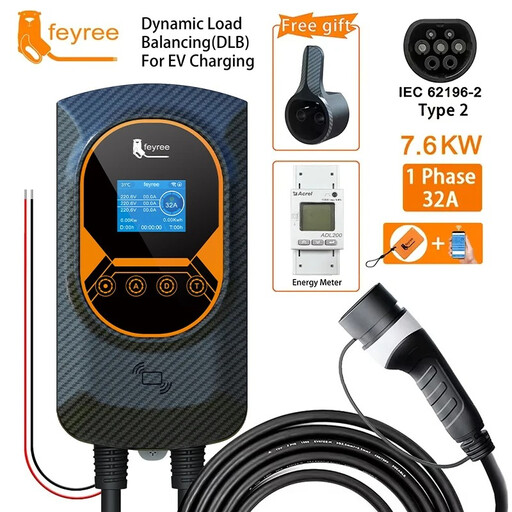
Why it suits this profile : The dynamic load-balancing function is suitable for homes where several electrical appliances operate at the same time.
DLB adjusts the power according to the home’s consumption, but its correct operation must be assessed in relation to the electrical installation.
5 m Type 2 cable, LCD screen, adjustable current from 8 to 32 A, mobile app and IP66 rating stated in the specifications.
We have brought together a complete, real-time updated selection of products that meet these demanding criteria, as well as European safety standards.
Yes, some models have an IP65 or IP66 rating suitable for installation in a garage, under a shelter or in a courtyard. The charging point must remain accessible, sufficiently well ventilated and protected from impacts. Never submerge it or use a pressure washer.
It depends entirely on the energy consumed and the tariff set out in your electricity contract. Scheduling charging during off-peak hours allows you to move charging to a cheaper period, but it does not reduce the amount of electricity required. The app can help you track each session and the number of kilowatt-hours used.
It varies depending on charging frequency, exposure to the elements, the quality of the installation and maintenance. Inspect the cable, socket, enclosure and mounts regularly. If you notice overheating, an unusual smell, an error message or a damaged cable, stop using the charging point immediately and have it checked by a qualified professional.