
Livraison le jour même ou le lendemain

Qualité garantie

Débloquez vos offres de bienvenue: Livraison GRATUITE | Jusqu'à -80 % | 30 jours d'essai gratuits à JoyPlus
Téléchargez l'application
Driving an electric or plug-in hybrid vehicle?? Choosing the right charging cable can quickly become a headache. Power, length, connectors... it's easy to get lost in the jungle of options. Don't panic: this guide is here to help you make sense of it all and find the Type 2 charging cable that's right for you—one that truly fits your car and your daily routine.
My role as Head of Product Recommendations at Joybuy is simple: to guide you to the best choice. Forget the marketing jargon; we're going to focus on concrete criteria and a selection of tried-and-tested products.
Before diving into our top picks, let's review the three key factors that will guide your decision: power, cable type, and length.
Charging speed is always dictated by the weakest link in the chain: your car's onboard charger (OBC), the charging station, and the cable. To avoid bottlenecking your setup, the golden rule is simple: choose a cable with a power rating at least equal to what your vehicle can accept.
There are two main types of charging solutions featuring a Type 2 connector:
Cable length is primarily a matter of convenience. A 5-metre cable is often sufficient at home, provided you can park right next to the station. For greater peace of mind, especially at public stations where parking spots aren't always ideally located, a length of 7 metres (or more) will give you much better leeway.
Also, consider durability! Check the quality of the materials (a TPU sheath is an excellent indicator of flexibility and resistance) and look for safety certifications (CE, T?V), which confirm the product's compliance with European standards.
Here is a selection of products that meet different needs, based on performance, safety, and versatility criteria.
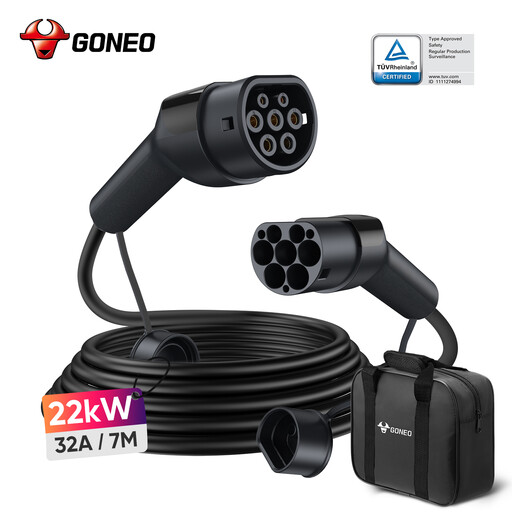
Why it stands out: This T2-T2 cable is for those who want to make no compromises on performance and versatility. With its 22?kW capacity, it's ready for almost all AC charging stations and electric vehicles, including the most demanding ones.
Key features:
Who is it for? For owners of all-electric vehicles (BEVs) with an 11?kW or 22?kW onboard charger (such as a Tesla accessory or for a Renault Zoe) who want to harness the full potential of fast charging stations, both public and private.
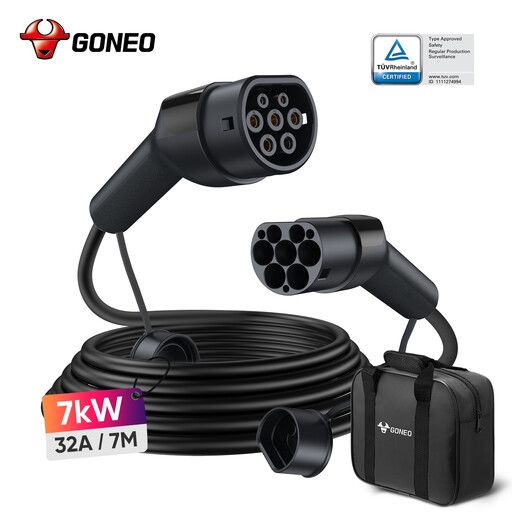
Why it stands out: This is the sensible, reliable, and efficient solution that covers most charging needs at home or at standard public stations. All with the same manufacturing quality as its 22?kW big brother.
Key features:
Who is it for? For drivers of plug-in hybrids or electric cars with an onboard charger of 7?kW (or less). A pragmatic and reliable choice for daily use.
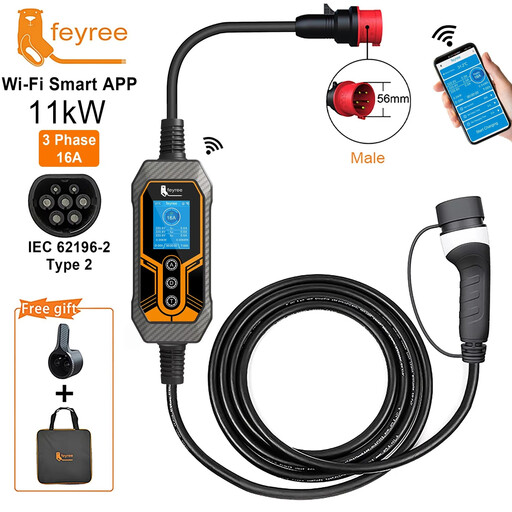
Why it stands out: Much more than a cable, this is a true smart mobile charging station. It's the ultimate portable and connected solution for anyone without a permanent wallbox at home.
Key features:
Who is it for? For EV drivers on the go, renters, or anyone who wants an ultra-flexible charging solution without a fixed installation. Perfect for topping up at work, on holiday, or at a second home equipped with a CEE socket.
Our selection aims to cover the most common needs, but every driver is unique. Are you looking for a different length, a different power rating, or specific features? Feel free to browse our complete catalogue.
? Discover Our Full Range of Type 2 Charging Cables
1. Can I use a 22?kW cable on a 7?kW station or with a car that only accepts 11?kW? Yes, absolutely. Cables are always backward compatible. A 22?kW cable will work without any issues on a 7?kW station or with a car that only accepts 11?kW. The charging speed will simply be limited by the slowest element in the chain (the station or the car's charger). Using an over-specced cable poses no risk; in fact, it's a good way to future-proof your setup.
2. What's the difference between a Type 2 cable and a portable charger? Think of the T2-T2 cable as a simple conduit for electricity: it connects your car to a charging station (wallbox, public station) but cannot be plugged into a standard wall socket. The portable EV charger, on the other hand, is smarter: it integrates the control electronics (the box) and plugs directly into a power socket (domestic or industrial), turning it into a proper charging point.
3. How do I maintain my charging cable to make it last longer? A few simple habits can significantly extend your cable's life. First rule: always put the protective caps back on after each use to shield the connectors from dust and moisture. Next, avoid driving over it or bending it excessively. To store it, coil it neatly without twisting it, and place it in its bag, away from moisture. Wiping the connectors with a dry cloth from time to time will be enough to ensure a perfect connection.