
Livraison le jour même ou le lendemain

Qualité garantie

Débloquez vos offres de bienvenue: Livraison GRATUITE | Jusqu'à -80 % | 30 jours d'essai gratuits à JoyPlus
Téléchargez l'application
So, you're now driving an electric or plug-in hybrid vehicle? Congratulations! Now comes a crucial step: choosing a charging cable. With a vast array of choices on the market, it's easy to make a mistake that could be costly or even compromise your safety. The goal isn't to find the "perfect" cable, but to find the one that is tailor-made for your car, your electrical setup, and your habits.
Before you make a purchase, here are the three mistakes to avoid at all costs:
To make the right choice, there's no secret: you need to understand a few key technical criteria. Once you've got these points down, you'll be able to sort through the options and invest in a reliable and durable piece of equipment.
The charging power (in kW) directly determines the charging speed of your battery. It must be perfectly aligned with two factors: the capacity of your on-board charger (OBC) and the power delivered by the charging station (whether it's your home charging station or a public one).
Pro Tip: Check the maximum AC charging power your vehicle accepts in its user manual. This is the factor that will always limit the charging speed.
In Europe, the Type 2 connector (sometimes called Mennekes) has established itself as the undisputed standard for AC charging. Virtually all electric and plug-in hybrid vehicles sold in the region (including recent Tesla models, the Peugeot e-208, Renault Zoé, etc.) are equipped with a Type 2 socket for charging at home and at standard public stations.
Therefore, a Type 2 electric car charging cable is the natural choice. It has a male connector for the station side and a female connector for the vehicle side.
When it comes to safety, there's no room for compromise. Here are the points to inspect closely:
Rather than an endless catalogue, we've selected products that match three typical user profiles. This should help you find the solution that's right for you.
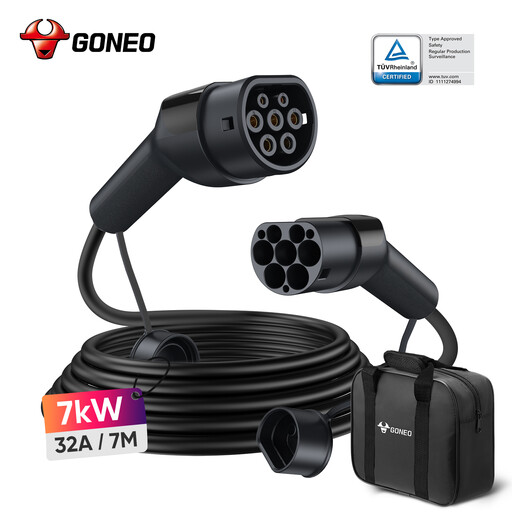
Why we chose it: It's the perfect balance for daily charging at home on a 7 kW station or at public chargers. Its 7-metre length offers great versatility without being too bulky.
It matches the most common charging power (7 kW), avoiding unnecessary extra cost. Its T?V certification and TPU sheath meet the highest safety and durability standards.
An excellent balance of power, length, and certified durability for reliable, worry-free regular use.
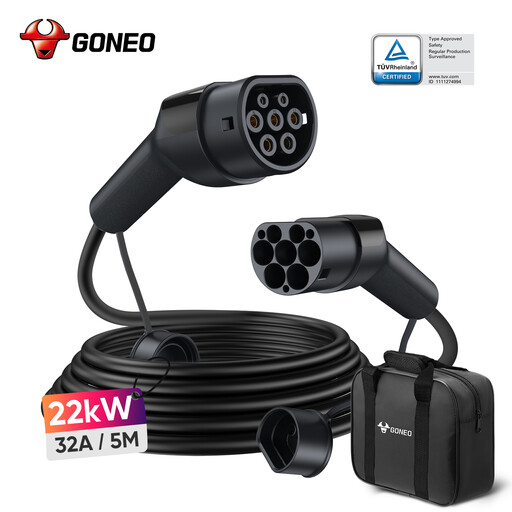
Why we chose it: Designed for owners of vehicles with a 22 kW on-board charger who want to get the most out of fast charging stations. Its 5m length is ideal for a home-installed wallbox.
This 22kW three-phase charging cable is specifically designed for high power, preventing the bottleneck of an undersized cable. Its robust construction is certified to handle high currents safely.
Allows you to reach your vehicle's maximum AC charging speed. Its silver-plated contacts and ultrasonic welding ensure perfect conductivity and minimise heat build-up.
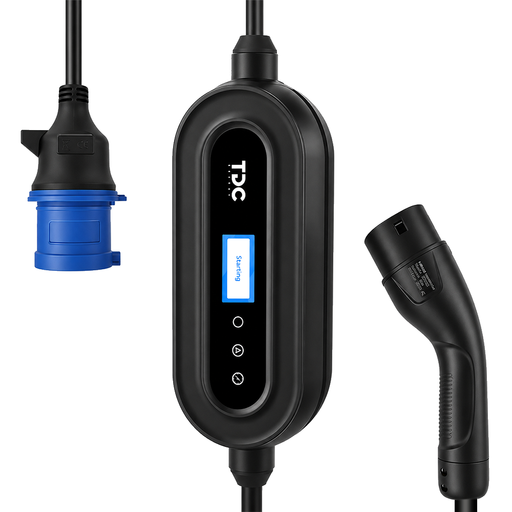
Why we chose it: More than just a cable, this is a true portable T2 charger. It turns an industrial CEE 32A socket into a 7 kW charging station. Essential for travel, at a second home, or to go without a dedicated wallbox.
It provides a complete and secure charging solution. The adjustable current (16/20/24/32 A) allows you to adapt it to the circuit's capacity, preventing overloads. Its IP66 rating makes it ready for any weather conditions.
Maximum flexibility to charge wherever a compatible socket is available. The app control and LCD screen are real everyday advantages.
Discover our full selection of cables and chargers that meet our quality criteria and European safety standards.
The main difference is the maximum power the cable can handle. A 7 kW cable operates on single-phase (1 phase, 32A), an 11 kW on three-phase (3 phases, 16A), and a 22 kW on three-phase (3 phases, 32A). Simply put: plugging a 22 kW cable into a car that only accepts 7 kW will not make it charge any faster. The charge will be capped at 7 kW.
Not always. While it offers more freedom at awkwardly placed public charging stations, it's also heavier, more expensive, and more of a pain to coil up and store. For almost exclusive home use with a dedicated parking spot, 5 metres is more than enough. A 7-metre cable is an excellent compromise for greater versatility.
If your car was purchased new in Europe after 2018, there's a 99% chance it's equipped with a Type 2 socket for AC charging. To be absolutely sure, a quick look at the vehicle's manual or the charging port itself is all it takes. You will see a 7-pin connector. Type 2 cables are compatible with all brands that use this standard (Tesla, Peugeot, Renault, Volkswagen, Hyundai, Kia, etc.).