
Livraison le jour même ou le lendemain

Qualité garantie

Débloquez vos offres de bienvenue: Livraison GRATUITE | Jusqu'à -80 % | 30 jours d'essai gratuits à JoyPlus
Téléchargez l'application
Buying a Type 2 charging cable for your electric car isn’t simply a matter of picking a length or a power rating off the packaging. A model advertised at 22 kW will still be limited by your vehicle’s onboard charger, while a cable that’s too short or poorly suited to the charging point can quickly become a daily hassle.
To avoid wasting your money, keep three common pitfalls in mind:
Start by checking your vehicle’s manual or technical specification to find out the power of its onboard charger (also called the OBC).
The actual power delivered also depends on the charging point, the electrical installation and the vehicle. Using a 22 kW model with a car that has an 11 kW OBC won’t turn your charging session into a 22 kW one.
In a home with a single-phase supply, a 7 kW single-phase charging cable can work perfectly well. At some public charging points or on three-phase installations, an 11 or 22 kW three-phase charging cable offers greater versatility – provided your vehicle is compatible.
The Type 2 to Type 2 format has a plug for the charging point and another for the car. This is the standard format used across Europe for AC charging of electric cars and plug-in hybrids.
GONEO product listings indicate compatibility with Type 2 vehicles as well as certain CCS2 models for their AC charging – including Tesla, Audi, BMW, Mercedes, Volkswagen, Hyundai, Kia, Renault and Volvo. However, it’s important to distinguish between the different standards:
A charging cable for a plug-in hybrid is therefore suitable as long as the vehicle has a Type 2 socket and accepts the corresponding AC charging.
Choose the length based on your parking setup:
An IP54 rating means the cable is protected against harmful dust and water splashes. It does not mean it can be submerged. GONEO models also mention a TPU sheath, an operating range of -40 °C to +50 °C and a carry bag. The product listing also states that the connector has been tested after a one-metre drop and after being driven over by a two-tonne vehicle. These details are based on the manufacturer’s stated specifications and do not replace careful handling of the cable.
The TÜV certified claim should be verified on the listing of the specific product you choose. The GONEO cables shown indicate TÜV Rheinland certification as well as CE, UKCA, RoHS, ISO and IEC references. Before each use, inspect the pins, the cable and the handles.
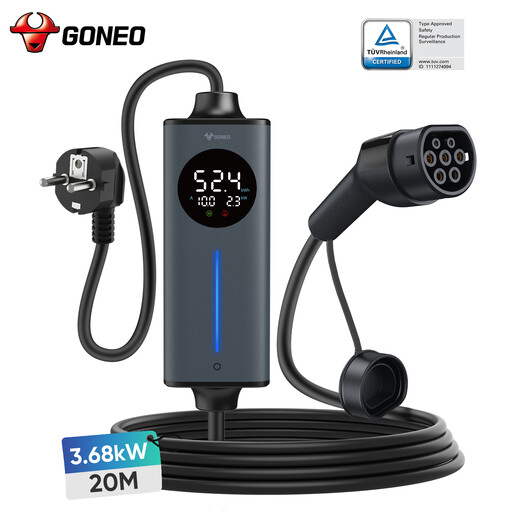
Why this choice suits this profile: This portable solution plugs into a properly earthed domestic Schuko socket. It’s suitable for charging at home or on the go, with an adjustable current up to 16 A.
The power rating is clearly limited to 3.68 kW and the device includes, according to its product listing, a 30 mA AC + 6 mA DC residual current protection.
Adjustable current, 0 to 8 hour timer, LED display and lengths available up to 20 m depending on the version.
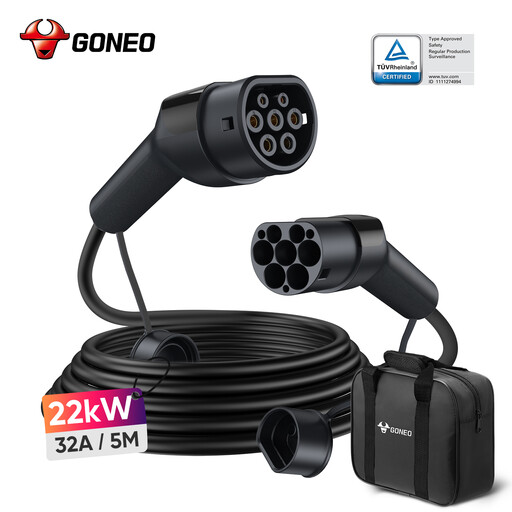
Why this choice suits this profile: This 5 m Type 2 to Type 2 cable is aimed at owners with a three-phase charging point and a vehicle capable of accepting charging up to 22 kW.
The listing clearly distinguishes the 22 kW, 32 A, three-phase cable from the actual capacity of the vehicle’s onboard charger.
TÜV Rheinland certification stated, silver-plated contacts, TPU sheath and IP54 rating as claimed by the manufacturer.
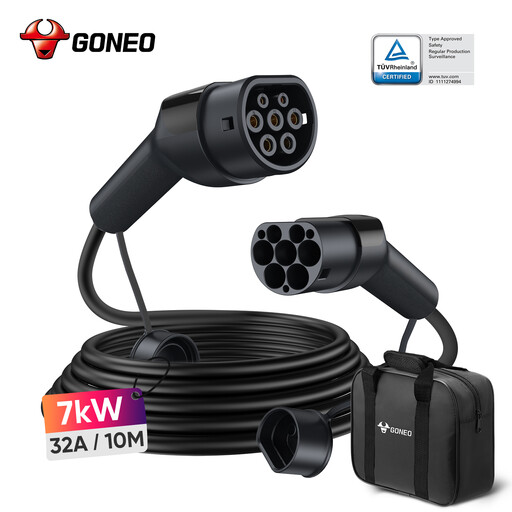
Why this choice suits this profile: At 10 m, this cable makes it easier to connect at public parking spots or in a garage where the charging point is further away.
The listing reminds you that a vehicle limited to 7 kW won’t automatically benefit from 11 kW. This helps you avoid an oversized purchase without first checking your OBC’s capabilities.
16 A three-phase, TPU sheath claimed to withstand over 20,000 flexes, IP54 rating and carry bag included.
We’ve put together a comprehensive, real-time updated list of products that meet these demanding selection criteria as well as European safety standards.
Yes, if the vehicle has a Type 2 socket and accepts AC charging. The power will be limited by the onboard charger, the charging point and the electrical installation. Check your vehicle’s manual before choosing between 7, 11 and 22 kW.
A 5 m cable is sufficient when the charging point is installed close to your parking space. A 7 m model gives you a bit more leeway. The 10 m option becomes useful when your vehicle’s position varies, but it takes up more space and must be uncoiled without forming tight kinks.
Avoid sharp bends, pulling on the connectors and regularly running the wheels over the cable. After charging, keep the contacts clean and dry, replace the protective caps and store everything in its bag. If you notice unusual heat, cracks or a damaged pin, stop using it immediately.