
Livraison le jour même ou le lendemain

Qualité garantie

Débloquez vos offres de bienvenue: Livraison GRATUITE | Jusqu'à -80 % | 30 jours d'essai gratuits à JoyPlus
Téléchargez l'application
As an owner of an electric or plug-in hybrid vehicle, you know that charging is an essential step. Whether at a public station, at work, or with your personal wallbox, choosing the right charging cable is crucial. But with all the different power ratings, lengths, and current types, it's easy to get lost.
As the Head of Product Recommendations at Joybuy, my goal is to shed some light on the subject. This guide will break down the technical jargon and steer you toward a smart choice, featuring a selection of reliable products that are fully compliant with European standards.
The Type 2 connector has become the standard in Europe for alternating current (AC) charging. It's found on the vast majority of vehicles, including European Tesla models. To make the right choice, there are three key criteria to consider.
Charging speed is a chain that's only as strong as its weakest link: the charging station, the vehicle's on-board charger (OBC), and the cable itself. The weakest component always dictates the final power output.
Our advice: Check your vehicle's manual to find its maximum AC charging power. Choosing a cable that matches your on-board charger is the best way to guarantee optimal performance.
Cable length is, above all, a matter of day-to-day convenience.
A charging station cable handles high levels of power. Its quality is therefore not an option—it's essential for your safety and the safety of your vehicle.
After analysing technical specifications and user feedback, we have selected three cables that meet distinct needs while all sharing a high level of quality and safety.
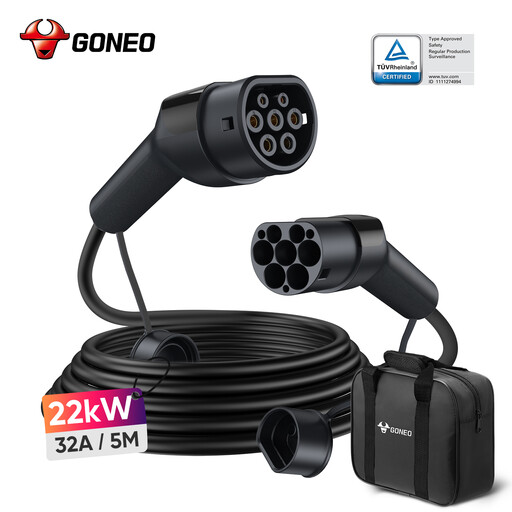
Highlights This cable is for those who want to harness the full power of AC charging. Its 22?kW power rating and 32A three-phase current can drastically reduce waiting times at compatible stations. Its meticulous design includes silver-plated connectors and ultrasonic welding, ensuring perfect conductivity and controlled heat levels. The T?V Rheinland certification attests to its compliance with the strictest safety standards.
Advantages
Who is it for? For owners of electric vehicles (like certain versions of the Renault Zoé or Audi e-tron) equipped with a 22?kW on-board charger, who primarily charge at home or at nearby stations and for whom every minute counts.
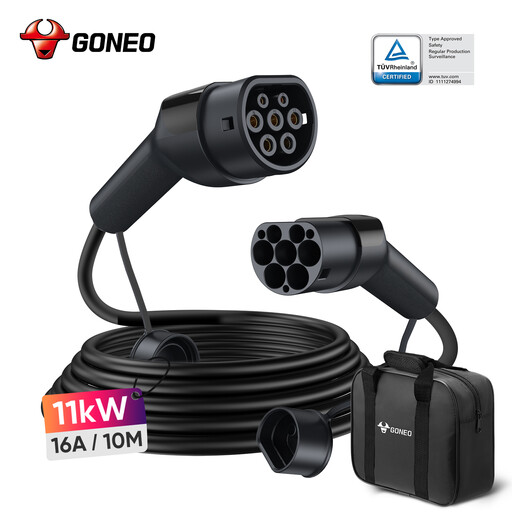
Highlights This model combines the 11?kW power rating, the most common for all-electric vehicles, with a very generous length of 10 metres. This extra reach is a real asset in public car parks or when a station's placement is tricky. It benefits from the same high manufacturing standards as other models in the range, including a durable TPU sheath and comprehensive safety certifications.
Advantages
Who is it for? For EV drivers who frequently use public charging stations and want to avoid parking headaches. It's a versatile solution for those whose vehicle accepts an 11?kW three-phase charge.
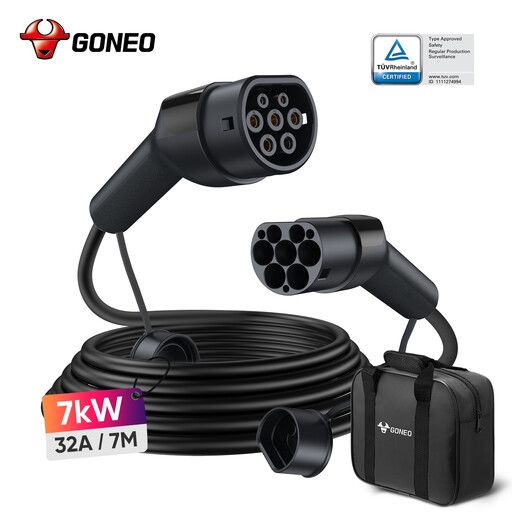
Highlights This cable is the balanced choice. At 7?kW, it's perfectly calibrated for single-phase home installations and most plug-in hybrid vehicles. Its 7-metre length is the perfect compromise: more flexible than a 5m cable, but less bulky than a 10m one. It features the same robust construction and safety certifications as its more powerful counterparts.
Advantages
Who is it for? Ideal for owners of plug-in hybrids or electric vehicles whose on-board charger is capped at 7.4?kW. It's the ultimate all-rounder, reliable both at home and on the go.
Didn't find what you were looking for in our selection? Need a different length, power rating, or connector type? Feel free to explore our full range. You're sure to find the perfect solution for your vehicle.
Discover our collection of electrical connectors
1. Can I use a 22?kW cable on a car that only accepts 7?kW? Yes, absolutely. The vehicle and the cable communicate to agree on the charging power. The session will automatically be limited to 7?kW, the maximum your car can accept. Using a higher-rated cable is never risky, but it won't speed up your charge.
2. What's the difference between a single-phase and a three-phase cable? To put it simply, single-phase uses one phase of the electrical grid, limiting power to around 7.4?kW. This is the standard setup in most homes. A three-phase EV charging cable, on the other hand, leverages three phases to achieve much higher power ratings (11?kW or 22?kW). This logically requires a three-phase electrical installation, which is more common in businesses or new-build homes.
3. Is a Type 2 charging cable compatible with a Tesla? Absolutely. In Europe, all Tesla models (Model 3, Y, S, and X) are equipped with a Type 2 port for alternating current (AC) charging. A Type 2 Tesla charging cable is therefore nothing more than a standard Type 2 cable, just like the ones in our selection.