
Livraison le jour même ou le lendemain

Qualité garantie

Débloquez vos offres de bienvenue: Livraison GRATUITE | Jusqu'à -80 % | 30 jours d'essai gratuits à JoyPlus
Téléchargez l'application
Switching to an electric car is a great move, but the surrounding ecosystem can be surprisingly complex. The charging cable, for instance, is a deceptively simple accessory. A poor choice can not only throttle your vehicle's charging speed but also pose safety risks or wear out incredibly quickly. Our mission: to help you navigate the options and avoid marketing traps to make the right choice, without breaking the bank.
Before you buy, let's break down the three most common mistakes that can be costly for EV owners:
To avoid these pitfalls, let's scrutinise the technical specifications that truly make a difference. They are your guarantee of compatibility, performance, and above all, your day-to-day safety.
Charging speed doesn't just depend on the station. It's the result of a three-part equation: the station, the cable, and your vehicle's on-board charger (the OBC).
Editor's Tip: Check your car's manual to find out the maximum AC charging power it accepts. Choosing a cable that matches the power of your on-board charger (OBC) is the best way to optimise your charging times without throwing money away.
A charging cable handles high electrical power. Here, safety isn't an option—it's a must.
In Europe, the Type 2 connector has established itself as the standard for alternating current (AC) charging, both at home and at public stations. It is compatible with the vast majority of vehicles on the market, including recent Tesla models (for AC charging).
As for the length, it all depends on your daily use:
Rather than an endless list, we've selected products that cater to specific user profiles. The goal: to help you find the cable that truly fits YOUR needs.
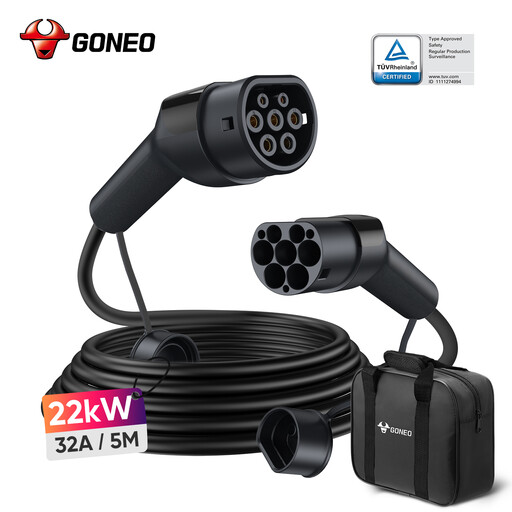
Why we chose it: You own an electric vehicle (like a Renault Megane E-Tech or Tesla Model 3/Y) with a 22 kW on-board charger and want to leverage 100% of its charging potential, whether at home or at fast AC stations.
It allows you to harness the full 22 kW of power, preventing any bottlenecks. Its T?V certification and IP54 rating check all the boxes for safety and durability.
Enables the fastest possible charging on alternating current (22 kW). The TPU sheath and silver-plated contacts ensure excellent conductivity and rock-solid durability.
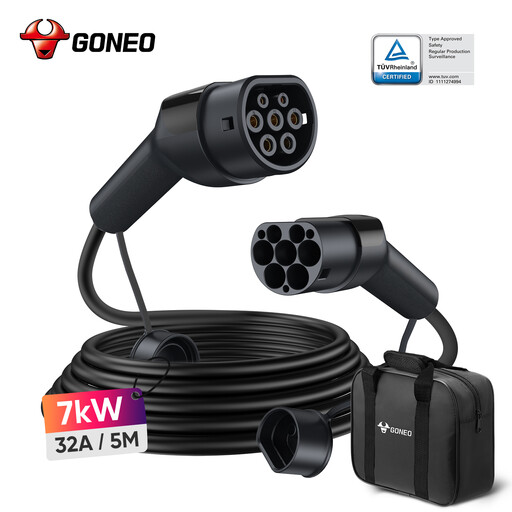
Why we chose it: Perfect for drivers of plug-in hybrids (PHEVs) or city EVs, whose on-board chargers are often limited to 3.7 kW or 7.4 kW.
It saves you from overpaying for a 22 kW cable whose full potential you would never use. It boasts the same build quality and certifications as more powerful models, without the extra cost.
A right-priced solution, perfectly sized for the most common charging needs. Its robust design (IP54, TPU sheath) is a guarantee of durability.
We have put together a complete selection of cables that meet our demanding specifications for quality and safety.
1. Can a 22?kW cable damage a car that only charges at 7?kW? No, there is absolutely no risk. The vehicle and the charging station constantly 'talk' to each other through the cable to determine the maximum accepted charging power. Even when plugged in with a 22?kW cable, a car limited to 7?kW will only 'draw' 7?kW. You won't damage anything, but you won't save a single minute on charging time.
2. What is the difference between a single-phase and a three-phase cable? It's a matter of electrical 'plumbing'. A single-phase cable uses only one phase to carry the current, which limits the power to 7.4?kW (32?A). A three-phase cable uses three, allowing it to reach much higher power levels like 11?kW (16?A) or 22?kW (32?A). Be aware that to benefit from this, both your home's electrical installation and your car's charger must be three-phase compatible.
3. What is the lifespan of an EV charging cable? It all depends on its manufacturing quality and the care you take of it. A good cable with a TPU sheath, solid connectors, and reputable certifications (T?V) can last for many years. A few simple tips to extend its life: avoid running over it (even if some are reinforced), never unplug it by pulling on the wire but by the plug itself, and store it in a sheltered place when not in use.