
Livraison le jour même ou le lendemain

Qualité garantie

Débloquez vos offres de bienvenue: Livraison GRATUITE | Jusqu'à -80 % | 30 jours d'essai gratuits à JoyPlus
Téléchargez l'application
Switching to an electric car is an exciting journey, but choosing your accessories—especially the right Type 2 charging cable—can quickly become a headache. Between marketing jargon and opaque technical sheets, it's easy to make a mistake. The wrong choice can not only throttle your charging speed but also endanger your vehicle and your safety.
As the Head of Product Recommendations at Joybuy, my mission is to demystify it all for you. Here are the 3 most common pitfalls to avoid and the essential criteria for making the right choice.
Buying a 22?kW charging cable hoping to charge your car faster is a classic mistake. The charging speed is always limited by the weakest link in the chain: the station, the cable, or your vehicle's onboard charger (OBC). If your car is capped at 7.4?kW, a 22?kW cable won't save you a single minute of charging time, but it will have cost you more for no reason.
A 5-metre cable might seem long enough for your garage. But at real-world public charging stations, the parking spot is rarely positioned ideally. A cable that's too short can simply prevent you from plugging in, forcing you to hunt for another station. Flexibility comes at a price, but being unable to charge costs far more.
A charging cable handles a considerable amount of electrical power. A product without recognised certifications (like T?V or CE) or made with low-grade materials (a PVC jacket instead of TPU) risks overheating, degrading poorly in bad weather, or wearing out prematurely. When it comes to this, safety should never be an area for compromise.
To make the right choice, you need to focus on the features that truly matter.
This is the essential starting point. The cable's power rating must match both your car's onboard charger capacity and your electrical setup.
Important note: A higher-power cable is always backward compatible. A 22?kW cable will work perfectly on a 7?kW station, but the charge will, of course, be limited to 7?kW.
Your primary use case will guide your choice.
These three elements determine the user experience and the lifespan of your cable.
Here are a few options that cater to different user profiles, taking into account safety and performance criteria.
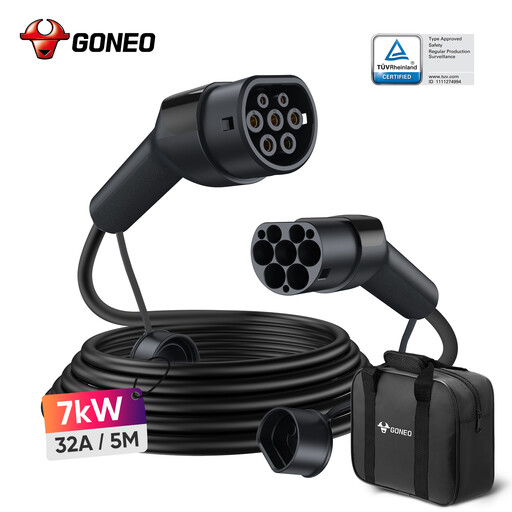
Why we chose it: Perfect for drivers of plug-in hybrids or city EVs whose onboard charger is limited to 7.4 kW. Its 5-metre length is ideal for home use when the charging station is close to the vehicle.
It's rated for the most common power level (7 kW), so you avoid paying for unnecessary capacity. Its T?V certification and TPU jacket are guarantees of safety and longevity.
Excellent value for money for safe, everyday use. The silver-plated contacts and ultrasonic welding attest to its reliability.
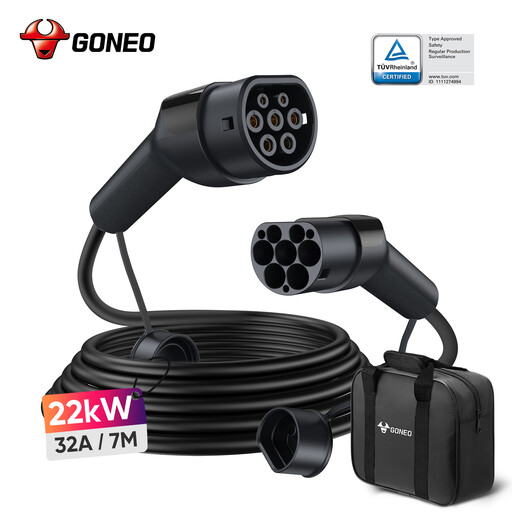
Why we chose it: Designed for owners of all-electric cars (BEVs) equipped with an 11 kW or 22 kW onboard charger. This three-phase EV cable allows you to harness the full power of fast AC charging stations.
It's sized for maximum AC power, preventing any charging bottlenecks. Its 7 m length provides comfortable leeway, even in poorly designed car parks.
The shortest possible charging time for compatible vehicles. Its robust construction (IP54, TPU jacket) and T?V certification make it a long-term investment.
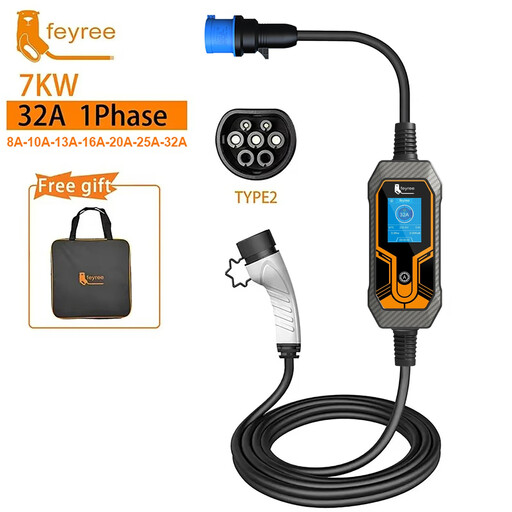
Why we chose it: This is the ultimate portable solution. This portable EV charger lets you plug into an industrial CEE socket to achieve 7 kW. It's essential for road trips, holidays, or simply as a backup plan.
It frees you from relying on public charging stations. Its LCD screen lets you monitor the charge in real time, and the adjustable current ensures a safe connection on any electrical system.
The freedom to charge (almost) anywhere. Its control box integrates multiple protections (overvoltage, overheating…) and its IP65 rating allows for worry-free outdoor use.
Some vehicles, particularly older or imported models (from Asia or North America), use a Type 1 connector. We have also selected cables suited for these specific needs.
Absolutely not. The communication between the station, the cable, and the car ensures that charging will always occur at the maximum power the vehicle can accept. The car is in control, never the cable. Therefore, using an oversized cable poses no risk.
Simply put, a single-phase cable uses one power line, limiting the power to 7.4?kW (32?A). A three-phase cable uses three simultaneously, allowing for much higher power levels like 11?kW (16?A per phase) or 22?kW (32?A per phase). The choice depends on your electrical installation and your car's charger.
A few simple steps are all it takes. Always store it in its bag after use to protect it from dust and moisture. Remember to put the caps back on the connectors. Above all, avoid running it over or bending it excessively. Wiping the contacts with a dry cloth from time to time will help maintain a perfect connection.