
Livraison le jour même ou le lendemain

Qualité garantie

Débloquez vos offres de bienvenue: Livraison GRATUITE | Jusqu'à -80 % | 30 jours d'essai gratuits à JoyPlus
Téléchargez l'application
Do you drive an electric or plug-in hybrid vehicle? Then you know how essential the right equipment is for simple and efficient charging. The Type 2 charging cable has become the standard in Europe, but with all the different power ratings, lengths, and features, it can be hard to navigate the options.
This guide is here to help you make sense of it all and choose the electric car charging cable that's perfectly suited to your needs and your vehicle, whether you're behind the wheel of a Renault Zoe, a Tesla, or any other model equipped with a Type 2 port.
Before diving into our top picks, let's review the three key factors to consider to make the right choice.
This is the most critical factor. The power rating of your cable directly determines the charging speed. It must be compatible with your vehicle's capacity (its onboard charger, or OBC) and the power supplied by the charging station.
Our advice: Check your vehicle's manual to find the maximum AC charging power it accepts. By choosing a cable with an equal or higher power rating, you'll ensure you're always charging at the optimal speed.
Cable length is, above all, a matter of day-to-day convenience.
A charging cable handles high electrical power. Therefore, safety isn't an option—it's a requirement.
We've selected a few models for you that tick all the boxes for safety, compatibility, and value for money.
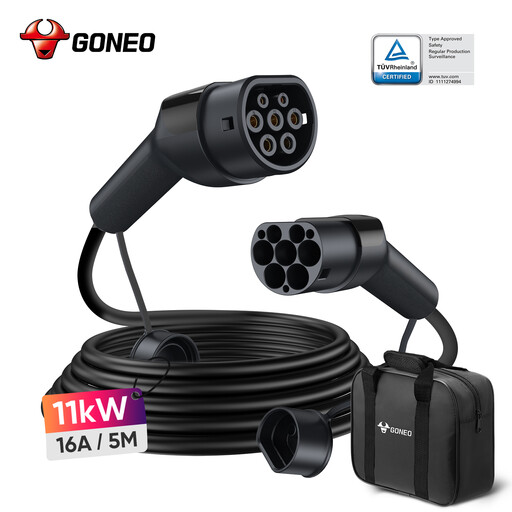
What sets it apart This cable offers an excellent compromise for the majority of all-electric car drivers. Its 11 kW three-phase power rating is perfectly calibrated for many of the leading models on the market. The design exudes safety, headlined by its T?V Rheinland certification, and durability is also top-notch thanks to a TPU sheath designed for daily use. The manufacturer highlights silver-plated contacts and ultrasonic welding to optimise conductivity and reduce heat build-up.
Key Features
Who is it for? For drivers of electric vehicles (like the Peugeot e-208 or certain Tesla Model 3 versions) with an 11 kW onboard charger, who are looking for a reliable and versatile cable for both home and public charging stations.
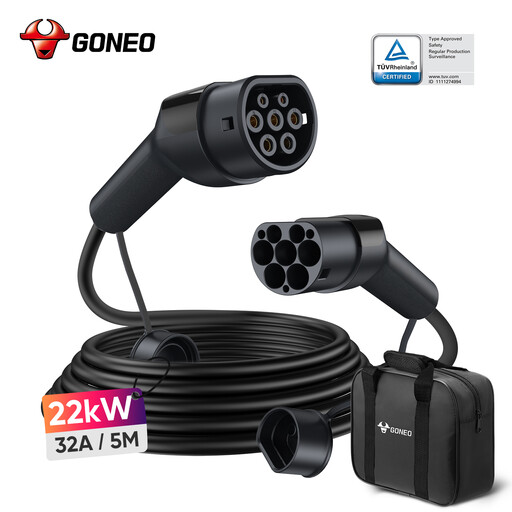
What sets it apart For those who want to get the most out of their car, this 22 kW Type 2 cable is a must-have. It allows you to reach the maximum AC charging speed on compatible vehicles, such as the Renault Zoe or certain versions of the Audi e-tron. It boasts the same quality hallmarks as the 11 kW model: T?V certification, a TPU sheath, and a robust design built to withstand the rigours of daily use (the manufacturer even claims it can resist being run over by a 2-tonne vehicle).
Key Features
Who is it for? Primarily for owners of electric cars with a 22 kW onboard charger. It's also a smart investment for those who plan to upgrade to a more powerful model in the future.
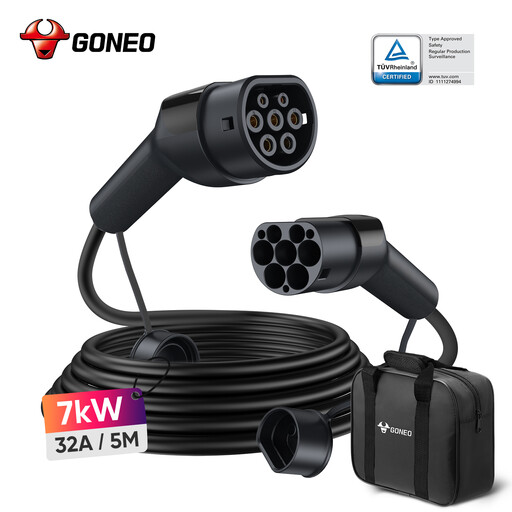
What sets it apart This 7 kW Type 2 cable is the tailor-made solution for plug-in hybrid vehicles (PHEVs) and electric cars limited to 7 kW single-phase charging. It makes no compromises on safety or build quality compared to its more powerful counterparts, featuring T?V certification and a TPU sheath to ensure reliable and durable use, whether for overnight charging at home or during the day at the office.
Key Features
Who is it for? For drivers of plug-in hybrids or electric cars with a single-phase charger (up to 7.4 kW). It's the ideal cable for daily charging needs that don't require three-phase power.
Having the right cable is one thing. Storing and protecting it properly is even better! If you're looking for accessories to organise your boot or secure your equipment, take a look at our selection.
? Discover our selection of cables and mounting accessories
Yes, absolutely. The cable and the car continuously communicate to agree on the maximum charging power. The charge will therefore be automatically capped at 7 kW, the vehicle's limit. Using an over-specced cable poses no risk whatsoever.
Yes. In Europe, Tesla models (Model 3, Model Y, etc.) are equipped with a Type 2 port for AC charging. Therefore, the charging cable you'll need for public stations or your wallbox is a completely standard Type 2 cable.
The name says it all! The difference lies in the number of electrical phases that carry the current. A single-phase cable (up to 7.4 kW) uses only one, like most household sockets. A three-phase charging cable (11 kW or 22 kW) uses three, allowing it to deliver much more power and therefore charge faster. The only requirement is that your electrical installation and your car must both be compatible with three-phase power.