
Livraison le jour même ou le lendemain

Qualité garantie

Débloquez vos offres de bienvenue: Livraison GRATUITE | Jusqu'à -80 % | 30 jours d'essai gratuits à JoyPlus
Téléchargez l'application
If you drive an electric or plug-in hybrid car, you already know this: choosing the right accessories is almost as crucial as choosing the vehicle itself. The Type 2 charging cable is one of those essential pieces of equipment; it's the umbilical cord that connects your car to the power grid. Yet, between the different power ratings, lengths, and certifications, it's easy to get lost.
This guide is here to demystify the technical details and help you find the perfect cable for your needs, whether you're charging at home or at public stations. As the Head of Product Recommendations at Joybuy, my mission is to give you all the keys to a smart and stress-free purchase.
Before diving into our selection, let's review the three decisive factors that will guide your choice?: power, length, and safety.
It's important to know that your vehicle's charging speed on alternating current (AC) is limited by its on-board charger (OBC). A cable cannot magically speed up the charge beyond what your car can accept.
The first thing you should do is check your vehicle's on-board charger capacity (the information is in the manual) to choose a cable that will allow you to get the most out of it.
Cable length is, above all, a matter of daily convenience.
A charging cable for an electric car is a high-power piece of equipment. Its reliability is non-negotiable.
Let's move on to our selection. We have chosen these models for their standards compliance, robustness, and versatility.
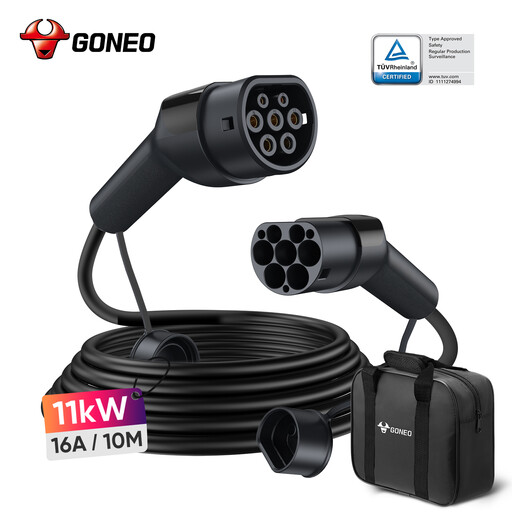
Why it stands out This model is the ultimate versatile choice. It combines a power rating of 11 kW, suitable for the majority of the electric car fleet, with a very convenient length of 10 metres.
Highlights
Who is it for?? For owners of electric vehicles with an 11 kW on-board charger who often plug into public stations and want to avoid parking gymnastics.
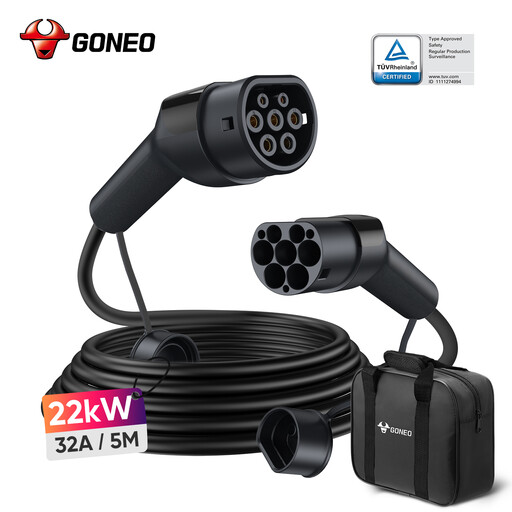
Why it stands out This cable is built for those who want to get the most out of AC charging. Its 5-metre length makes it practical and easy to store for primarily home use.
Highlights
Who is it for?? For drivers of electric vehicles equipped with a 22 kW charger (like some Renault Zoé or Audi e-tron models) who mainly charge at home and want to top up their energy as quickly as possible.

Why it stands out This is the Swiss Army knife of charging cables. It combines the maximum power of 22 kW with the flexibility of a 10-metre length. It's ready for any situation.
Highlights
Who is it for?? For demanding users who want no compromises, who own a 22 kW-compatible vehicle (or plan to get one), and who are looking for THE do-it-all cable that is equally at home in the garage or on the road.
Our selection covers the most common needs, but the market is full of other configurations. If you haven't found what you're looking for here, don't worry.
To explore a wider range, check out our complete category of charging cables.
1. Is a Type 2 cable compatible with all electric cars?? The Type 2 connector is the standard for alternating current (AC) charging in Europe, adopted by virtually all manufacturers (Renault, Volkswagen, Peugeot, Hyundai, Kia, as well as Tesla for its European models). However, it is not compatible with older vehicles that use a Type 1 plug (mostly older American or Asian imports) or for direct current (DC) fast charging, which uses CCS or CHAdeMO connectors.
2. Can I use a 22 kW cable on a car that only accepts 11 kW?? Yes, absolutely. The cable, the station, and the car are in constant communication. The vehicle's on-board charger has the final say and sets the maximum charging power. The cable will simply deliver the power requested by the car, with no risk of damage. Using a cable that is over-specced for power is a common and completely safe practice.
3. Why is T?V certification important for a charging cable?? Think of T?V certification as a safety inspection for your cable. A reputable, independent third-party organisation has put the product through its paces to verify its compliance with the strictest safety and quality standards. For equipment that handles high electrical power, this is an essential safeguard against the risks of overheating, short-circuiting, or manufacturing defects. Put simply?: it's a guarantee for your safety and your car's.