
Livraison le jour même ou le lendemain

Qualité garantie

Débloquez vos offres de bienvenue: Livraison GRATUITE | Jusqu'à -80 % | 30 jours d'essai gratuits à JoyPlus
Téléchargez l'application
Switching to an electric car is a game-changer, but it naturally comes with new questions. One of the most common is: how do you choose the right Type 2 charging cable? Power, length, compatibility... the options can quickly become overwhelming.
This guide is here to help you make sense of it all. As the Head of Product Recommendations at Joybuy, my mission is simple: to give you practical, concrete advice to find the ideal cable for your vehicle and your lifestyle, all without the unnecessary marketing jargon.
To make the right choice, there are three essential criteria to consider. These will ensure efficient and safe charging, whether at home with a wallbox or at a public charging station.
Charging power, measured in kilowatts (kW), is the number one criterion: it dictates how quickly your car's battery fills up. For optimal charging, the cable's power rating should be at least equal to the maximum capacity your vehicle can accept (its onboard charger, or OBC).
Good to know?: Using a 22kW cable on a car that only accepts 11?kW will not damage it. The charge will automatically be limited to the maximum speed the vehicle can handle, which is 11?kW.
The cable's length is all about daily convenience. Don't overlook it!
The Type 2 connector (or T2) is the European standard for alternating current (AC) charging. It is compatible with almost all electric and plug-in hybrid vehicles on the market, including models from Tesla, Peugeot, Renault, and Volkswagen.
Insist on a cable with recognised safety certifications. The T?V certification, for example, is a guarantee of reliability and compliance with very strict safety and quality standards. Also, check the IP (Ingress Protection) rating, which measures its resistance to dust and water. An IP54 rating is the minimum for worry-free outdoor use.
To help you decide, here is our selection of cables that meet different needs, all chosen for their performance, safety, and durability.
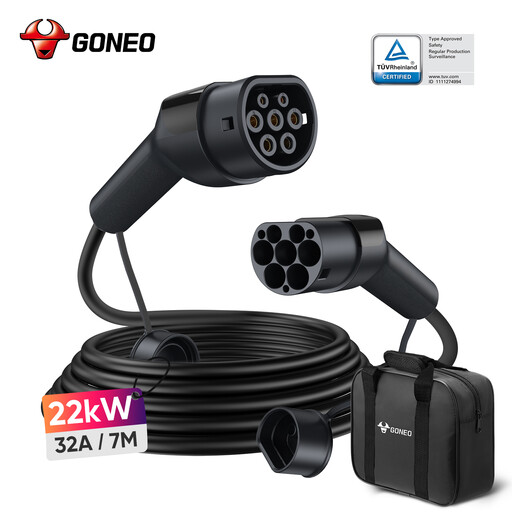
Why it stands out?: This cable is for those who want the fastest possible charging speed. Its 22kW power and robust construction (T?V certified) make it a top-tier choice for demanding users. Ultrasonic welding and silver-plated connectors ensure optimal conductivity and enhanced durability.
Highlights?:
Best for?? Owners of all-electric vehicles (BEVs) with a 22?kW onboard charger who want to minimise their waiting time at compatible stations.
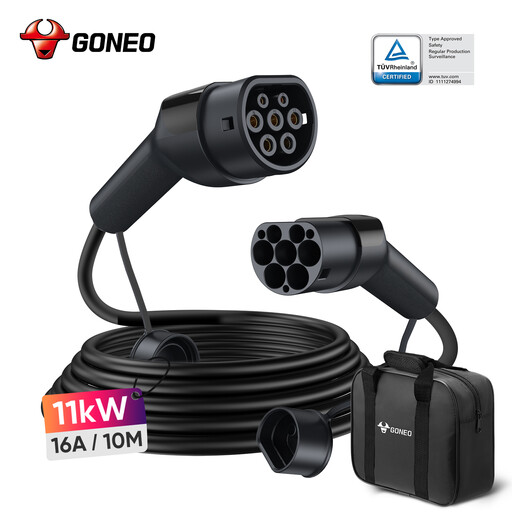
Why it stands out?: Its main advantage is its generous 10-metre length, which offers maximum flexibility in any charging situation. Paired with 11kW of power, it represents an excellent balance for many electric vehicle owners.
Highlights?:
Best for?? Drivers who frequently plug into public stations where parking can be tricky, or whose home wallbox is far from their parking space.
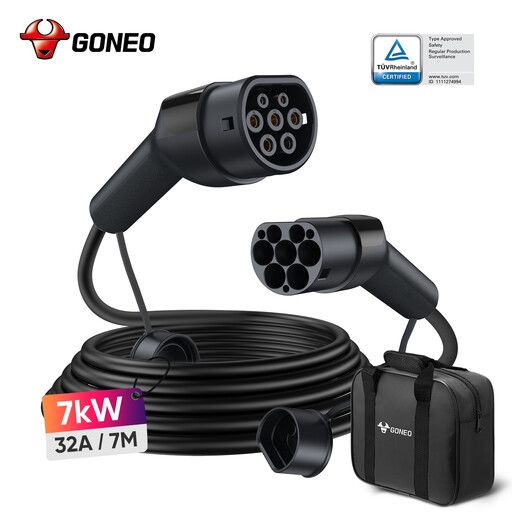
Why it stands out?: This is the ultimate reliable and versatile solution, covering the majority of needs. Its 7kW power is perfectly suited for single-phase home installations and most hybrid and electric vehicles. Its 7-metre length ensures excellent ease of use.
Highlights?:
Best for?? Owners of plug-in hybrid (PHEV) or all-electric (BEV) vehicles who primarily charge at home or at standard public stations.
This selection covers the most common use cases with reliable products, but every driver has unique needs. If you're looking for a different length, a different power rating, or simply more choice, many other solutions are available.
To discover our full range of cables and accessories, feel free to browse our vehicle electrical connectors category.
Yes, absolutely. The T2 cable and the vehicle communicate to adjust the power. The charge will therefore automatically be limited to 7?kW, the maximum power accepted by the car. There is no risk whatsoever to your battery or the vehicle.
The Type 2 connector is the European standard for alternating current (AC) charging, which is used at home or at most public charging stations. The Combo CCS (Combined Charging System) connector is an extension of the Type 2: it adds two pins for fast direct current (DC) charging, typical of motorway superchargers. A vehicle equipped with a CCS socket can perfectly use a standard Type 2 charging cable for its AC charging.
A few simple steps are all it takes to extend its lifespan. Always remember to put the protective cap back on the connector after each use to shield it from dust and moisture. Avoid leaving it lying on the ground where it could be run over. Finally, coil it carefully without twisting it, and store it in its carrying case to protect it from impacts.