
Livraison le jour même ou le lendemain

Qualité garantie

Débloquez vos offres de bienvenue: Livraison GRATUITE | Jusqu'à -80 % | 30 jours d'essai gratuits à JoyPlus
Téléchargez l'application
Switching to an electric or plug-in hybrid car is an excellent move. But a crucial question quickly arises: how do you recharge your vehicle, simply and safely? Between wall-mounted units, portable chargers, and the maze of cables, it's easy to feel lost.
This guide is here to clear things up. We'll break down the solutions compatible with the Type 2 charging port—the universal standard in the UK and Europe—to help you find the perfect equipment for your needs, your electrical system, and your budget.
Before diving into our selection, here are the key points to consider to make the right choice.
Your daily routine will determine the best type of equipment for you.
Charging speed depends on three factors: the power of the charging station, the capacity of the cable, and, most importantly, the maximum power accepted by your vehicle's on-board charger (OBC).
Charging an electric vehicle involves high power levels. On this point, there's no room for compromise. Check for certifications (CE, T?V) and multiple protections: overvoltage, overheating, current leakage, etc. A high Ingress Protection (IP) rating (e.g., IP54 or IP65) guarantees resistance to dust and water splashes, allowing for outdoor use.
To help you see things more clearly, we have selected three charging solutions that cater to very different needs.

Why it stands out The feyree Wallbox stands out as a complete and particularly robust solution for home charging. Its aluminium alloy body exudes durability. Inside, a smart chip monitors the entire charging process and activates no fewer than 10 levels of protection for maximum safety. Its 5-metre cable offers plenty of flexibility in most garages.
Advantages
Who is it for? For homeowners looking for a permanent, reliable, and secure home charging station to charge their vehicle every night. Installation must be carried out by a qualified electrician on a dedicated circuit.
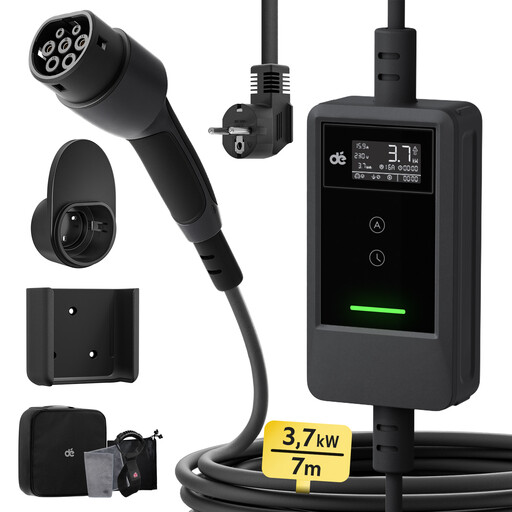
Why it stands out This portable charger is a champion of versatility. Its key feature is an LCD screen that displays all charging information in real time (current, voltage, energy, etc.). Most importantly, it allows you to manually adjust the current (6A, 8A, 10A, 13A, or 16A) to suit any domestic socket without risking tripping the circuit breaker.
Advantages
Who is it for? The ideal travel companion for drivers without a dedicated parking spot, renters, or simply as a backup solution to keep in the trunk. It's the perfect portable EV charger for holidays or for charging up at a friend's house.
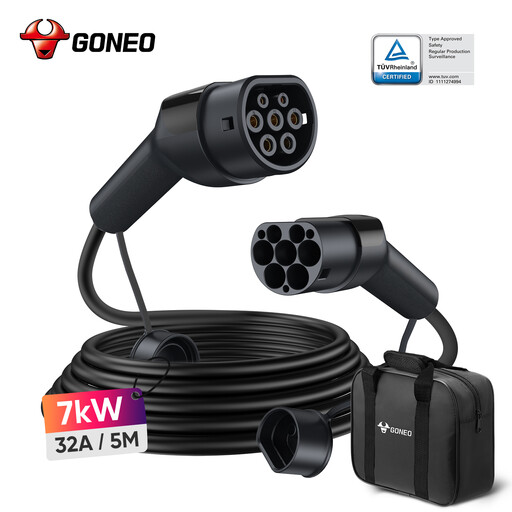
Why it stands out Note: the GONEO is not a charger, but the cable that connects your car to a charging station. Its main advantage? Impeccable build quality, certified by the independent organisation T?V Rheinland, which guarantees its compliance with the strictest safety standards. Its TPU sheath and robust connectors are built to last.
Advantages
Who is it for? Essential for any EV driver who uses public charging stations or owns a Wallbox without a tethered cable. It's the key accessory to ensure a connection in all circumstances with a reliable 32A Type 2 cable.
If the solutions presented don't perfectly match your requirements, especially in terms of length, other options are available. A shorter cable will be easier to handle, while a longer one will offer more flexibility for parking.
Discover our selection of charging cables in different lengths
The Type 1 connector is an older standard, found mainly in North American and Asian markets, as well as on some first-generation European models. The Type 2 connector is now the official and mandatory standard for all new electric vehicles sold in the UK and Europe. It is more versatile, supporting both single-phase and three-phase current.
No, and this is a matter of safety and compliance. The installation of a wall-mounted charger (Wallbox) must be carried out by a qualified electrician with the appropriate certification (e.g., OZEV-approved in the UK). This guarantees that the installation meets all standards, ensures your safety, and is also a prerequisite for receiving government grants.
A charging cable for domestic sockets is designed to be safe, provided you follow a few golden rules. Using an extension cord is strongly discouraged, and you must ensure the socket is in good condition and properly earthed. For prolonged use at a high current (e.g., 16A), having your installation checked by a professional is a wise precaution to eliminate any risk of overheating. The advantage of a charger with adjustable current is that you can limit it if you have any doubts about the quality of your circuit.