
Livraison le jour même ou le lendemain

Qualité garantie

Débloquez vos offres de bienvenue: Livraison GRATUITE | Jusqu'à -80 % | 30 jours d'essai gratuits à JoyPlus
Téléchargez l'application
Choosing a Type 2 22 kW electric vehicle charging cable might seem straightforward: a plug at each end, a stated power rating… and you're done. In reality, several factors determine whether it's compatible with your car, your charge point and your electrical installation.
Tesla, Audi, BMW, Mercedes, Volkswagen, Hyundai and Kia often use a Type 2 connector for AC charging. Vehicles fitted with a CCS2 inlet also have a Type 2 section dedicated to AC charging. However, please note: a Type 2 cable cannot be used for rapid DC charging.
A three-phase Type 2 cable rated at 32 A can handle up to 22 kW. However, your car will only charge at this power if its onboard charger (OBC) supports it. Many models are limited to 7.4 kW or 11 kW on AC.
To find out the actual charging speed you can achieve, check:
A 22 kW three-phase cable remains compatible with lower-power charging, provided the charge point and vehicle regulate the current correctly. It obviously cannot turn a single-phase installation into a three-phase supply.
Marks such as TÜV, CE, UKCA, RoHS or IEC should be understood in their proper context. They confirm compliance or certification against certain requirements, but they do not remove the need for careful use or for checking your installation.
The same applies to an IP54 rating: it indicates protection against some dust and water splashes. It does not make the cable suitable for immersion, pressure washing or prolonged storage in the rain. Outdoors, keep the connectors clean and dry, and protect them once charging is complete.
A 5 m EV cable is generally suitable for a home parking space or a public charge point installed close to your vehicle's charging port. It is also easier to handle and store than a longer model. Before ordering, measure the distance between your usual charge point location and your car's charging port, taking the vehicle's orientation into account.
A carry bag and protective caps are also welcome: they stop the cable from sliding around in your boot and keep the contacts free from dust.
To aim for charging up to 22 kW, look for the specifications 22 kW, 32 A and three-phase. On the charge point side, a three-phase 400 V supply is generally required. The actual power delivered then depends on the charge point, the vehicle, the installation and the battery's state of charge.
If your car is limited to 11 kW, a 22 kW cable will not speed up charging beyond that value. For a plug-in hybrid, the AC power is often lower: check your vehicle's data sheet before paying for a capability you cannot use.
A male-to-female Type 2 cable connects between the charge point and your vehicle's AC inlet. It can be used with a car fitted with a Type 2 inlet or with the Type 2 section of a CCS2 inlet, but not with a J1772, CCS1 or CHAdeMO connector.
Compatibility claimed with Tesla, Audi, BMW, Mercedes, Volkswagen, Hyundai and Kia should be confirmed for your exact model and its charging equipment. Some older versions or vehicles intended for other markets may differ.
A TPU sheath offers flexibility and good resistance during repeated handling. However, stated characteristics should not be taken as guarantees of unlimited use: a cable tested to over 20,000 flexes should not be bent at a sharp angle, deliberately crushed or left under a wheel.
Silver-plated contacts and ultrasonic welding are design choices stated by the manufacturer. They can help maintain a reliable connection, but the condition of the plugs, the absence of moisture and adherence to the rated current remain decisive factors.
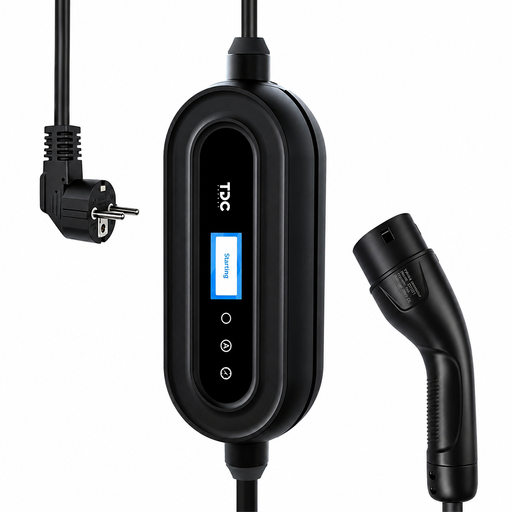
Why this choice suits this profile: This portable charger is ideal for drivers of an electric car or plug-in hybrid who have a suitable domestic Type F socket and are looking for a 5 m backup solution.
At 3.5 kW, this model avoids paying for a 22 kW capability that cannot be used on a standard single-phase socket. The current can be adjusted to 8, 10, 13 or 16 A depending on the circuit.
Type 2 connector, 5 m cable, 1.9-inch LCD screen and stated IP66 rating. Use requires a properly earthed socket, without extension leads or unapproved adaptors.
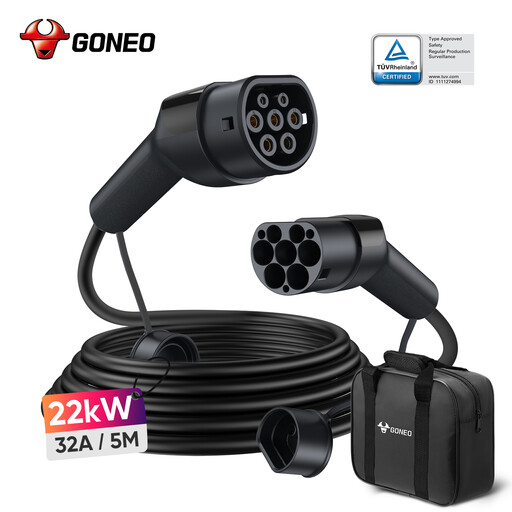
Why this choice suits this profile: This Type 2 cable for Tesla and electric vehicles is aimed at those looking for a three-phase model that is easy to transport, for a compatible home or public charge point.
The specification states a power of 22 kW, a current of 32 A, three phases and a length of 5 m. It also mentions TÜV Rheinland along with CE, UKCA, RoHS, ISO and IEC certifications: check the documents supplied with the product.
TPU sheath, silver-plated contacts, protective cap, carry bag included and stated IP54 rating. To achieve 22 kW, the vehicle must have a compatible three-phase OBC.
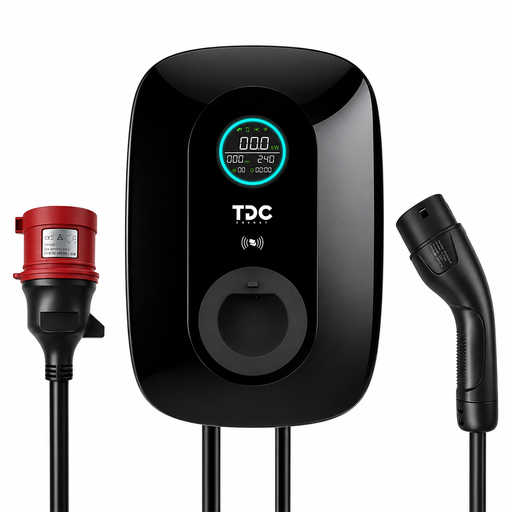
Why this choice suits this profile: This wall-mounted charge point is designed for drivers with a three-phase 400 V supply who want to manage their charging sessions via an app or RFID card.
The power rating, maximum current of 32 A and installation requirements are clearly stated. Installation and commissioning must be carried out by a qualified electrician.
3-inch display, Wi-Fi, Bluetooth, RFID, 5 m cable and protection against overvoltage, overheating and earth leakage.
We have compiled a comprehensive, real-time updated list of products that fully meet these demanding selection criteria and European safety regulations.
No. It works with vehicles fitted with a Type 2 inlet or with the AC section of a CCS2 inlet, but the power depends on the onboard charger. A car limited to 7.4 kW or 11 kW will not exceed that value, even with a 32 A three-phase cable.
A 5 m cable is suitable when the charge point is close to your charging port. Measure your usual parking position before buying. An excessively long cable adds weight and bulk, while a cable that is too short may prevent connection in some layouts.
Yes, if the vehicle has a Type 2 inlet and supports AC charging. However, plug-in hybrids often have a lower charging power. Check your vehicle's documentation to choose a cable capacity that matches its onboard charger.