
Livraison le jour même ou le lendemain

Qualité garantie

Débloquez vos offres de bienvenue: Livraison GRATUITE | Jusqu'à -80 % | 30 jours d'essai gratuits à JoyPlus
Téléchargez l'application
Just bought a new television? You're probably tempted to mount it on the wall for a clean, modern look. It's an excellent way to optimize your space and enhance your viewing experience. But be careful—choosing the right TV wall mount can quickly become a headache. Between technical standards, marketing promises, and the risks of a poor installation, it's easy to make the wrong choice.
I'm a product expert at Joybuy, and my role is to guide you. Let's break down the common pitfalls to avoid and the essential criteria for making a safe, long-lasting choice, all without any unnecessary technical jargon.
The 3 mistakes to avoid when buying a TV wall mount:
To avoid these unpleasant surprises, three checks are essential before you buy.
The VESA (Video Electronics Standards Association) standard simply defines the distance, in millimeters, between the four mounting holes on the back of your television. It's expressed as two numbers (for example, 200x200 or 400x400).
Each mount is designed for a specific screen size range (e.g., 55 to 90 inches) and, more importantly, for a maximum load in kilograms. Weigh your television (or check its spec sheet) and choose a mount with a load capacity that is significantly higher. For a wall mount for a large TV, allow for a safety margin of at least 20%.
This is the non-negotiable safety checkpoint for mounting a TV on the wall.
To help you see things more clearly, here's how these criteria apply to a few models suited for different needs.
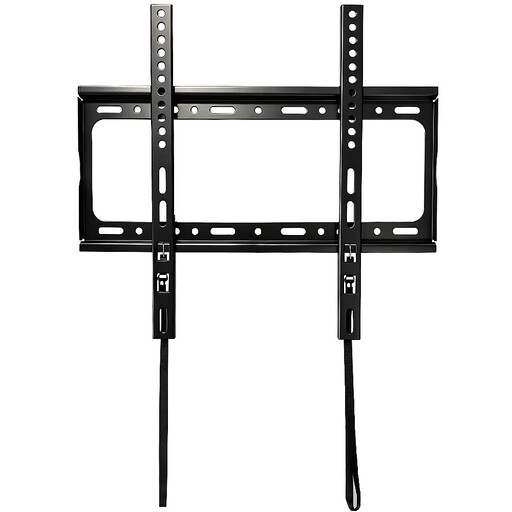
Why we recommend it: Perfect for a first-time installation in a living room or bedroom. This fixed mount offers an ultra-slim profile for a discreet look and maximum space-saving, especially if your sofa is directly facing the wall.
Its specifications are clear: VESA compatibility up to 400x400 mm and a maximum load of 45 kg. The instructions are unambiguous and require installation on a solid wall, which limits the risk of error.
Its simple and robust steel construction. Its slim profile places the TV as close to the wall as possible for a nearly invisible integration.
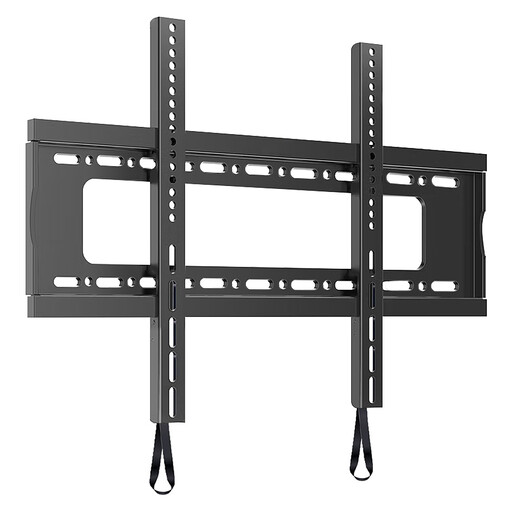
Why we recommend it: Designed for owners of very large and heavy televisions (up to 90 inches). Here, the absolute priority is peace of mind, with a structure engineered to support a very high load in complete safety.
It meets the load challenge with a certified capacity of 85 kg and a wide wall plate that distributes the weight perfectly. Its design is unambiguous: it's made for solid, load-bearing walls, which eliminates any uncertainty.
Its single-piece, 2.8 mm thick steel structure and its VESA compatibility up to 600x600 mm ensure unbeatable robustness and compatibility, even for the largest screens on the market.
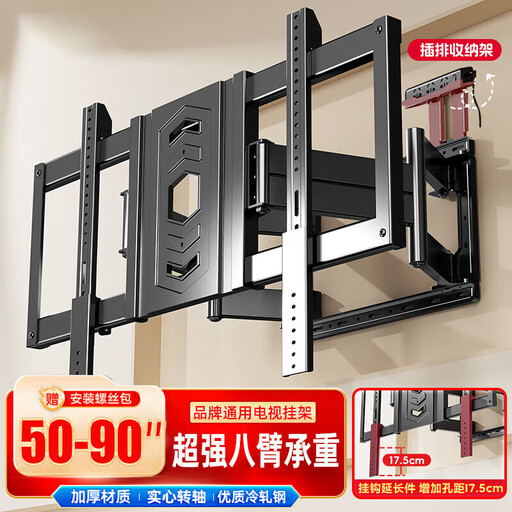
Why we recommend it: Essential for open-plan living areas (living room-kitchen) or for combating sun glare. Its articulated arm allows you to position the television however you like.
It anticipates the dynamic load (the leverage effect) pitfall by clearly stating a 30 kg capacity for articulated use. This forces you to check your TV's weight and make an informed decision, with no unpleasant surprises.
Its telescopic arm offers an extension of up to 46 cm, a swivel function, and vertical tilt for a perfect viewing angle every time.
Not a DIY enthusiast or simply seeking absolute peace of mind? For large televisions, hiring a TV wall mounting service is a wise precaution. Joybuy offers installation services that ensure a professional installation to the highest standards.
We've put together a complete selection of products that meet our strict criteria for safety and quality.
Yes, but with great care. It is essential to screw the mount directly into the studs (the wooden or metal beams) that form the wall's frame. Use a stud finder to locate them accurately. Never use simple plasterboard anchors, which are absolutely not designed to support the weight and pull of a television. For heavy screens, this operation is not recommended without consulting a professional.
The golden rule is to place the center of the screen at eye level when you are sitting on your sofa. Generally, this corresponds to a height between 100 and 110?cm from the floor. This measurement should, of course, be adjusted based on the height of your sofa and the size of the screen for perfect viewing comfort.