
Livraison le jour même ou le lendemain

Qualité garantie

Débloquez vos offres de bienvenue: Livraison GRATUITE | Jusqu'à -80 % | 30 jours d'essai gratuits à JoyPlus
Téléchargez l'application
Mounting a large TV on the wall is the ideal solution to save space and give your living room a modern upgrade. But with a maze of options out there, choosing the right TV wall mount can quickly become a headache. The safety of your valuable screen (and your family!) is at stake, not to mention the need for perfect viewing comfort.
This guide is here to help you see clearly and identify the criteria that truly matter. As product experts at Joybuy, we've dissected the technical specs to bring you reliable and suitable solutions, without the usual marketing fluff.
Before you make a purchase, there are three technical points to check. This will guarantee a safe and perfectly compatible installation.
The VESA (Video Electronics Standards Association) standard defines the spacing, in millimetres, of the four screw holes on the back of your television (for example, 400?x?400?mm). This is the first compatibility point you absolutely must confirm. You can find this information in your TV's manual or, even more simply, by measuring the spacing directly.
Next, consider the weight. Ensure the chosen mount can handle your screen's weight. For televisions over 50?inches, a heavy-duty TV mount isn't an option—it's a necessity. Always compare the maximum load capacity advertised by the mount manufacturer with your TV's weight, leaving a safety margin for peace of mind.
It all depends on your room's layout and your viewing habits.
Fixed TV Mount: The simplest and most streamlined solution. The television sits flush against the wall, like a piece of art. This is the perfect choice if your sofa always faces the screen, as in a dedicated home cinema. The look is incredibly discreet.
Tilting TV Mount: This allows you to adjust the screen on the vertical axis, usually by just a few degrees. It's very useful for combating glare from a window or if your TV is mounted a bit high (above a fireplace, for example).
Full-Motion (Swivel and Tilt) TV Mount: The most versatile, hands down. Thanks to its articulated arm, you can extend, swivel, and tilt the television as needed. It's the best option for large living spaces where you want to watch TV from the sofa, the dining table, or even an open-plan kitchen.
Be careful, not all walls are created equal when it comes to supporting the weight of a large television.
To help you make an informed choice, here are three models that caught our eye for their robustness and features.
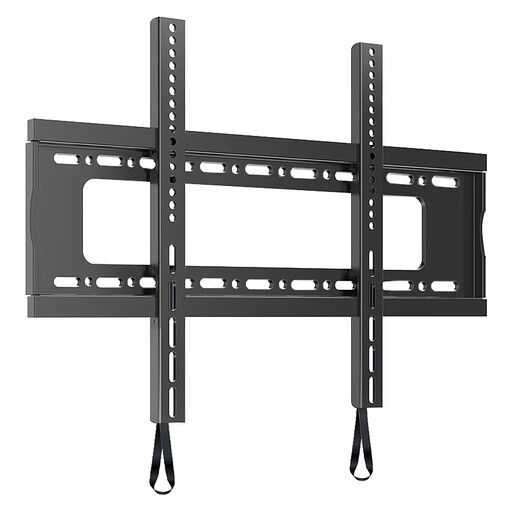
What sets it apart: The absolute priority here is safety. Its single-piece, 2.8?mm thick cold-rolled steel frame and extra-wide wall plate (660?x?218?mm) guarantee perfect weight distribution. The anti-dislodgement locking system adds a welcome final layer of security.
Key Features:
Who is it for? For owners of (very) large TVs, up to 110?inches, who want the peace of mind that comes with an ultra-sturdy, fixed installation on a load-bearing wall. The sensible choice for a home cinema where the screen never needs to move.
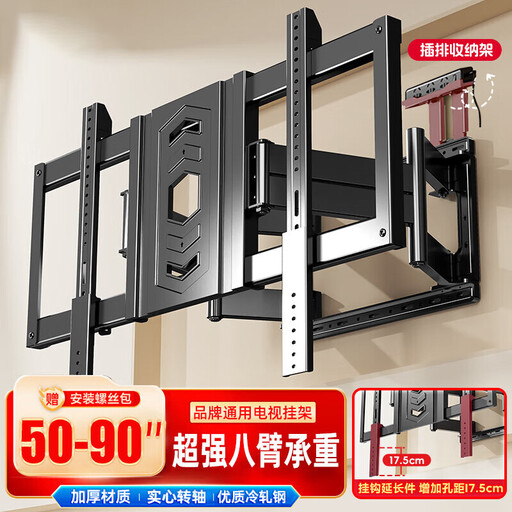
What sets it apart: This is the champion of versatility. This full-motion (swivel and tilt) TV mount offers maximum freedom of movement. Its telescopic arm can extend up to 46?cm from the wall and swivel widely to the sides, which is ideal for adjusting the viewing angle based on your position in the room.
Key Features:
Who is it for? For anyone who needs to adjust their TV on demand in a large living space. Perfect for a corner installation or for swivelling the screen between the lounge area and the dining table.
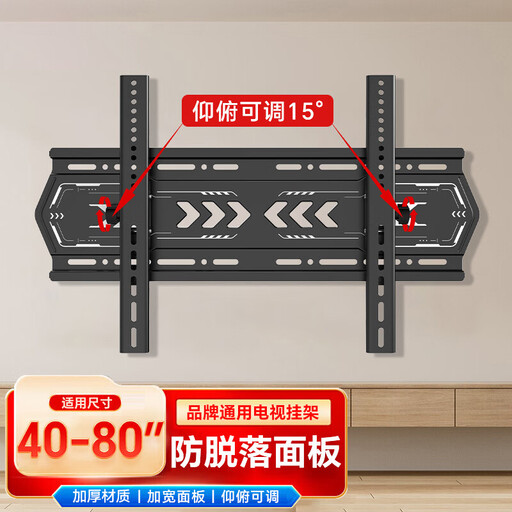
What sets it apart: A simple, smart solution for a very common problem: glare. Its tilting function allows you to angle the screen vertically to regain optimal viewing comfort, especially if the TV is mounted a little high.
Key Features:
Who is it for? This is the pragmatic choice for a 75-inch TV wall mount (or smaller) in a bedroom or living room. Ideal when the screen is placed slightly above eye level and a simple vertical adjustment makes all the difference.
Warning: The models in our selection are designed for solid, load-bearing walls. Installing on a drywall partition (like Placo) is a different ball game. It requires special precautions and specific hardware to distribute the load and prevent any risk of the mount being torn from the wall.
To discover solutions suitable for this type of wall, we invite you to check out our dedicated selection: ? Explore our category of Drywall TV Wall Mounts
The easiest way: check your TV's user manual or look up its specifications online. If you no longer have that information, don't worry: measure the horizontal distance (in mm), then the vertical distance (in mm) between the centres of the four screw holes on the back of the screen. The result (for example, 400?x?200?mm) is your VESA standard.
It's a risky operation and not recommended with a standard mount, especially for a heavy television. The combined weight can tear the fixings out of the drywall. For such an installation, it is imperative to use a sufficient number of specific expansion anchors (like Molly bolts) and, ideally, to screw the mount into the wall's metal or wood studs. For complete peace of mind, the best option is to choose a mount specifically designed for drywall.
The golden rule: the centre of the screen should be at eye level when you are seated on your sofa. Generally, this corresponds to a height of between 1?m and 1.15?m from the floor. Our pro tip: before you drill, tape a large piece of cardboard with your TV's dimensions to the wall to simulate its position and find the perfect height for you.