
Livraison le jour même ou le lendemain

Qualité garantie

Débloquez vos offres de bienvenue: Livraison GRATUITE | Jusqu'à -80 % | 30 jours d'essai gratuits à JoyPlus
Téléchargez l'application
Mounting your television on the wall is an ideal way to modernise your home, save space, and secure your equipment. However, choosing a TV wall mount can quickly become a headache. Faced with a jungle of different models, it's easy to fall into traps that could compromise the safety of your setup.
As a Product Expert at Joybuy, my role is to help you see things more clearly. Let's forget the marketing jargon and focus on the essential criteria for making the right choice?: an informed, durable, and, above all, perfectly safe one. Here are the two classic mistakes you must avoid?:
This guide gives you the keys to avoiding these pitfalls and choosing THE perfect mount for your TV and your wall.
Before you even consider the design or price, three technical parameters must be checked first. They are the pillars of a reliable and long-lasting installation.
The VESA standard (Video Electronics Standards Association) simply refers to the distance in millimetres between the four mounting holes on the back of your television. It is an international standard that ensures mechanical compatibility between your mount and your TV.
The dimensions are always expressed as width x height. For example, a VESA 400x400 standard means the holes form a 40?cm square.
Every mount is designed to support a maximum weight load and a specific range of screen sizes. Exceeding these limits is an unnecessary and dangerous risk.
The choice depends on your room's layout and how you use it.
To help you take action, here are a few options that suit different needs, all selected for their reliability and compatibility.
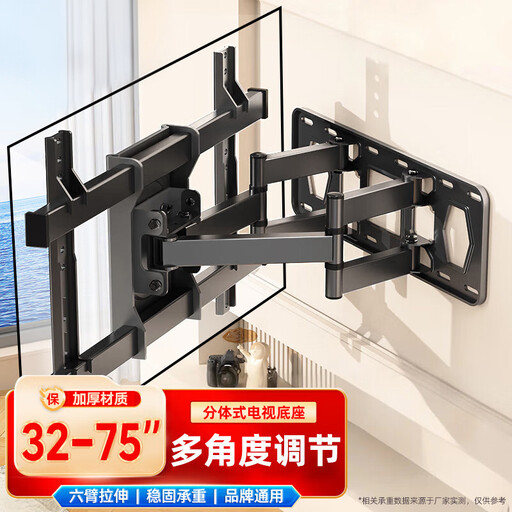
The user profile : Perfect for living rooms with a lot of movement. Whether you're on the sofa, at the dining table, or in the open-plan kitchen, the screen follows you. Its flexibility is a real bonus for family life.
With its wide VESA compatibility and high load capacity, it avoids the trap of being too specific. Its articulated arm adapts to almost any room configuration.
Total flexibility. Thanks to its telescopic and swivelling TV wall arm, you can position the screen exactly where you want it, without compromise.
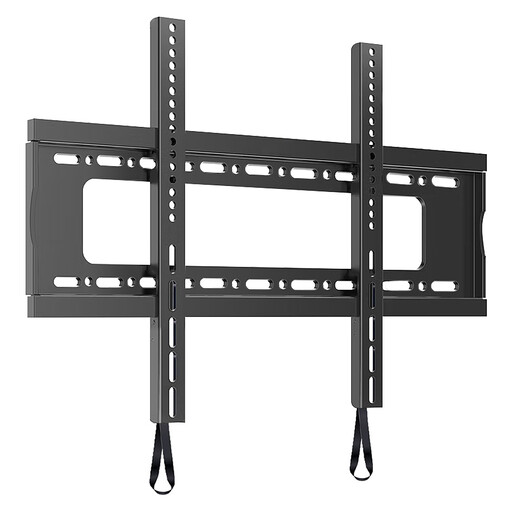
The user profile : Designed for owners of very large screens who want a fixed, ultra-stable, and secure installation. The goal : total cinematic immersion, with no compromises.
Its reinforced steel structure and impressive load capacity (up to 85 kg) are built for heavyweights. Say goodbye to the risk of the mount bending, a common flaw in low-end models.
Rock-solid sturdiness to secure TVs up to 110 inches. Its ultra-slim profile ensures a minimalist look, as if the screen were floating on the wall.
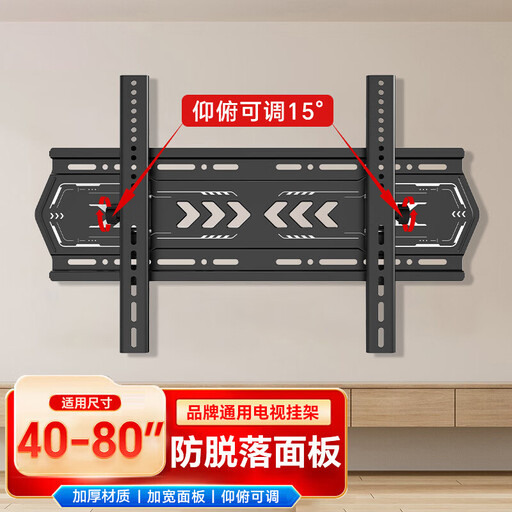
The user profile : The perfect solution for a bedroom, where the television is often mounted high up. Its adjustable tilt ensures optimal viewing comfort and eliminates distracting glare.
This model gets straight to the point : tilting. No complex articulated arm, just a precise and well-executed function that meets a specific need while guaranteeing a secure mount.
It effectively combats glare and optimises the viewing angle for a high-mounted TV, all while maintaining a discreet, low-profile design that sits close to the wall.
Discover our full selection of mounts that meet our strictest safety and reliability criteria.
Yes, but with extreme caution. You should never screw the mount directly into the plasterboard alone?: it is not designed to support that kind of pulling force. The only reliable solution is to locate the metal or wooden studs within the wall structure (using a stud finder) and screw the mount directly into them. This is the only way to guarantee a rock-solid installation. For the heaviest screens, hiring a professional isn't a luxury—it's a safeguard.
The easiest way?: check your TV's manual or its technical specifications on the manufacturer's website. Can't find it?? Get out your tape measure. Measure the distance (in millimetres) between the mounting holes, first horizontally and then vertically. You will get a value like 400x400?mm or 200x200?mm.
It all depends on your room's layout and your viewing habits?: