
Livraison le jour même ou le lendemain

Qualité garantie

Débloquez vos offres de bienvenue: Livraison GRATUITE | Jusqu'à -80 % | 30 jours d'essai gratuits à JoyPlus
Téléchargez l'application
Your new television is finally here. You're itching to mount it on the wall for a sleeker living room and to reclaim valuable floor space. But be careful—choosing the right TV wall mount is far from a trivial decision. Between VESA standards, a bewildering array of models, and safety concerns, it's easy to make a mistake. The wrong choice can ruin your viewing experience and, in a worst-case scenario, send your brand-new screen crashing to the floor.
Our mission?: to help you cut through the noise. We'll skip the marketing jargon and focus on what's essential. Here are the most common pitfalls and the criteria you need to know to make a safe choice that's perfectly suited to your needs.
Before you make a purchase, let's review the pitfalls that can turn a great idea into a costly and risky hassle.
This is the classic rookie mistake. You find a mount that looks sturdy, but once you unbox it, the mounting holes don't line up with the ones on the back of your TV. This mounting standard is called the VESA standard (Video Electronics Standards Association). It defines the distance in millimetres between the four screw holes. An incompatible mount is simply unusable.
Not all walls are created equal. Trying to hang a TV on a simple plasterboard partition (drywall) with the wrong anchors is a recipe for disaster. A TV mount for a concrete or solid brick wall requires specific hardware, which is very different from what's needed for a wood-stud wall. Ignoring this factor jeopardises the safety of your installation and your home.
An articulating and tilting TV mount offers great flexibility, but it also creates significant physical stress. When an articulated arm is fully extended, the weight exerted on the wall mounting points is magnified. A low-quality or poorly secured mount, even if it seems to hold when the TV is flat against the wall, can give way under this leverage effect.
To avoid these pitfalls, a methodical approach is key. Here are the three technical criteria to confirm before any purchase.
First mission?: identify your TV's VESA standard. This information is usually listed in the user manual or on the product's spec sheet. It's expressed as two numbers, for example, 200 x 200 mm or 400 x 400 mm. If you can't find the information, simply measure the horizontal and then the vertical distance (in millimetres) between the centres of the mounting holes on the back of the screen. Then, check that the VESA TV mount that has caught your eye is compatible with these dimensions.
Every wall mount is designed to support a maximum weight. This is a non-negotiable safety criterion. Weigh your television or check its spec sheet, then choose a mount with a load capacity that is comfortably higher. This is especially critical for large screens; an 85-inch TV mount must be certified for a high load, often over 60 kg. The screen size is also a useful indicator to ensure the mount itself won't be visible behind the TV.
Your choice will depend on your room's layout and your viewing habits.
To put theory into practice, here is a selection of solutions that meet specific needs, all vetted for their design and safety.
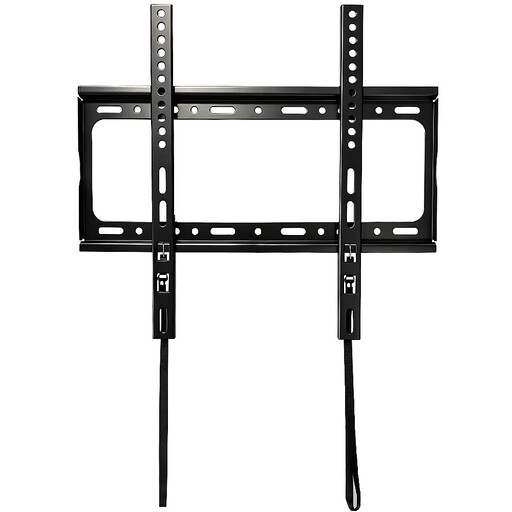
Why we recommend it : Ideal for a living room where the viewing position is fixed. This mount ensures an installation that's flush with the wall (29 mm) for a minimalist and secure result, with no complex moving parts.
Its steel construction and wide wall plate guarantee a rock-solid installation on a load-bearing wall (concrete, brick), eliminating the risk associated with misjudging the wall type.
Thick steel frame (2.9 mm) supporting up to 65 kg and a locking system that prevents any accidental dislodging.
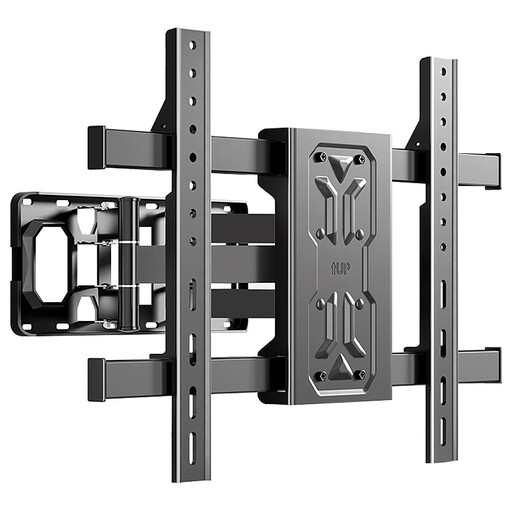
Why we recommend it : A must-have for large living rooms or discerning cinephiles. Its dual articulating arms allow you to extend and swivel a very large screen with surprising ease.
It neutralises the leverage effect thanks to its ultra-thick steel structure (5.5 mm) and a large wall plate (250 x 250 mm), engineered to handle a 75 kg load even when the arm is fully extended.
Wide range of motion (extends up to 67 cm, tilts +5°/-15°). Compatible with large VESA patterns up to 800x600 mm.

Why we recommend it : For those who are all thumbs, short on time, or simply want the guarantee of a perfect and secure installation without the headache.
Simple : the service eliminates all guesswork. A professional assesses your wall, verifies compatibility, and uses the correct hardware for an installation done to professional standards.
Zero tools to buy, zero risk of error. The service includes installing the mount (provided) and hanging the TV. An impeccable result and maximum safety are guaranteed.
We've compiled a complete, up-to-date list of products that meet these strict selection criteria and safety standards.
The simplest trick?: knock on the wall. A solid, dull sound usually indicates a load-bearing wall (concrete, solid brick). A hollow, resonant sound signals a plasterboard partition (drywall). If in doubt, drill a small exploratory hole with a thin drill bit. The type of dust (red for brick, fine and grey for concrete, white and powdery for drywall) will give you a clear indication. For hollow walls, a TV mount installation requires specific expansion anchors (like toggle bolts) and should ideally be secured to the metal studs within the framework.
If you are reasonably handy, well-equipped (hammer drill, spirit level, stud finder, appropriate wrenches), and meticulous, installing on a load-bearing wall is entirely feasible. However, handling a heavy television (especially 55 inches and larger) must be done with two people. If you're not confident in your skills, your tools, or your wall type, hiring a professional is the safest solution.
The golden rule for perfect viewing comfort?: the centre of the screen should be at eye level when you are seated on your sofa. On average, this corresponds to a height between 95 cm and 105 cm from the floor. Measure your eye level from your sofa and use that measurement as the reference point for the centre of your future screen.