The television is often the centerpiece of the living room, but the stand that holds it can be bulky and inflexible when it comes to room layout. A TV wall mount is the ideal solution to free up floor space, secure your device, and optimize your viewing comfort.
However, with the vast array of available models, it's easy to feel overwhelmed. Should you choose a fixed, tilting, or full-motion mount? How can you ensure it's compatible with your television and, most importantly, your wall?
As the Head of Product Recommendations at Joybuy, my role is to guide you. This guide is designed to help you navigate the technical specifications and choose the perfect TV wall bracket for your needs with complete confidence.
Key Criteria for Choosing Your TV Wall Mount
Before exploring our top picks, here are three essential checks to ensure a successful purchase and a hassle-free installation.
1. Compatibility: VESA, Weight, and Screen Size
This is the non-negotiable starting point. You need to verify three key pieces of information:
- The VESA Standard: This refers to the distance in millimeters between the four mounting holes on the back of your TV (e.g., 200x200 mm or 400x400 mm). Your wall mount must match your TV's VESA standard. You can find this information in the device manual or by measuring it yourself. A VESA 400x400 TV mount is a very common standard for medium to large screens.
- Maximum Supported Weight: Every mount is designed for a maximum load. For uncompromising safety, make sure your television's weight is well below this limit.
- Recommended Screen Size: Manufacturers provide a compatible screen diagonal range (e.g., 32 to 75 inches). While the VESA standard and weight are the decisive factors, this recommendation gives you a good indication of the mount's suitability for a 65-inch TV mount or another size.
2. Type of Movement: Tilting or Full-Motion?
The choice depends on your room's layout and your viewing habits.
- Tilting TV Mount: This allows you to adjust the screen vertically by a few degrees. It's an excellent option if the TV is mounted slightly high (e.g., above a fireplace), allowing you to angle it down towards your line of sight for a better viewing angle.
- Full-Motion & Extending TV Mount: This is the most versatile option. Thanks to its articulating arm(s), it allows you to extend the TV from the wall, swivel it left or right, and tilt it. It's perfect for large rooms where you want to watch TV from different spots (the sofa, the dining table) or for a corner installation.
3. Safety: The Type of Wall
The sturdiness of your installation depends entirely on the strength of your wall. A TV mount for a concrete or solid brick wall offers the best guarantee. The wooden studs within a partition wall are also an equally reliable solution.
Important Warning: It is strongly advised against mounting a heavy television on simple plasterboard (drywall) or a hollow brick wall. These materials are not designed to support such a load, and the risk of it falling is very real. If in doubt, consult a professional.
Our TV Wall Mount Picks
Here are a few models we recommend, selected for their smart design and their ability to meet the most common needs.
1. CNTSLNB+ Tilting TV Wall Mount for 32-75 Inches
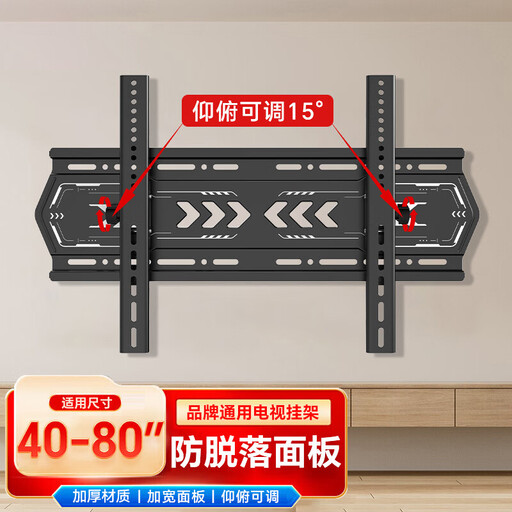
- Why it stands out: This model focuses on simplicity and security. Its ultra-slim profile keeps the television close to the wall for an incredibly discreet look, while offering a practical tilt to adjust the viewing angle.
- Advantages:
- Ultra-slim profile for a minimalist look.
- Easy tilt to counteract glare.
- Safety locking system for complete peace of mind.
- Who is it for?: Perfect for those who watch TV from a fixed position (the living room sofa, the bed in the bedroom) and are looking for a simple, sturdy, and discreet installation with the ability to make slight vertical angle adjustments.
2. Universal Full-Motion TV Wall Mount for 32-55 Inches
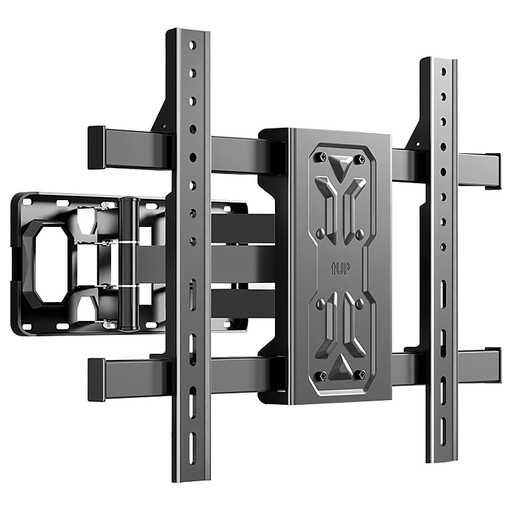
- Why it stands out: Versatility is the key feature of this mount, equipped with an extending articulating arm. It allows you to pull the screen away from the wall and swivel it across a very wide angle, adapting to almost any room configuration.
- Advantages:
- Extends from the wall from 42 to 340 mm for precise placement.
- VESA compatibility up to 400 x 400 mm and a maximum load of 45 kg.
- Designed for mounting on load-bearing walls (concrete, brick, wooden studs).
- Who is it for?: Essential if you need to angle the TV in multiple directions, for example, in a living room that opens into a kitchen or for a corner installation. Its sturdiness makes it a reliable choice for medium-sized screens.
3. CNTSLNB+ Telescopic TV Mount for 32-75 Inches
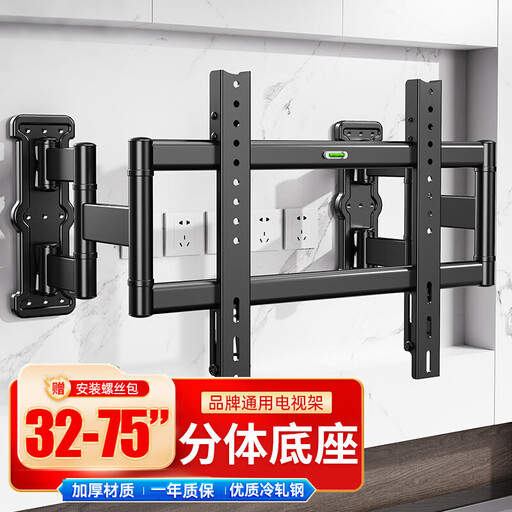
- Why it stands out: This model is a true Swiss Army knife: it combines broad compatibility (up to 75 inches) with dual telescopic and swiveling functionality. Its two-part ("split") design simplifies installation while offering a generous range of motion, even for large televisions.
- Advantages:
- Compatible with a wide range of screens from 32 to 75 inches.
- Maximum flexibility thanks to the telescopic and swiveling arm.
- Rock-solid durability, designed for modern TVs.
- Who is it for?: The ideal compromise for owners of large screens who want more flexibility than a simple tilting mount but don't need extreme extension.
Looking for Other Options?
The models presented cover the most common needs, but every setup is unique. If you're looking for a specific configuration, such as a mount with an extra-long extension or an ultra-slim profile, other solutions are available.
We invite you to explore our full range of full-motion low-profile TV mounts to discover other models and find the perfect fit for your living room.
Frequently Asked Questions (FAQ)
1. How do I know if my TV is compatible with a wall mount?
You need to check three things on the back of your television:
- The presence of four screw holes that form a square or rectangle.
- Measure the horizontal and vertical distance between these holes to get the VESA standard (e.g., 400x400 mm).
- Check your TV's spec sheet to find its exact weight. Then, simply compare this data (VESA and weight) with the specifications of the wall mount you are interested in.
2. Can I install a TV wall mount on a plasterboard (drywall) wall?
For a lightweight television (under 20 kg) and with a fixed mount (no arm), using expanding anchors (like Molly bolts) is possible, provided you use multiple anchor points. However, for a heavier television or with a full-motion and extending TV mount, the lever effect created by the articulating arm makes the installation far too risky. The golden rule: always anchor into the studs (wood or metal) within the wall, or reserve the installation for a load-bearing wall (concrete, solid brick).
3. What is the ideal height to mount a TV wall mount?
The golden rule is simple: the center of the screen should be at eye level when you are seated in your usual spot. On average, this corresponds to a height between 90 cm and 1.20 m from the floor. The easiest way: sit on your sofa and have someone mark the wall at your eye level. This is your reference point. If you choose a tilting TV mount, you have the flexibility to mount it slightly higher.


