Barbecue hosts catering for a group
For a salad or side dish to share, work out how much drained tuna you’ll need. A large tin suits a dish that will be served soon after preparation, while several small tins let you open only what you need.


If you’re making several dishes at different times, choose a multipack of small tins so you can open only what you need. For a dish to share that will be served soon after preparation, a large tin may be more convenient. In either case, compare the total drained weight, then check the ingredients and storage instructions after opening.
For a salad or side dish to share, work out how much drained tuna you’ll need. A large tin suits a dish that will be served soon after preparation, while several small tins let you open only what you need.
If you’ll be using the tuna for several meals over the summer, check the drained weight per tin and the number of tins in the multipack. An opened tin and unopened tins need to be handled differently.
Whether it’s tuna in spring water or oil, the salt content, species and any sourcing claims: check these details on the product you choose rather than assuming they apply to every product from the same brand.
First, decide whether you’d prefer tins you can open as needed or a large tin for a dish to share. Then check the ingredients and sourcing information for each product.
Choose this if: you’ll be making salads or side dishes at different times.
Bear in mind: you’ll need to open several tins to get a large quantity at once.
Choose this if: you’re making a dish to share that will be served soon after preparation.
Bear in mind: you’ll need to store any leftovers according to the instructions for that product.
| Criterion | What to check | Who it matters to |
|---|---|---|
| Quantity and format | Total drained weight and amount per tin, compared with the number of portions you’re planning. | If I’m serving salad to a group without opening tins unnecessarily, I need to know how much tuna I can use; around 31% of shoppers prioritise this. |
| Managing your stock | How many tins you’ll need to open for each meal and the storage instructions after opening. | If I’m keeping tuna for several meals, I’d rather open only what I’m going to use. Around 31% of shoppers put this need first. |
| Ingredients and salt | Covering liquid, ingredients and the salt content per 100 g for the product you choose. | If I’m adding tuna to a dish that’s already seasoned, I want to know what’s in it before I open the tin; around 23% of shoppers prioritise this. |
| Species and sourcing | The species listed and the exact wording of any certification or sourcing initiative. | If the species or a sourcing claim influences my choice, I need to be able to identify it on the specific product. Around 15% of shoppers make this their priority. |
Two multipacks can contain different drained weights. Carrefour lists a total drained weight of 280 g for its Classic’ 2 × 140 g multipack, while Auchan’s product listing for the Petit Navire 4 × 93 g multipack gives 0,372 kg.
Check the total drained weight and compare it with the amount you need for your recipe.
A dish to share may not use the whole contents. Storage instructions after opening vary by product.
Choose a large tin if you plan to serve it soon after opening. Otherwise, smaller tins let you open them as needed.
Auchan describes the Saupiquet 3 × 140 g multipack as MSC-certified, but says the Petit Navire 4 × 93 g multipack comes from a fishery involved in a programme working towards this certification.
Check the exact wording on the product you’re buying rather than assuming it applies to every product from the same brand.
Carrefour’s Classic’ product listing gives skipjack tuna, water and salt as the ingredients; Lidl’s Sol&Mar product is packed in sunflower oil. This affects which ingredients you’ll need to account for in your dish.
Check the covering liquid, ingredients and nutritional information before choosing tuna for your dish.
Auchan stocks, among other options, a 4 × 93 g multipack of tuna in spring water. Petit Navire also offers a separate reduced-salt product.
Auchan stocks a 3 × 140 g multipack of MSC-certified whole tuna in spring water.
Carrefour’s product listing shows a 2 × 140 g multipack of whole tuna in spring water, with a drained weight of 140 g per tin.
E.Leclerc’s Marque Repère range includes several sizes of tuna in spring water, including 140 g, 2 × 140 g, 280 g and 3 × 93 g.
Lidl stocks a 750 g drained-weight product of MSC-certified tuna in sunflower oil.
This large tin of tuna in vegetable oil may be worth considering if your barbecue recipe calls for a substantial amount to be used after opening.
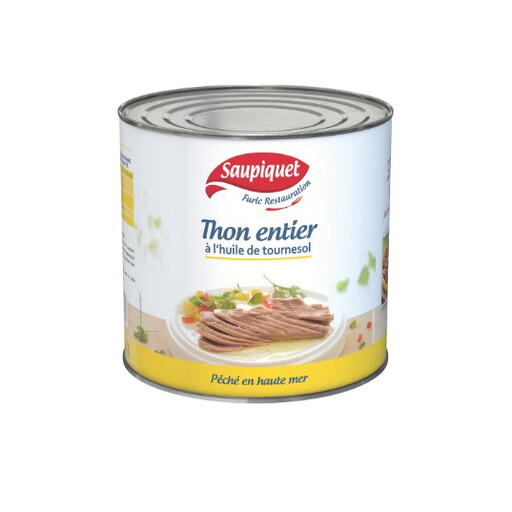 Image unavailable
A large tin to consider for a dish to share when your recipe calls for tuna in vegetable oil. The 2,4 kg stated in the product name doesn’t specify how much tuna there is after draining, so check the drained weight to work out how much you’ll need for your dish.
After opening, the instructions for this product say to transfer the contents to a suitable food container, keep it between 0 and 4 °C and use within 48 hours.
Compare the total drained weight before looking at the number of tins. Carrefour lists a total drained weight of 280 g for its Classic’ 2 × 140 g multipack; Auchan’s product listing for the Petit Navire 4 × 93 g multipack gives 0,372 kg. Check the ingredients too if you’re adding the tuna to a dish that’s already seasoned.
Follow the storage instructions for the product you’ve bought. For the Saupiquet 3 × 140 g multipack stocked by Auchan, the instructions say to transfer the leftovers to a suitable food container, keep them between 0 and 4 °C and use within 48 hours.
No, these descriptions refer to different things. Auchan describes the Saupiquet 3 × 140 g multipack as MSC-certified and says the Petit Navire 4 × 93 g multipack comes from a fishery involved in a programme working towards this certification. Check the wording on the pack you choose.
Check the ingredients and declared allergens, drained weight, nutritional information and storage instructions for the product you choose. In its guidance dated 7 May 2025, the DGCCRF states that prepacked products must display mandatory information on their labels. Also check the precise wording of any species or sourcing claim that matters to you.