Homes without an outside vent
You need to dry your laundry without a vent leading outdoors. Your choice will depend on how the appliance collects water, how much space it needs and the installation requirements in its manual.


If your home has no outside vent, a heat pump condenser tumble dryer lets you dry laundry regularly without venting moist air outdoors. Compare its capacity and energy consumption with cycle times. If you only have room for one appliance to wash and dry your clothes, a washer-dryer is another option, provided you’re happy with a lower drying capacity than washing capacity.
You need to dry your laundry without a vent leading outdoors. Your choice will depend on how the appliance collects water, how much space it needs and the installation requirements in its manual.
Energy use per cycle matters, but it’s not the only thing to consider. Check that the capacity suits your laundry, how long the eco programme takes and whether the parts that need maintenance are easy to access.
A washer-dryer combines both functions in one place. According to UFC-Que Choisir, its drying capacity is lower than its washing capacity, so you may need to split a full wash load before drying it.
If you don’t have an outside vent, first distinguish between appliances that collect water and those that vent moist air outdoors. Then decide whether you have space for a separate tumble dryer as well as a washing machine.
Worth considering: if you want a separate tumble dryer in a home without an outside vent.
The trade-off: UFC-Que Choisir says these appliances generally use less energy than older models with a heating element, but their cycles can take longer.
Worth considering: mainly when looking at an older or second-hand appliance, rather than as a standard choice for a new model.
The trade-off: UFC-Que Choisir notes that these models generally have shorter cycles but use more energy. Check the details of the specific model before buying.
Worth considering: only if there’s a suitable vent that actually carries moist air outdoors.
Limitation: it won’t suit a home without an outside vent.
Worth considering: when you only have space for one appliance to do both jobs.
The trade-off: UFC-Que Choisir says drying capacity is lower than washing capacity. You may need to remove some of the laundry before drying a full wash load.
The European Commission says that the requirements which have applied since 1 July 2025 to new domestic tumble dryers placed on the EU market favour heat pump technology. Washer-dryers are covered by a different framework, so don’t assume that a combined appliance has to meet the same requirements.
| Criteria | What to check | What consumers are looking for |
|---|---|---|
| Installation and collected water | Make sure the appliance doesn’t need an outside vent, and check whether the model has a water tank or a connection that’s compatible with your drain. Also check the ventilation instructions in the manual. | With no opening to the outside, I want to be able to install the appliance and deal with the collected water. Around 31% of consumers prioritise this installation requirement. |
| Energy consumption | For the exact models you’re considering, compare the current energy label and weighted energy consumption per cycle. Don’t assume the old energy classes are equivalent to the new ones. | If I dry laundry often, the energy used by each cycle affects my choice. Around 25% of consumers prioritise this. |
| Capacity and cycle time | Match the drying capacity in kg to your usual loads and check how long the eco programme takes. For a combined appliance, compare its washing and drying capacities separately. | With several loads to get through, I want to avoid splitting laundry unnecessarily while choosing a cycle time that works for me. Around 25% of consumers put this need first. |
| Available space | Measure the space and allow room to open the door. If you’re considering a washer-dryer, check how long the wash-and-dry cycle takes. | If I can only fit one appliance, saving space is more important, even if I have to dry smaller loads. This is a priority for around 19% of consumers. |
This type of appliance sends moist air outside through a vent. A room without a suitable connection won’t meet this requirement.
Check whether there’s a suitable outlet before comparing programmes. If there isn’t one, look at a heat pump condenser tumble dryer instead.
The energy label scales aren’t equivalent. According to the European Commission, the new A to G scale has applied to domestic tumble dryers since 1 July 2025.
Compare the energy labels for the specific models, including their weighted energy consumption per cycle and eco programme duration.
According to UFC-Que Choisir, a washer-dryer’s drying capacity is lower than its washing capacity.
If you want to run both functions one after the other without removing any laundry, limit the load from the start to the model’s stated drying capacity.
A larger load may need to be split and dried over several cycles.
Filters, the water tank and, depending on the appliance, the condenser all need the care outlined in the manual, even if an automatic cleaning function is advertised.
Before you buy, check how easy these parts are to access and what maintenance the specific model requires.
Bosch Electroménager France offers heat pump tumble dryers in a range of capacities, including the 9 kg WQN246D0FR.
Miele France offers T1 heat pump tumble dryers, including the 9 kg TWD640WP.
Samsung France offers 9 kg heat pump tumble dryers, with features such as Optimal Dry available on selected models.
These two freestanding heat pump tumble dryers are suitable if you’re looking for a separate appliance to dry laundry without an outside vent. Compare their energy labels and the requirements of your available space, rather than choosing on capacity alone.
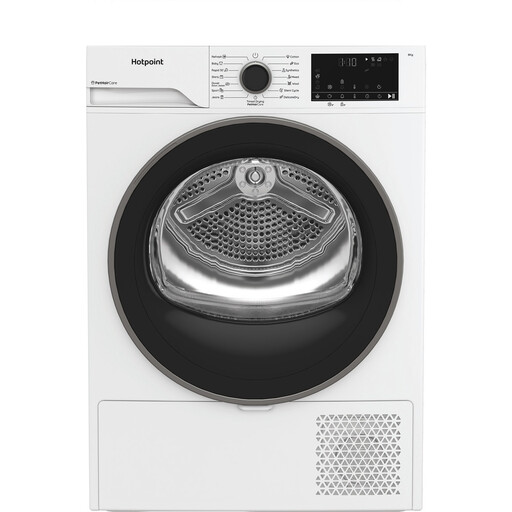 Image unavailable
Worth considering if you want a separate tumble dryer without an outside vent and its 8 kg capacity suits your laundry loads.
The product name indicates an energy rating of C. Check the energy label for the exact model to compare energy consumption per cycle and eco programme duration. Check the manual for dimensions and the requirements for connecting it to a drain, if applicable.
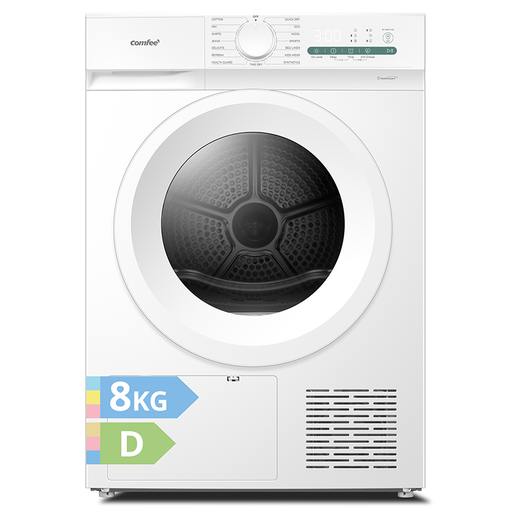 Image unavailable
Worth considering if you want to dry loads that suit its 8 kg capacity in a home without an outside vent.
The product name indicates an energy rating of D and an LED display. Check the energy label for consumption per cycle and eco programme duration. If you need direct drainage or have limited space, confirm the connections and dimensions in the manual.
Yes. A condenser tumble dryer, particularly a heat pump model, doesn’t need a vent to carry moist air outdoors. The water is collected in a tank or, if the model and installation allow, drained away. Follow the manual’s instructions for the room where you plan to put it.
If the appliance isn’t connected to a drain, empty the tank as directed for your model, especially when it’s full. Some appliances allow direct drainage. Check the manual to confirm compatibility and whether any accessories are needed.
Not if the full wash load exceeds its drying capacity. UFC-Que Choisir points out that the two capacities differ. To run a wash and dry cycle one after the other, keep the load within the drying capacity in kg stated for the specific model.
For a domestic tumble dryer covered by the current energy labelling rules, check the A to G scale that has applied since 1 July 2025, along with the energy label for the exact model. According to the European Commission, it includes information such as weighted energy consumption per cycle and eco programme duration. An old A+++ rating can’t be compared directly with a current A rating.
You’ll need to clean the filters and water tank, then follow the manual’s instructions for the condenser if your model needs attention. Even if an automatic function is advertised, check what maintenance you still need to do yourself.