If you’re keeping your washing machine and have room for a second appliance, a condenser tumble dryer works without an external vent. A heat pump model generally uses less electricity, while a conventional model may offer faster drying. If you only have space for one appliance, a washer-dryer combines washing and drying, but its washing and drying capacities differ. In every case, check the ventilation requirements, how water is collected or drained, and whether the appliances and stacking kit are compatible if you plan to stack them.
Who are these options for?
Households that dry laundry often
If you’re keeping your washing machine and dry laundry regularly, compare the models’ electricity consumption and technology. UFC-Que Choisir and the European Commission explain the differences to consider between condenser models.
Households with space for just one appliance
If you can only install one appliance, a washer-dryer can combine both functions. UFC-Que Choisir points out that its drying capacity may be lower than its washing capacity. Also check whether stacking is actually possible in your home.
Households with laundry piling up
If your priority is to dry successive loads quickly, compare cycle times and electricity consumption. UFC-Que Choisir outlines the trade-offs between a separate tumble dryer and a washer-dryer, which generally takes longer to dry clothes.
What to compare
Heat pump tumble dryer
Choose this if: you’re keeping your washing machine, have a suitable space and dry laundry regularly.
Keep in mind: cycles may take longer than with a conventional model. You’ll also need to allow for the maintenance and ventilation requirements in the instruction manual.
Conventional condenser tumble dryer
Choose this if: faster drying matters more and you’re happy with the model’s running costs.
Keep in mind: UFC-Que Choisir reports that these models generally use more electricity than heat pump models.
Washer-dryer
Choose this if: you only have space for one laundry appliance and are happy to choose or replace your washing machine too.
Keep in mind: drying generally takes longer than with a separate appliance. Check the drying capacity and water consumption for the cycle.
If your home has no external vent, compare the technology, the space you actually have, cycle times and how much laundry you can dry in one go.
| What matters |
What to check |
Who prioritises it most |
| Regular use |
The exact technology and the energy consumption shown on the energy label; compare the same reference cycles and loads. |
When I dry laundry often, I want to keep my washing machine while limiting electricity use. Around 33% of consumers put running costs first. |
| Space and installation |
Dimensions, clearances specified in the instruction manual, and access to the water tank or drain. If stacking, check that both appliances and the kit are compatible. |
If I only have one space or limited floor space, I check whether an appliance will fit in the room or can be stacked safely with compatible equipment. Around 27% of consumers make space their priority. |
| Cycle times |
The duration of the relevant programme at full load and whether you can spread out your laundry. A small-load time is not comparable to a full-load time. |
When loads keep coming, I look at how long each one will take to dry and weigh that against electricity use. Around 20% of consumers prioritise cycle times. |
| Drying capacity |
Washing and drying capacities in kg, especially for a washer-dryer; compare them with your usual load. |
If I want to dry washed clothes without splitting the load, I check the drying capacity rather than relying on the washing capacity alone. Around 20% of consumers prioritise how much laundry they can dry. |
Mistakes to avoid
-
Confusing condenser and heat pump technology
Both technologies collect water without needing an external vent, but they are not the same type of appliance. Check the technology listed for the exact model number.
Then compare the energy label and running costs based on your drying habits.
Higher energy use can make a bigger difference if you use a conventional condenser model frequently.
-
Choosing a washer-dryer based on its washing capacity alone
Its drying capacity may be lower. For example, Samsung France lists the Samsung WD90HG5U34BEEF as having a 9 kg washing capacity and a 6 kg drying capacity.
Compare the drying capacity with your usual loads and check the figures for the full cycle.
If your load exceeds that capacity, you may need to split it and run extra cycles.
-
Assuming an appliance without an external vent can go in a closed cupboard
Not needing an external vent doesn’t mean you can ignore the appliance’s ventilation requirements. Electrolux advises against installing the models concerned in an unventilated, closed cupboard.
Before buying, check the model’s installation requirements and whether the room can be ventilated adequately.
-
Planning to stack appliances without checking the kit
Stacking kits are not universal. Bosch lists several washing machine models as incompatible with its 00574010 kit.
Note down the full model numbers of both appliances and confirm that the kit is compatible and suitable for the installation method.
Depending on your chosen setup, remember to check the cost of a compatible kit and any installation service.
Brands to consider
Bosch
The French models WQG2450SFR and WTN85V08FF showcase two different technologies, according to Bosch Électroménager France’s product specifications.
- The WQG2450SFR is listed with a 9 kg capacity and a self-cleaning condenser; the WTN85V08FF has an 8 kg capacity and neither a heat pump nor a self-cleaning condenser.
- Stacking kit compatibility depends on the exact model numbers of the washing machine and tumble dryer.
Electrolux
The EW6HI5829SB is an 8 kg heat pump model featured on Electrolux France’s product page.
- The product page lists 97 kWh per 100 cycles and a full-load cycle time of 2 h 55, under the labelling conditions for this model.
- Follow the manufacturer’s ventilation and maintenance recommendations. These figures alone are not enough to compare every model.
Miele
The TCA520WP 8kg Active is an example of a heat pump option in the T1 range, according to Miele France’s product page.
- The product page lists an 8 kg capacity, a condensed water tank and an integrated kit for draining the water.
- These features do not mean that cycle times are longer or that the same benefits apply across the whole range.
Samsung
The WD90HG5U34BEEF is an example of a washer-dryer featured on Samsung France’s product page.
- The product page lists a 9 kg washing capacity and a 6 kg drying capacity, a difference to bear in mind when running successive cycles.
- Don’t assume it will save energy compared with a separate tumble dryer based solely on promotional claims for certain modes.
Tumble dryers available on Joybuy
These condenser tumble dryers, including heat pump models, are designed for drying laundry without an external vent. Check the room’s ventilation, how water is collected or drained, and the space available for installation.
 No image available
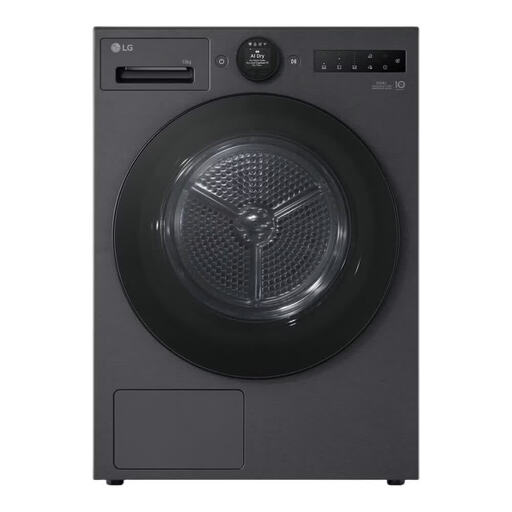
LG RT10X8B — heat pump tumble dryer, 10 kg, black, class C
The heat pump meets the need for drying without an external vent. Compare its stated 10 kg capacity with your usual loads.
View on Joybuy
 No image available
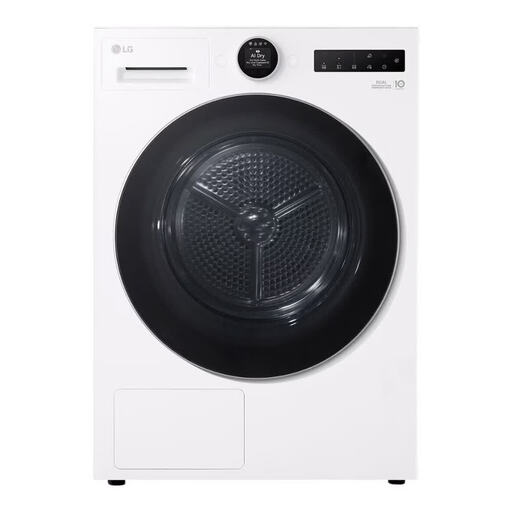
LG RT90X8 — heat pump tumble dryer, 9 kg
Heat pump technology suits homes that need drying without an external vent. Check whether the stated 9 kg capacity suits your loads.
View on Joybuy
 No image available
Electrolux EDH1018CD GentleCare — condenser tumble dryer, 8 kg, white, class E
A condenser model may suit a home without an external vent. Compare its 8 kg capacity and energy class with your needs.
View on Joybuy
 No image available
Hotpoint CHD84MWBSEE — heat pump tumble dryer, 8 kg, white, class C
Heat pump technology lets you dry without an external vent. Compare the stated 8 kg capacity with the amount of laundry you want to dry per cycle.
View on Joybuy
 No image available
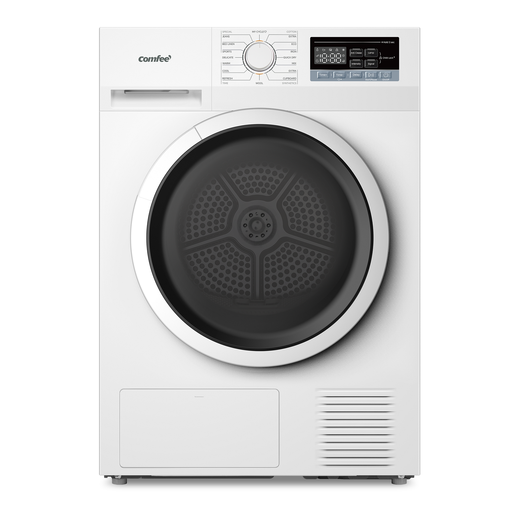
Comfee’ CFP01EH80W-JD — heat pump tumble dryer, 8 kg, class D
Heat pump technology lets you dry laundry without an external vent. The model name specifies its class D rating and 8 kg capacity.
Installation requirements specify a ventilated room of at least 4 m² and an earthed 220–240 V socket. The circuit contains flammable R290 propane: follow the manufacturer’s instructions.
View on Joybuy
Frequently asked questions
Do you need an external air vent or a water outlet?
A condenser tumble dryer, with or without a heat pump, does not need an external air vent, according to the European Commission. Condensed water is collected in a tank or drained through a connection if the model and installation allow it. Check which option is available for the model you’re considering.
Can you install a tumble dryer in a closed cupboard or on top of a washing machine?
Only if you’ve checked the model’s installation requirements. For the models concerned, Electrolux advises against placing appliances in a closed cupboard without ventilation. To stack appliances, check that the model numbers of both appliances and the kit are compatible; Bosch, for example, lists several washing machine models as incompatible with its 00574010 kit.
What maintenance should you do if cycles start taking longer?
Follow the instruction manual to empty the tank when needed and clean the filters. For the models concerned, Electrolux recommends cleaning the filter after every cycle and checking the condenser when it’s accessible and the manual recommends doing so. A blocked condenser can increase energy consumption.
How do you compare energy labels, and what are your rights after buying in France?
Since 1 July 2025, the new European energy label for tumble dryers has used an A to G scale, according to the European Commission. Don’t compare an older A+++ rating directly with an A rating under the new scale. For a purchase from a trader by a private individual in France, the Ministry of the Economy states that the legal guarantee of conformity also covers second-hand and refurbished goods. You have two years from the date the goods are delivered to take action.


