Households without an external vent
If you can’t connect a vent hose to the outside, consider condenser tumble dryers, with or without a heat pump. A vented model needs a suitable outlet for the air.


If you can’t dry your washing outdoors, a condenser tumble dryer means you won’t need an air-exhaust hose leading outside. A heat pump model is worth considering if you dry clothes frequently; if you have a suitable external vent, compare that option too. Whichever you choose, check the available space, usable capacity, energy consumption and programme times of the model you’re considering.
If you can’t connect a vent hose to the outside, consider condenser tumble dryers, with or without a heat pump. A vented model needs a suitable outlet for the air.
If you do laundry often, compare the energy consumption and programme times of heat pump models with those of other dryers you’re considering. Lower electricity use alone isn’t enough to decide between two cycles of different lengths.
Compare the tumble dryer’s capacity with your washing machine’s, then check the permitted load for each programme. For wool, silk or outdoor clothing, the garment’s care label is still the deciding factor, even if the dryer has a dedicated programme.
Start by checking your installation options, then compare models that suit your room with your usual loads and laundry routine in mind.
Consider this if: you don’t have an external air outlet and use your tumble dryer frequently.
Compare: the energy consumption and programme times of the exact model, as well as how it collects the condensed water.
Consider this if: you need to avoid an external vent hose and want to compare different condenser technologies.
Compare: energy use and programme times for comparable programmes and loads, rather than relying on the technology name alone.
You’ll need: an external opening or a vent hose that’s suitable for the appliance.
Limitation: without this connection, this type of dryer isn’t suitable for the room, even if there’s space for the appliance.
| Priority | What to check | Your needs |
|---|---|---|
| Installation | Check whether the technology requires an external air outlet, along with the appliance dimensions and the clearances specified in the manual. Make sure you can access the plug and water tank, or check the requirements for connecting a condensate drain if the model allows it. | I need to be able to install the appliance in the available room, without assuming I can add an external vent hose. If I also dry clothes on an airer in the room, ventilation matters too. For this, ADEME recommends a large, well-ventilated room or one fitted with an extractor. |
| Energy use and cycle time | Compare the energy labels of the exact models, then check energy consumption and cycle times for the programmes and loads you’re interested in. In its test protocol, UFC-Que Choisir reports the time and energy used per kilogram of dried laundry. Comparing results on the same basis is important. | I do laundry regularly and want to know both how much electricity the dryer uses and how long I’ll need to wait before my clothes are ready. |
| Capacity | Compare the tumble dryer’s capacity with your washing machine’s and check the maximum load for the programmes you use, particularly where cotton and synthetics have different limits. | I don’t want to have to split a large load into several drying cycles every time. UFC-Que Choisir recommends taking the size of your household and the capacity of your washing machine into account. |
| Fabrics and care | Check the model’s programmes, the care labels on your clothes and the maintenance steps set out in the manual for the filter, condenser and water tank. | I want to dry only clothes that are suitable for tumble drying and choose the right programme, while knowing what routine maintenance the appliance will need. |
A vented tumble dryer must send moist air outside, so having enough room for the appliance doesn’t necessarily mean you can use it there.
Check that you can connect it before choosing this type. Otherwise, compare condenser models.
Two models may differ in both energy consumption and cycle length. The words ‘heat pump’ don’t tell you how much energy the programme you’ll use consumes.
Check the energy label and compare cycle times and energy use for similar programmes and loads.
The permitted load for synthetics or delicate fabrics may be lower than the appliance’s stated maximum capacity.
Check the capacity of the programmes you use regularly before comparing it with your washing machine’s loads.
A wool or silk programme doesn’t mean that every garment made from those fabrics can go in the tumble dryer.
Check each garment’s care label first, then choose a programme recommended in the appliance manual.
Bosch offers heat pump tumble dryers, with product specifications that let you check capacity and dimensions for each model.
The Electrolux range includes heat pump tumble dryers, with fabric programmes that vary from model to model.
Miele’s T1 range includes 8 kg and 9 kg heat pump tumble dryers, depending on the model, with garment-care features that vary between models.
Beko offers heat pump tumble dryers and describes a technology that reuses warm air inside the appliance.
These three condenser models are options to consider if you need to dry clothes without an external air-exhaust hose. The Hotpoint and Comfee are listed as heat pump models. Confirm the exact technology used by the Electrolux before comparing energy consumption and cycle times.
 Image unavailable
This 8 kg heat pump model is worth considering if you don’t have an external air outlet. It’s listed with energy rating C. Check the dimensions, how it handles condensate and the programme times before making your choice.
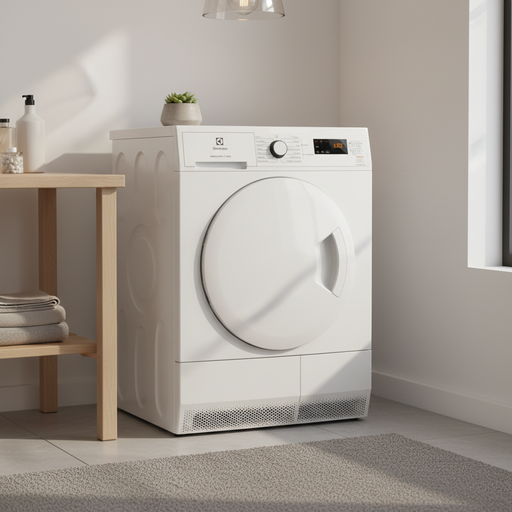 Image unavailable
Its 8 kg capacity makes it worth comparing with your washing machine loads, and it doesn’t need an external air vent. The product name mentions OptiSense and propane refrigerant. Before comparing energy use, check whether it uses a heat pump or standard condenser technology.
 Image unavailable
This 8 kg heat pump model is an option for a room without an external air-exhaust hose. It’s listed with energy rating D. Check its dimensions, water management and programmes to make sure they suit your laundry.
Yes. A condenser tumble dryer, including a heat pump model, doesn’t need an air-exhaust hose leading outside. A vented model does need an external opening or a suitable vent hose. Also check the installation requirements for the model you choose.
It depends on the tank’s capacity, how you use the appliance and how it’s installed. Some condenser dryers allow the water to drain directly away. Check whether this is possible, along with the connection requirements and any accessories needed, in the manual.
Follow the electrical and safety instructions for the exact model. The Bosch WTH83014FR manual specifies a properly installed, earthed wall socket. Don’t assume its other installation requirements apply to a different appliance; check that model’s manual.
Your washing machine’s capacity is a good starting point, along with the size of your household, as UFC-Que Choisir recommends. Then check the permitted load for the programmes you’ll use: the stated maximum capacity may not apply to every fabric type.
No. The garment’s care label must first say it’s suitable for tumble drying. Then choose a suitable programme from those listed in the appliance manual.