How do the options compare?
Your first decision depends on the space you have: a freestanding tumble dryer and a washer-dryer solve different problems. A conventional condenser dryer you already own or are considering second-hand is another case to look at, but it isn’t the usual option when choosing a new household tumble dryer placed on the EU market since 1 July 2025, according to the European Commission.
Heat pump tumble dryer
Consider it: if you want a new freestanding appliance and have a separate space for drying your regular loads.
Bear in mind: the technology alone won’t tell you how long the cycle takes, how noisy the model is or what installation it requires.
Washer-dryer
Consider it: if your home can’t accommodate two appliances or you generally have small loads to dry.
Bear in mind: drying capacity may be lower than washing capacity, so you might need to remove some laundry before drying.
Conventional condenser dryer
Consider it: if you want to understand how an appliance you already have works or assess a second-hand listing. Check its condition and how it collects water.
Keep in mind: its old energy rating can’t be directly compared with the new A–G scale for tumble dryers.
If you’re considering machine drying because outdoor drying is unreliable or you’re short on time and space, the most important factor will depend on your situation:
| Factor |
What to check |
Who should consider it? |
| Energy use |
The kWh per 100 cycles for the eco programme and the generation of the tumble dryer’s energy label. |
If you dry laundry often, you’ll want to know how much energy repeated cycles use before choosing. Around 33% of consumers prioritise energy use. |
| Laundry load |
The eco programme capacity in kg; for a washer-dryer, its separate washing and drying capacities. |
If your usual loads are large, you’ll want to avoid splitting them across several drying cycles. Capacity is the top priority for around 27% of consumers. |
| Space and installation |
The dimensions and required clearances, plus access to the water tank or drainage options for the model. |
In a home where every bit of space counts, you’ll need to know which appliance can actually be installed and used. Space and installation are the main concern for around 27% of consumers. |
| Cycle time and noise |
The eco programme duration, the conditions for short cycles and the noise information. |
If you need laundry ready by a particular time or the appliance will be near living areas, you’ll want a cycle that fits in with your household routine. Around 13% of consumers rank cycle time or noise as their main concern. |
Brands to know
There are no brand profiles to display in this section.
Joybuy models for your space
These models illustrate two of the options covered here: a washer-dryer if you don’t have room for two appliances, and freestanding heat pump tumble dryers if you have space for a separate appliance. For each one, compare the stated capacity with your usual loads, and check the model’s energy label and instructions before deciding.
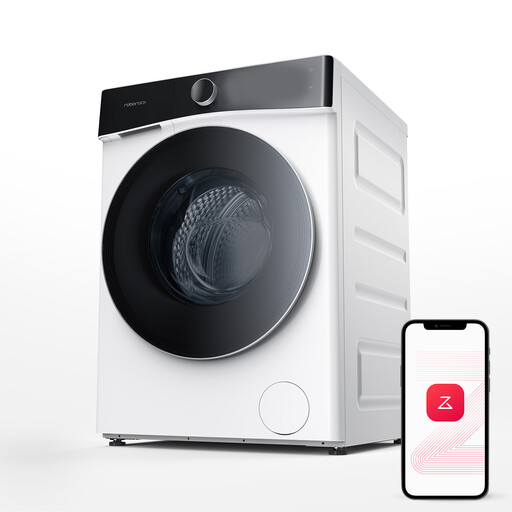 Image unavailable
Roborock Zeo Lite white washer-dryer, 10 kg/6 kg
Worth considering if you don’t have room for a separate washing machine and tumble dryer. Its stated capacity is 10 kg for washing and 6 kg for drying, so a full wash load may be too large to dry in one go.
Before buying, check the dimensions and installation requirements, as well as the wash-and-dry cycle information in the model’s documentation.
View on Joybuy
 Image unavailable
Hotpoint CHD84MWBSEE white heat pump tumble dryer, 8 kg
Worth a look if you have space for a freestanding tumble dryer and need a stated capacity of 8 kg.
Compare its energy use and eco programme duration on the energy label; check the instructions for dimensions, clearances and water management. If the appliance will be near living areas, also check its stated noise level.
View on Joybuy
 Image unavailable
Comfee CD08EHP05W-HR white heat pump tumble dryer, 8 kg
Another freestanding option to consider if a stated capacity of 8 kg suits your usual loads.
The product name mentions energy class D; check the applicable energy label and its kWh per 100 cycles before making comparisons. Also check the eco programme duration, noise level, dimensions and installation requirements for the model.
View on Joybuy
Frequently asked questions
Can you compare an older tumble dryer’s A+++ rating with an A–G rating?
Not by comparing the letters alone: according to Gifam, the new A–G label for tumble dryers has applied since 1 July 2025. When choosing between models, check that they use the same generation of energy label, then compare their kWh per 100 cycles, eco programme capacity and duration.
Is a conventional condenser dryer still an option if you’re buying a new tumble dryer?
It isn’t the usual option for a household tumble dryer newly placed on the EU market: the European Commission says heat pump technology has been required since 1 July 2025. If you’re looking at a second-hand appliance or older stock, check the details of the listing rather than assuming its status based on the technology alone.
Does a heat pump tumble dryer need to vent air outside?
Not necessarily: the extracted water can be collected in a tank, and some models can be connected to a drain. Check the instructions for your chosen model for connection options and clearance requirements, and make sure you can access the tank in your home.
Can a washer-dryer dry the whole load it has just washed?
Not always: its drying capacity may be lower than its washing capacity. Compare both figures in kg for the model you’re considering, and check the wash-and-dry cycle information on its own energy label rather than using the figures for a freestanding tumble dryer.
What maintenance should you consider before choosing a tumble dryer?
Make sure you can easily access any parts the instructions say need maintenance, particularly the filter and, if the water isn’t drained away, the collection tank. Check the requirements for the specific model: a self-cleaning feature doesn’t replace the manufacturer’s maintenance instructions.


