If you don’t have an external vent, consider a condenser tumble dryer. Compare heat pump and conventional condenser models by their energy consumption and cycle times. A vented dryer needs an opening or duct leading outside, as UFC-Que Choisir points out. Whatever type you choose, check the capacity, available space, noise level and installation requirements.
Who is each option suited to?
Whether you can vent damp air outside determines which technologies are suitable. How often you use the dryer and how much laundry you have will help narrow down your choice.
Homes without an external vent
If you live in a flat or have a utility room without a suitable duct, choose a condenser dryer rather than a vented model. Be sure to check the dimensions and installation requirements in the manual for the model you choose.
Homes that often dry family-sized loads
Look for a dryer capacity that matches your washing machine and the loads you actually dry. If you use it frequently, also check the energy consumption on the label and the length of the eco programme.
Homes with an existing external vent
You could consider a vented dryer if the opening or duct is suitable for the model and meets the requirements in its manual. Then compare its energy consumption and installation requirements with those of a condenser dryer.
What should you check before choosing?
First rule out any appliances that aren’t suitable for your space. Then compare capacities and programmes that suit the loads you plan to dry.
| Criteria |
What to check |
My needs |
| Installation |
For a vented model, check the external opening or duct required, as specified by UFC-Que Choisir. For any model, check its dimensions and the clearances set out in the manual. |
I need to be able to install and use the appliance in the space available, without assuming that an external vent can be added. |
| Energy consumption |
Compare the energy consumption shown for the eco programme using documents with the same energy-label scale. Consider it alongside the cycle time, rather than looking at the energy efficiency class alone. |
If I dry laundry often, I want to know how much electricity each technology uses under comparable conditions before I choose. |
| Capacity |
Compare the stated capacity in kg with that of your washing machine and the loads you actually transfer to the dryer. Also consider bulky items and the programmes you’ll use. |
My usual loads need to fit in the appliance, but I don’t want to choose a capacity based only on the biggest number. |
| Cycle time and noise |
Compare eco programme times between models with similar capacities. Check the noise emissions in dB(A), particularly if the dryer will be near a living area. |
I want to know whether a cycle fits my routine and whether the stated noise level is suitable for where I plan to put the appliance. |
| Water and maintenance |
Check whether water is collected in a tank or can be drained directly, and whether any accessories are needed. Check the manual for instructions on cleaning the filter and condenser. |
I’d like to know what maintenance is involved and how to empty the water before installing the appliance. |
| Fabrics |
Check the care labels on your clothes and the programmes available for the fabrics you need to dry. Don’t assume every item is suitable for tumble drying. |
I want to dry my usual loads without using the same programme for every fabric. |
What mistakes should you avoid?
-
Choosing a vented dryer without checking for an outlet
According to UFC-Que Choisir, this technology needs an opening to the outside or access to a ventilation duct. A room without a compatible outlet won’t meet this requirement.
Check what outlet is available, then make sure it’s compatible with the model’s instructions before choosing a vented dryer.
-
Comparing an old A++ rating directly with an A to G rating
Product information may use different energy-label scales. The European Commission says the revised measures for tumble dryers have applied since 1 July 2025. A letter on its own isn’t enough to compare two different scales.
Check the scale and date of the product information, then compare the energy consumption and cycle time on a like-for-like basis.
-
Relying on the maximum capacity alone
A figure in kg doesn’t tell you what your usual loads are, how long the programmes take or how much space the appliance needs.
Check your washing machine’s capacity, estimate the loads you’ll transfer to the dryer, and look at its dimensions and eco programme time.
-
Overlooking fabric care labels and maintenance
The programme you choose needs to suit the clothes in the drum. Cleaning requirements for the filter and condenser vary by model.
Follow the care labels on your fabrics and check the manual for the available programmes and maintenance instructions.
A few models to consider by brand
These details apply to the models mentioned, not to every tumble dryer made by each brand.
Bosch
The Bosch WTH83V01FF is an example of an 8 kg heat pump tumble dryer for which Bosch publishes the dimensions and noise level.
- Bosch lists a noise level of 65 dB(A) and dimensions of 842 × 598 × 613 mm for this model.
- According to its product information, the condenser is not self-cleaning and a water drain hose is not included.
Electrolux
The Electrolux EDHF5841EC is an example of an 8 kg heat pump model for which the room temperature requirements are worth checking.
- Electrolux gives an operating temperature range of 5 °C to 35 °C for the EDHF5841EC.
- The product information shows a water collection tank; a direct-drain kit is available as an optional extra for this model.
Beko
The Beko DCB816W is an example of a conventional condenser tumble dryer with a stated capacity of 8 kg.
- Beko lists a direct-drain hose and a cycle time of 142 minutes for this model’s standard cotton programme at full load.
- Its annual energy consumption figures and energy class are shown in documentation that uses a scale you should check before comparing them with a recent A to G label.
Condenser tumble dryers available on Joybuy
This selection includes heat pump tumble dryers and one model described as a condenser dryer. To compare them, match their confirmed specifications to your space and laundry loads. The heating technology of the Electrolux EDH1018CD model still needs to be confirmed.
 Image unavailable
Hotpoint CHD84MWBSEE heat pump tumble dryer, 8 kg
This heat pump model could be a good option if your room doesn’t have an external air duct and a capacity of 8 kg suits your loads. The title lists a C energy class; compare the energy consumption and eco programme time using documentation based on the same scale. Check the dimensions and installation requirements before deciding where to put it.
View on Joybuy
 Image unavailable
Comfee CD08EHP05W-HR heat pump tumble dryer, 8 kg
Compare its stated capacity of 8 kg with your usual laundry loads. The heat pump technology means it could be suitable for a space without an external air duct. The title lists a D energy class. Before choosing this model, check the dimensions, noise level, eco programme time and energy consumption for this variant.
View on Joybuy
 Image unavailable
Electrolux EDH1018CD GentleCare condenser tumble dryer, 8 kg
This 8 kg condenser model is worth considering if your room doesn’t have an external air duct. Its title mentions OptiSense and propane refrigerant, but that isn’t enough to confirm its heating technology. Check the model’s documentation before comparing energy consumption. Also check the eco programme time and installation clearances.
View on Joybuy
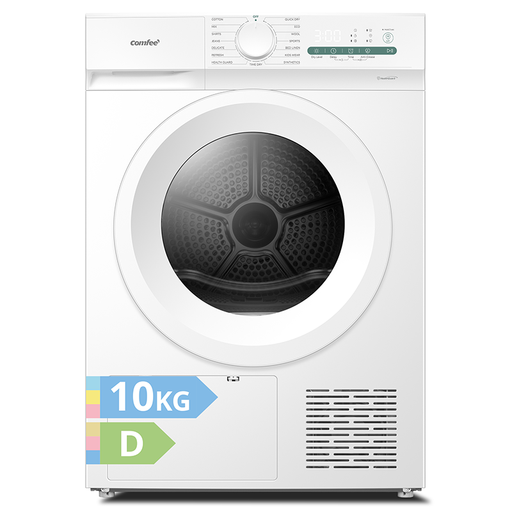 Image unavailable
Comfee CD10EHP05W-HR heat pump tumble dryer
The heat pump technology means this model could be suitable for a room without an external air outlet. The stated capacity for this variant differs between 8 kg and 10 kg, so confirm the capacity of the CD10EHP05W-HR before choosing it for your loads. Also check its dimensions, noise level, eco programme time and energy consumption.
View on Joybuy
Frequently asked questions
Can you install a vented tumble dryer without an external outlet?
No. According to UFC-Que Choisir, this type of dryer needs an opening to the outside or access to a ventilation duct. If there’s no compatible outlet, consider condenser models and follow the installation instructions in the manual.
Why do some dryers have A++ ratings and others have A to G ratings?
These ratings may be based on different energy-label scales. The European Commission says the revised measures for tumble dryers have applied since 1 July 2025. Check which scale is being used before comparing two appliances: an older A++ or A+++ rating cannot be directly converted to an A to G rating.
Does a condenser tumble dryer need to be connected to a water drain?
Not necessarily: water can be collected in a tank. Some models can be connected directly to a drain, but the accessories needed vary. For example, Electrolux offers an optional kit for the EDHF5841EC. Check the product information and manual for the model you plan to install.
What room temperature does a heat pump model need?
It depends on the model. Electrolux gives an operating temperature range of 5 °C to 35 °C for the EDHF5841EC; this doesn’t automatically apply to other appliances. Check the manual, particularly if you plan to install the dryer in a garage or cold utility room.
How do you choose a programme that won’t damage your fabrics?
First check that the garment’s care label says it can be tumble dried, then choose a programme that suits the fabric. The instructions in the appliance manual add to the garment’s care label; they don’t replace it.


