Households doing several loads close together
If you do several loads of laundry each week, compare the drying capacity with your usual loads, then check the energy use and programme duration against your routine.


If you do laundry frequently, start by looking at a separate heat pump tumble dryer if you want to keep electricity use down without needing an external vent. According to UFC-Que Choisir, this technology generally uses less energy than conventional condenser or vented models, although its cycles can take longer. If speed is your priority, compare the other technologies and their installation requirements. If there’s only room for one appliance, check the washing and drying capacities of a washer-dryer separately.
If you do several loads of laundry each week, compare the drying capacity with your usual loads, then check the energy use and programme duration against your routine.
If you don’t have a suitable opening or duct, a condenser tumble dryer avoids the external vent required by a vented model. You’ll still need to plan where to put it and how to manage the collected water.
If there isn’t room for two appliances side by side, compare a compatible stacking set-up with a washer-dryer. With the latter, the drying capacity may be lower than the washing capacity.
Worth considering: for regular drying without an external vent, particularly if keeping electricity use down is important.
The trade-off: according to UFC-Que Choisir, cycles generally take longer than with conventional technologies.
Worth considering: if speed matters more and an external vent isn’t available.
The trade-off: UFC-Que Choisir says these models generally use more energy than heat pump models.
Worth considering: if a suitable external vent is genuinely an option and speed is your priority.
The trade-off: a vent is essential. UFC-Que Choisir also says these models generally use more energy than heat pump models.
Worth considering: when there’s only room for one appliance, even if two separate appliances could be stacked.
The trade-off: the machine may be able to wash more laundry than it can dry in one go. For example, Whirlpool lists an 11 kg washing capacity and a 7 kg drying capacity for the FFWDD 1176258 BCV FR.
To compare models, start with the constraint that matters most for your usual laundry routine, then check the specifications for the programme you’ll actually use.
| Criterion | What to check | Consumers concerned |
|---|---|---|
| Electricity use | Compare the energy label and the stated consumption for cycles suited to your fabrics. | If I dry several loads every week, I want to keep electricity use down, even if the cycle takes longer. Around 36% of consumers would make energy efficiency their priority. |
| Capacity and turnaround | Compare the drying capacity with your usual loads and check the duration of the cotton programme. A quick programme may take less laundry. | When loads come one after another, I want to avoid running several batches to dry my usual load. Around 29% of consumers would prioritise turnaround time. |
| Installation | Measure the space and check the instructions for ventilation, whether condensate needs draining and, for vented models, the external outlet. | If there’s no suitable vent in the room, I need to choose an appliance that can be installed there in line with its instructions. Around 21% of consumers would put this compatibility first. |
| Two-in-one appliance | Check the washing and drying capacities separately, as well as the specifications for the combined cycle. | With room for just one appliance, I’d rather combine washing and drying, even if I have to remove some laundry before drying. Around 14% of consumers would put this need first. |
If the drying capacity is lower than your usual load, you’ll need to remove some laundry or run several batches. The washing and drying capacities can also differ on the same machine.
Compare your usual load with the maximum capacity for the drying programme you plan to use, especially for cotton.
Splitting a load means more handling and may require an extra cycle.
A vented tumble dryer sends moist air outside through a duct. A room without a suitable outlet isn’t ready for this type of installation.
Before choosing an appliance, check its instructions against the proposed outlet. If changes are needed, make sure you understand the requirements for your home.
Whether you can stack the appliances depends on their model numbers and dimensions. Bosch, for example, says its stacking kits aren’t suitable for every combination.
Check both model numbers, the required depth and the compatible kit, then make sure the washing machine is stable.
Worth considering if you’re comparing a heat pump tumble dryer and the stacking options for a specific model.
Worth considering if managing the collected water from a condenser tumble dryer is part of your decision.
A heat pump range to explore if you’re comparing different capacities and programmes.
A heat pump tumble dryer range to explore if you’re comparing 8 kg and 9 kg models.
Worth considering if a washer-dryer would solve a space constraint.
These appliances let you compare separate tumble dryers for regular laundry with a washer-dryer for when space is limited. For each model, check the usable capacity, programmes and installation requirements that matter in your home.
 Image unavailable
Worth a look for regular laundry if the stated 8 kg capacity suits your loads and you prefer heat pump technology.
Before deciding where to put it, check programme durations, dimensions, drainage requirements and stacking options.
 Image unavailable
The stated capacity may suit you if your usual loads stay within the limit for the programme you choose.
Check the load limits and durations for the programmes you plan to use, along with the space needed for installation.
 Image unavailable
Worth comparing if you’re looking for a separate tumble dryer with a stated capacity that suits your usual loads.
The product name mentions OptiSense. Check the instructions to confirm its drying technology, cycle durations and installation requirements before comparing energy use.
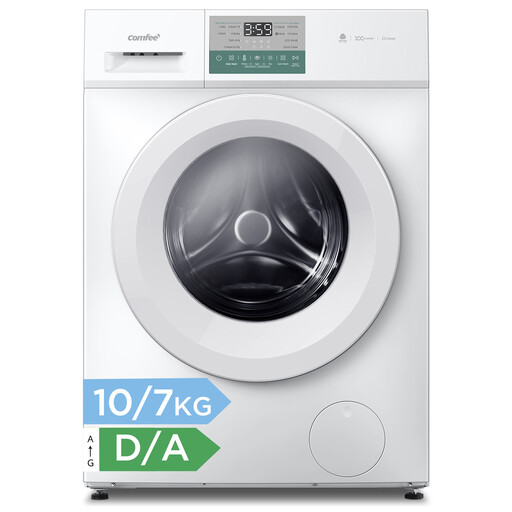 Image unavailable
Worth considering when washing and drying need to fit into a single space. Any load over 7 kg will need to be reduced before drying.
Stated width: 60 cm. Check the other dimensions, as well as the duration and energy specifications for the combined cycle you’d use for your usual laundry.
Start by comparing heat pump tumble dryers if keeping electricity use down is your priority. According to UFC-Que Choisir, they generally use less energy than conventional condenser or vented models, but their cycles can take longer. Check that the capacity and programme durations also suit your laundry routine.
No. This technology needs to send moist air outside through a suitable duct. Before buying, check the model’s instructions and the proposed outlet. If changes to your home are needed, find out what requirements apply.
No. Stacking depends on the model numbers and dimensions of both appliances, as well as having a compatible kit. Bosch, for example, says one of its kits requires a washing machine with a depth of more than 55 cm. This requirement doesn’t apply to every kit or appliance.
Not necessarily, if your model supports direct drainage and there’s a suitable connection available. Electrolux offers a drainage kit for some appliances; check compatibility using the appliance’s PNC number.
Not always. The drying capacity may be lower than the washing capacity. For example, Whirlpool lists an 11 kg washing capacity and a 7 kg drying capacity for the FFWDD 1176258 BCV FR. If the washed load is over the drying limit, you’ll need to reduce it before starting the drying cycle.