What should you look for?
For everyday laundry in a flat, first check where the moist air or condensed water will go. Then compare energy consumption and cycle times based on how often you do your laundry.
Heat pump
Consider this if: you dry clothes regularly without an external air outlet and energy consumption matters more to you than speed.
The trade-off: cycles can take longer. Condensed water goes into a tank or, if the model and installation allow it, into a drain.
Standard condenser
Consider this if: you don’t have an external air outlet and generally shorter cycles would suit your routine better.
The trade-off: according to UFC-Que Choisir, this technology generally uses more energy than a heat pump. You’ll also need to deal with the collected water.
Vented
Consider this if: the room and property allow for a suitable outlet to the outside for hot, damp air.
The trade-off: installation is more complicated and energy consumption is generally higher than with a heat pump, according to UFC-Que Choisir.
| Factor |
What to check |
Who is this important to? |
| Energy consumption |
Compare kWh/100 cycles and the capacity of the exact models you’re considering, as well as the programme you’re likely to use. |
If I do laundry often, I want to limit energy use without ignoring drying time; around 36% of consumers would make this their priority. |
| Installation and water |
Measure the available space and required clearances; check that you can access the tank or that direct drainage is compatible. |
Without a suitable external outlet, I need a machine that fits my space and lets me manage the condensed water; around 29% of consumers would make this their priority. |
| Speed |
Check the programme time for a similar load and fabric type, rather than relying on the presence of a quick-dry programme alone. |
If I need to use my laundry again before the next load is ready, drying time comes before other factors; nearly 21% of consumers would make it their priority. |
| Fabrics and maintenance |
Check that the programmes suit your clothes and that the filters, tank and other parts you need to maintain are easy to access. |
If I need to care for delicate fabrics or want regular maintenance to be easier to fit into my routine, I look at the features of the specific model; around 14% of consumers would prioritise this. |
Tumble dryers to explore on Joybuy
These models give you a starting point for exploring condenser tumble dryers for everyday laundry in a flat, including three labelled as heat pump models. To compare energy consumption and cycle times, check the heating technology and specifications for the Electrolux EDH1018CD.
 Image unavailable
Hotpoint CHD84MWBSEE, 8 kg heat pump
Worth considering if you do laundry regularly and energy consumption matters more than drying speed.
The model name indicates an 8 kg capacity and energy rating C. Check its kWh/100 cycles, programme times, space requirements and the conditions for any direct drainage. The specifications list 64 dB, which is worth considering in relation to the room you plan to use it in.
View on Joybuy
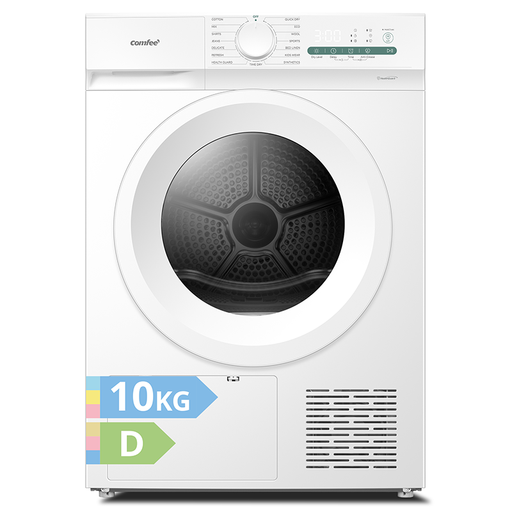 Image unavailable
Comfee' CD10EHP05W-HR, 10 kg heat pump
Worth exploring if your usual loads call for a stated capacity of 10 kg and you don’t have an external air outlet.
The product name indicates energy rating D and mentions UV, refresh and quick-dry functions. To decide whether they suit your fabrics and routine, check the programmes, the load sizes they allow and their cycle times. Also check the noise level, dimensions and how water is handled.
View on Joybuy
 Image unavailable
Comfee CD08EHP05W-HR, 8 kg heat pump
Worth comparing for regular use if a stated capacity of 8 kg is a better fit for your laundry loads.
The product name indicates energy rating D and mentions UV, refresh and quick-dry functions. Check the care instructions for your fabrics, then compare the kWh/100 cycles and the cycle times that matter to you. Also measure the available space and check how the water is collected or drained.
View on Joybuy
 Image unavailable
Electrolux EDH1018CD GentleCare, 8 kg condenser
Worth exploring for an installation without an external air outlet, provided you can access the water tank.
The product name mentions propane refrigerant and OptiSense. Check the heating technology of the exact model before comparing it with heat pump models. The description lists 66 dB and dimensions of 60 × 65 × 85 cm; make sure these suit your room and the clearances required in the manual.
View on Joybuy
Frequently asked questions
Can you install a tumble dryer without a balcony or external outlet?
Yes. You can use a condenser tumble dryer, including a heat pump model, without an external air outlet. The water is collected in a tank or directed into a drain if the model and installation allow it. Check the clearances and installation requirements in the manual. As UFC-Que Choisir points out, a vented model needs a suitable outlet to the outside.
Is direct drainage essential for a condenser tumble dryer?
No. The water can be collected in the appliance’s tank. If you’d prefer direct drainage, check that the model, any accessory you need and your available drain are compatible. Bosch recommends checking compatibility for its kit, which is designed for certain condenser tumble dryers.
Can you connect a vented tumble dryer to your home’s ventilation system?
Don’t plan to connect it unless you’ve confirmed that the connection is suitable for your specific installation and is permitted. A vented tumble dryer must expel hot, damp air through a suitable outlet. Check the manual and ask your landlord or property manager, and don’t block the existing ventilation.
How do you compare the energy consumption of two tumble dryers?
Compare the kWh/100 cycles listed for each model, then consider these figures alongside the capacity and programmes you’ll use. The energy rating letter alone isn’t enough to compare them. Cycle times and noise levels may also affect your choice in a flat.
Can you put a tumble dryer on top of a washing machine?
Yes, if both appliances, their dimensions, the floor and the stacking system allow it. UFC-Que Choisir recommends putting the tumble dryer on top of the washing machine, not the other way round. Follow both manufacturers’ instructions and check that the controls and parts requiring maintenance remain accessible.


