Only room for one appliance
If there’s no space for two appliances in your home, compare the washer-dryer’s drying capacity with the size of your usual loads. UFC-Que Choisir points out that drying capacity can be lower than washing capacity.


If you can fit two appliances, a separate heat pump tumble dryer could suit frequent drying. UFC-Que Choisir says it generally uses less energy than a conventional tumble dryer, although drying usually takes longer. If you only have room for one appliance, a washer-dryer saves space, but the load you dry must stay within its drying capacity, which is often lower than its washing capacity. In either case, check the dimensions, clearances and installation requirements for the exact model.
If there’s no space for two appliances in your home, compare the washer-dryer’s drying capacity with the size of your usual loads. UFC-Que Choisir points out that drying capacity can be lower than washing capacity.
If you can fit a separate appliance, compare its capacity with your usual loads and take cycle times and energy consumption into account. UFC-Que Choisir outlines the trade-offs between tumble dryer technologies.
If you want to stack two appliances in the space taken up by one, check that the stacking kit is compatible with the exact models. Bosch and UFC-Que Choisir point out that whether appliances can be stacked depends on the models and how they’re installed.
Consider one if: you can fit a separate appliance and dry clothes regularly.
Bear in mind: UFC-Que Choisir says these generally use less energy than conventional tumble dryers, but usually take longer to dry clothes.
Consider one if: you want a separate appliance without a vent to the outside.
Bear in mind: UFC-Que Choisir says these generally dry clothes faster, but use more electricity than heat pump models.
Consider one if: you only have room for one appliance and your laundry loads fit within its stated drying capacity.
Bear in mind: In the models it tested, UFC-Que Choisir found drying performance less convincing than with a separate tumble dryer. Most also use water during the drying cycle.
Consider one if: you have an opening to the outside or a ventilation duct.
Bear in mind: UFC-Que Choisir says that simply having a ventilated room is not a substitute for the required connection to the outside.
| Criteria | What to check before you buy | Who prioritises it most |
|---|---|---|
| Available space | Measure the space and access routes. If stacking appliances, check the kit and compatibility of both models. | I only have room for one appliance and want to dry my clothes without adding another appliance on the floor. Around 33% of consumers concerned prioritise available space. |
| Drying capacity | Compare the stated washing and drying capacities, as well as the limits of the programme you plan to use. | I want to dry my usual laundry load without having to split it up. Around 27% of consumers concerned prioritise a suitable drying capacity. |
| Installation | For a vented model, make sure there’s an opening to the outside or a ventilation duct. Follow the manual’s guidance on clearances. | I need to choose an option that works with the actual constraints of my home. Around 20% of consumers concerned prioritise installation. |
| Energy use and cycle time | Compare the energy use and cycle times of comparable programmes. Remember that the energy label for a tumble dryer is different from the one for a washer-dryer. | I dry clothes often and want to weigh up electricity use against how long it takes before I can collect my laundry. Around 20% of consumers concerned prioritise this balance. |
For the models with published specifications, drying capacity is lower than washing capacity. A full wash load could therefore exceed the stated drying capacity.
Compare both capacities and plan the full cycle around the drying capacity and the limits of the programme for the exact model.
If the load exceeds this capacity, you may need to remove some damp clothes or run an additional drying cycle.
Compatibility depends on the models and the stacking kit, not just the width of the appliances.
Check that the manufacturer approves the kit for both models and that the space is suitable for the planned installation.
The energy label scale for tumble dryers changed in 2025, so an older A+++ rating cannot be compared directly with a current A rating.
Compare energy-use figures from product information based on the same scale, and take into account how often you dry clothes. The European Commission says the revised tumble dryer label has applied since 1 July 2025.
UFC-Que Choisir specifies that a vented appliance needs an opening to the outside or access to a ventilation duct.
Only choose this type of installation if the required connection is available, and check the model’s installation requirements in the manual.
The specifications below apply to the models listed; they do not apply to every range from each brand.
Separate heat pump tumble dryers and stacking accessories to consider if you’re planning to stack your appliances.
Washer-dryers to compare if you only have room for one appliance.
The brand offers washer-dryers and heat pump tumble dryers to consider model by model.
French product pages for washer-dryers let you compare the capacities and dimensions of individual models.
Separate tumble dryers to consider if you have enough depth and energy use is a factor in your choice.
This selection includes separate condenser tumble dryers, some of them heat pump models, as well as a washer-dryer so you can compare the two-in-one option.
 Image unavailable
A separate condenser tumble dryer for homes where there’s room for a second appliance.
Capacity: 8 kg. Refrigerant: propane.
 Image unavailable
A separate heat pump tumble dryer for loads that are within its capacity.
Capacity: 8 kg. Energy class stated in the product name: C.
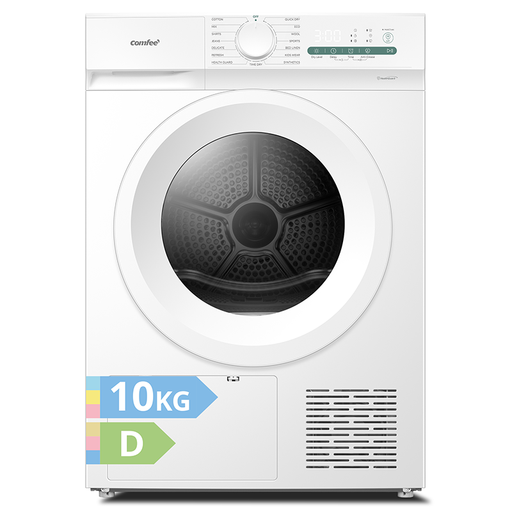 Image unavailable
A separate heat pump tumble dryer for homes where there’s room for a second appliance.
Capacity: 10 kg. Energy class stated in the product name: D.
 Image unavailable
A separate heat pump tumble dryer for loads that are within its capacity.
Capacity: 8 kg. Energy class stated in the product name: D.
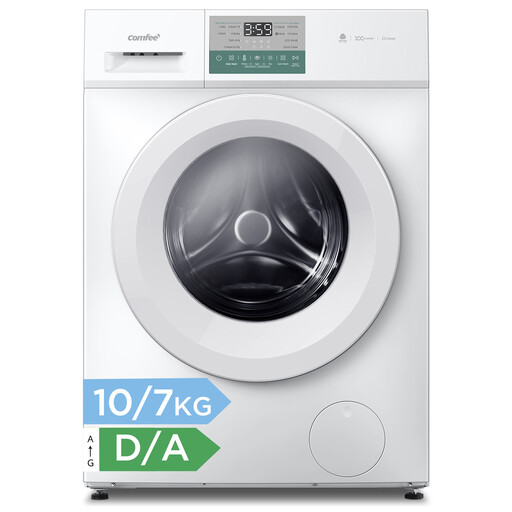 Image unavailable
A two-in-one washer-dryer for homes where there’s room for just one appliance.
Capacity: 10 kg for washing and 7 kg for drying. Stated width: 60 cm.
Not if 8 kg is its washing capacity. For example, Electrolux lists the EW7IW4285BW as having an 8 kg washing capacity and a 5 kg drying capacity. To run both stages without removing any clothes, stay within the drying capacity and the limits of the programme you choose.
No. Check the model numbers of both appliances, the stacking kit and the available space. Bosch says its WTZ27510 kit is designed for a full-size washing machine over 55 cm deep, and advises checking compatibility.
No. Unlike a vented model, it doesn’t need a duct connected to the outside, but you should still check the dimensions, clearances and installation instructions in the manual for your chosen model.
No. In the European Union, washer-dryers have their own rules and have used the A to G scale since 1 March 2021. The revised A to G label for tumble dryers has applied since 1 July 2025. The European Commission and EUR-Lex distinguish between these two categories, so check the label for the exact model.
Follow the manual for your model when cleaning the filters, water tank and condenser. Bosch recommends cleaning the filters on the appliances concerned, although some AutoClean designs don’t have a door filter that needs cleaning after every cycle. So, a self-cleaning condenser doesn’t mean no maintenance is needed at all.