Who might each option suit?
Available space isn’t the only deciding factor: the size of your laundry loads and how often you dry clothes also affect whether a separate appliance is right for you.
Households with room for two appliances
If you regularly dry full loads of washing, a separate tumble dryer lets you choose its capacity independently of your washing machine’s. UFC-Que Choisir distinguishes between heat pump models, which generally use less electricity, and conventional condenser models, which are generally quicker.
People with space for just one appliance
A washer-dryer combines both functions in one place. Before replacing your washing machine, measure the space and check the connections, then compare the washing and drying capacities separately: they’re not the same, as UFC-Que Choisir points out.
Households that mainly dry smaller loads
A washer-dryer can be a good choice if you want to wash and dry clothes in one go without transferring the laundry, as long as your usual load fits within its drying capacity. Also check the length of the full cycle: UFC-Que Choisir says drying takes longer than with a conventional tumble dryer.
What should you check before choosing?
Heat pump tumble dryer
Consider this if : you have space for a separate appliance and often dry laundry; UFC-Que Choisir reports that these models generally use less electricity than conventional condenser models.
Bear in mind : drying can take longer, and the condensed water must be collected or drained, depending on the installation.
Conventional condenser tumble dryer
Consider this if : you can install a separate appliance and prefer a generally shorter drying time, according to UFC-Que Choisir.
The trade-off : according to UFC-Que Choisir, it generally uses more electricity than a heat pump model.
Washer-dryer
Consider this if : you only have space for one appliance for washing and drying, and want to run both programmes in one go with a suitable load.
Bear in mind : UFC-Que Choisir highlights a lower drying capacity than washing capacity, longer drying cycles and water use during drying for most of the models in its test.
Once you’ve chosen the type of appliance, compare the load you need to dry, the available space and the cycle information for the programme you’ll actually use.
| Priority |
What to check |
Your needs |
| Space |
Measure the appliance, its depth with connections and the space needed to open the door. For a washer-dryer, check the water inlet and waste outlet; for a condenser tumble dryer, make sure you can access the water tank or a compatible drain. |
I can’t leave a drying rack in the room. Do I have space for a separate tumble dryer, or only for my washing machine? |
| Drying capacity |
Compare the drying capacity with the largest load you usually wash. For a washer-dryer, don’t confuse it with the washing capacity: Bosch, for example, lists 9 kg for washing alone and 6 kg for the combined cycle on the WNG24402FR model. |
I want to dry my washing without taking out some of the wet clothes or running several cycles. |
| Time and resources |
Compare models with similar capacities and check the programme duration and kWh per 100 cycles. For a washer-dryer, also look at water use and the figures for the wash-and-dry cycle, which differ from those for washing alone. |
If I often run a full cycle, its duration and resource use matter just as much as the space it frees up in the room. |
| Condensed water and maintenance |
Check where the water tank is, whether a direct connection is compatible and how to access the filters. A drainage kit won’t work with every model: Electrolux, for example, only recommends its E2YH01 kit for models with the tank at the top of the appliance. |
I’d rather know before installation whether I’ll need to empty a tank and whether I can clean the filters without moving the appliance. |
| Drying clothes in the room |
If you still occasionally air-dry clothes, choose a suitable, well-ventilated space. ADEME recommends a large, well-ventilated room or one with an extractor fan when drying laundry indoors. |
I want to free up my living space without having to move damp laundry to another occupied room every time. |
A few brands to consider
These examples of ranges and models can help you identify which features to compare; always check the details for the specific appliance you’re considering.
Bosch
Bosch’s French range includes washer-dryers with separate washing and drying capacities, including 8/5 kg and 9/6 kg configurations.
- The Bosch WNG24402FR specifications list 9 kg for washing alone and up to 6 kg for a combined wash-and-dry cycle.
- Check the drying capacity, cycle duration and dimensions of the specific model rather than judging its suitability by its washing capacity alone.
LG
LG’s French range includes washer-dryers in different depths, including the Slim F852SV52IRS, listed as 47,5 cm deep.
- For the F852SV52IRS, LG lists an 8,5 kg washing capacity and a 5 kg drying capacity, making the difference between the two clear.
- LG lists a full-load wash-and-dry cycle time of 7 h 50 and water use of 90 L per cycle for this model. Check these details suit your needs and don’t assume they apply to other models.
Electrolux
Electrolux offers the EW6HI5829SB heat pump tumble dryer, for example, with a listed maximum capacity of 8 kg.
- Electrolux lists 97 kWh per 100 cycles and a water collection tank for this model: two useful details to help you compare and plan your installation.
- The Electrolux E2YH01 drainage kit is only suitable for models with a tank at the top of the appliance. Check exact compatibility before planning a direct drain connection.
Miele
Miele offers heat pump tumble dryers with different installation options, depending on the model and compatible accessories.
- Miele lists an 8 kg capacity for the TEA525WP and shows different installation options, including stacking or placing the appliances side by side.
- If you plan to stack your appliances, check that both models and the stacking kit are compatible. Also check the dimensions and water management requirements of your chosen model.
Appliances for all three options
These Joybuy options include a washer-dryer and separate condenser or heat pump tumble dryers. First check which type of installation will work in your home, then compare the features of each model.
 Image unavailable
Electrolux EDH1018CD GentleCare, 8 kg
A separate tumble dryer to keep laundry off the drying rack, with a listed capacity of 8 kg. Its description mentions a water collection tank and reversible door. Check the exact condenser technology, required clearances and whether a direct connection is possible if you want to avoid emptying the tank.
View on Joybuy
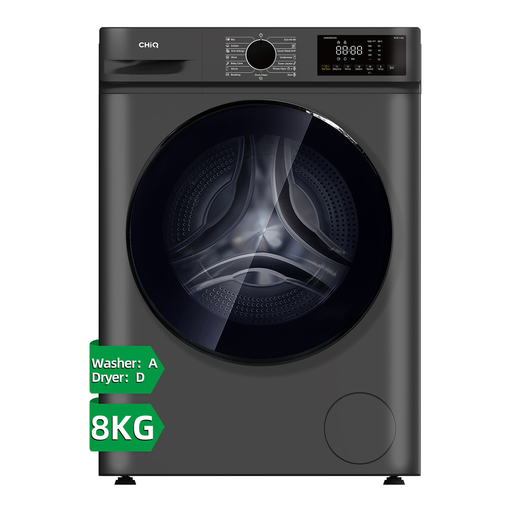 Image unavailable
CHiQ JW85882HG, 8/5 kg washer-dryer
Designed for a single space, this model lists a washing capacity of 8 kg and a drying capacity of 5 kg. So a full washing load can’t be dried all at once at its maximum listed capacity. The width given in the title differs from the figure in the description; check the official dimensions, door clearance and wash-and-dry cycle details before choosing.
View on Joybuy
 Image unavailable
Hotpoint CHD84MWBSEE, 8 kg heat pump
This separate heat pump tumble dryer has a listed capacity of 8 kg. Its description mentions the option of a direct connection for condensed water and an accessible filter. Check the instructions for connection requirements, dimensions and clearances, then look at the energy label for kWh per 100 cycles and programme duration.
View on Joybuy
 Image unavailable
Comfee CD08EHP05W-HR, heat pump
This model is an option if you’re looking for a separate heat pump tumble dryer; its description mentions a double-layer lint filter. The capacity details differ between the product listings, so confirm the drying capacity of the exact model before comparing it with your laundry loads. Also check the dimensions, condensed water management and energy figures.
View on Joybuy
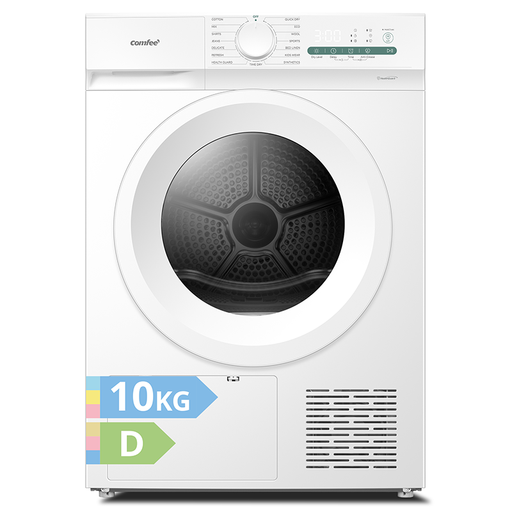 Image unavailable
Comfee CD10EHP05W-HR, heat pump
Another separate heat pump tumble dryer, this model is listed with a double-layer lint filter. The title and descriptions don’t agree on its capacity, so check the capacity of the exact model before planning to dry a full load in one go. Also check its dimensions, condensed water drainage and energy label.
View on Joybuy
Frequently asked questions
Does a heat pump tumble dryer need an outside vent?
No. A heat pump condenser tumble dryer doesn’t need the outside vent used by a vented tumble dryer. The water is collected in a tank or, if the model and installation allow, sent to a compatible drain. You should still follow the clearance and installation instructions in the manual.
What connections does a washer-dryer need?
You’ll need a water inlet, a waste outlet and a suitable electrical supply, just as you would for a washing machine. Check the manual for the position of the connections and the space needed to install the appliance and open the door.
Can a washer-dryer dry a full washing load?
Not necessarily: according to UFC-Que Choisir, drying capacity is generally lower than washing capacity. Bosch, for example, lists a washing capacity of 9 kg but up to 6 kg for a combined wash-and-dry cycle on the WNG24402FR. Compare both capacities before relying on a cycle that doesn’t require you to remove any laundry.
Which figures should you compare for a washer-dryer?
If you plan to use both functions, look at the wash-and-dry cycle figures, including drying capacity, duration, electricity use per 100 cycles and water use per cycle. Don’t confuse these with the figures for washing alone: the LG F852SV52IRS specifications distinguish between the two.
What if you sometimes need to air-dry your laundry?
Set aside a suitable, well-ventilated space for occasional drying rather than leaving laundry up for a long time in an occupied room. For indoor air-drying, ADEME recommends a large, well-ventilated room or one with an extractor fan. This advice doesn’t replace an appliance’s installation instructions.


