Frequent laundry loads
If you want to free up your drying rack quickly and get through several loads, compare capacity, programme times and energy use in practice. Que Choisir covers these factors in its buying guide.


If you do laundry frequently and don’t have an external vent, a heat pump condenser tumble dryer is a good place to start. Que Choisir says it generally uses less energy than a conventional model, although drying can take longer. If you can ventilate your home properly and do laundry less often, air-drying may still be an option. ADEME recommends using a spacious, well-ventilated room or one fitted with an extractor vent. A vented model is only suitable if your home allows moist air to be expelled outside. Check the dimensions and instructions for each appliance too.
If you want to free up your drying rack quickly and get through several loads, compare capacity, programme times and energy use in practice. Que Choisir covers these factors in its buying guide.
To save space without running a vent to the outside, check the dimensions, door opening, condensate water handling and installation instructions for the model. Que Choisir distinguishes between condenser and vented appliances.
If you’re choosing between an appliance and air-drying, weigh up running costs, available space and ventilation. For drying clothes indoors, ADEME recommends using a spacious, well-ventilated room or one fitted with a mechanical ventilation extract vent.
Que Choisir recommends considering the venting type, location, capacity and running costs. For indoor air-drying, ADEME recommends a spacious, well-ventilated room or one fitted with a mechanical ventilation extract vent.
Consider this if: you dry clothes regularly and don’t have an external vent.
Bear in mind: Que Choisir says it generally uses less energy than a conventional model, but cycles can take longer.
Consider this if: a particular model meets your preferred cycle time and is suitable for your home.
Bear in mind: Que Choisir says this technology generally uses more energy than a heat pump model. Compare the energy label and specifications for the model you’re considering.
Consider this if: your home and installation allow moist air to be expelled outside.
Bear in mind: Que Choisir says this type can dry clothes faster, but uses more energy than a heat pump model and needs an external vent.
Consider this if: you have enough space and can ventilate the room properly when drying clothes indoors.
Bear in mind: ADEME says indoor air-drying adds moisture to the air and takes up space too.
| What matters | What to check | Who is it important to? |
|---|---|---|
| Space and installation | Measure the space and doorways; check whether an external vent is required or whether a stacking kit is compatible. | If space is limited, I want to know whether the appliance and its installation will fit in my home; around 30% of consumers make installation their priority. |
| Energy use and running costs | Compare energy-use figures for models on the same basis and take into account how often you dry clothes. | If I run cycles often, I want to understand the impact on my electricity bill; around 30% of consumers put running costs first. |
| Capacity and laundry routine | Match the stated capacity to the load you need to dry and compare the duration of the programme you’re interested in. | When another load is waiting, I want to avoid tying up the drying space for too long; around 30% of consumers prioritise their laundry routine. |
| Continuing to use a drying rack | Assess the space available and how well the room can actually be ventilated. For indoor air-drying, ADEME recommends a spacious, well-ventilated room or one fitted with a mechanical ventilation extract vent. | If I’d rather avoid buying an appliance, I check that air-drying is practical in my home; around 10% of consumers prioritise continuing to use this option. |
Since 1 July 2025, the European Commission says tumble dryer energy labels displayed in shops and online have used the A to G scale. Compare figures for the same programme on a like-for-like basis, rather than directly comparing the old and new scales.
A vented tumble dryer expels moist air outside. Without a compatible vent route, the intended location won’t be suitable.
Check the vent route and the requirements in the instructions before choosing this type of appliance.
The European Commission says tumble dryer labels have used the A to G scale since 1 July 2025. The old classes can’t be read in the same way as the current scale.
Compare appliance specifications using the same scale and check their energy-use figures for the programme you plan to use.
Compatibility depends on the appliances and the stacking kit you choose. Bosch recommends checking the model numbers and dimensions of the intended setup.
Check the model numbers of both appliances, the kit details and the dimensions of the space before making a decision.
ADEME says indoor air-drying adds moisture to the air, while also recognising it as an option when ventilation is suitable.
Consider the available space, room ventilation and how often you do laundry before choosing between a drying rack and an appliance.
The WQG2450SFR is an example of a 9 kg heat pump tumble dryer to compare against the space you have available.
The EW7HI292GW is one 9 kg heat pump setup to consider.
The D3H18C01W is an example of a heat pump model with scheduling and filter-care features.
The RH9V72IXN is a 9 kg heat pump model. Check its dimensions against the space you have in mind.
The TCA520WP 8kg Active is an example of an 8 kg heat pump model.
This selection includes condenser tumble dryers, including heat pump models, for drying clothes at home.
 Image unavailable
Worth comparing if you’re looking for a condenser tumble dryer for regular loads. The title lists an 8 kg capacity and propane refrigerant.
 Image unavailable
Worth considering for regular loads without a dedicated external vent. The title lists heat pump technology and an 8 kg capacity.
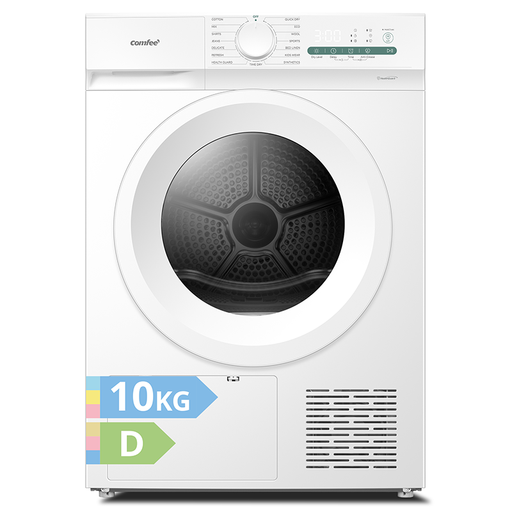 Image unavailable
Worth comparing if you want to dry larger loads without a dedicated external vent. The title lists a 10 kg capacity and heat pump technology.
 Image unavailable
Worth comparing for regular loads if you’re looking for an 8 kg heat pump model. The title specifies the technology and capacity.
Yes, for a vented model: moist air needs to be expelled outside. A condenser appliance doesn’t need an external vent, but its instructions explain the installation requirements and how to collect or drain the water.
Only if the appliances and stacking kit are compatible. Bosch recommends checking compatibility for its kit. Don’t assume that a setup will work with every brand and model.
Check the model’s instructions for cleaning the filters, guidance on the condenser and emptying the water tank, if there is one. A self-cleaning condenser on one model doesn’t mean you can skip the other maintenance instructions.
Since 1 July 2025, the European Commission says tumble dryer labels displayed in shops and online have used the A to G scale. Compare the figures for the eco programme on a like-for-like basis too. The old A+++ to D scale is no longer the one used for current labels.
No. ADEME says air-drying clothes indoors adds a lot of moisture to the air and recommends using a spacious, well-ventilated room or one fitted with a mechanical ventilation extract vent. This recommendation doesn’t mean you always need to buy a tumble dryer.