Households without an external air outlet
In a room without a duct or opening to the outside, your choice is limited to condenser appliances. You’ll also need to consider where to put the dryer and how to manage the collected water.


If you don’t have an external air outlet, a heat pump condenser tumble dryer is worth considering first for regular laundry loads and controlled electricity consumption. A standard condenser model is another option in this situation; a vented dryer requires an external opening or duct, as UFC-Que Choisir points out. Indoor air-drying is better suited to occasional use, provided the room meets the ventilation conditions described by ADEME.
In a room without a duct or opening to the outside, your choice is limited to condenser appliances. You’ll also need to consider where to put the dryer and how to manage the collected water.
When you run regular cycles, it’s important to compare models’ electricity consumption as well as how long they take. UFC-Que Choisir assesses both factors in its tumble dryer tests.
If you do several loads in quick succession, programme duration matters as much as capacity. However, you can only consider a vented dryer if the room has a suitable outlet.
First rule out appliances that aren’t suitable for your room. Then compare energy consumption, cycle times and maintenance for the models still under consideration.
Consider this: for regular cycles without an external air outlet, when running costs matter.
Trade-off: cycles can take longer than with a standard model; compare the programmes on the specific models you’re considering.
Consider this: if the room has no external outlet and drying time is a priority.
Trade-off: electricity consumption may be higher than with a comparable heat pump model.
Consider this: only if an external opening or compatible ventilation duct is available, as required by UFC-Que Choisir.
Trade-off: the need for a duct limits where you can install it.
Keep this as: a supplementary option if you have a large, well-ventilated room or one with an extractor, in line with ADEME’s recommendations.
Trade-off: the airer takes up space while your laundry dries, so it won’t suit you if you want to avoid having it set up all the time.
| Criterion | What to check | Who it matters to |
|---|---|---|
| Installation | Whether an air outlet is needed, dimensions and installation instructions; for stacking, check that the appliances and stacking kit are compatible. | In a small room without a duct, I first need to find an appliance that will fit in the space available. Around 36% of consumers put this compatibility at the top of their requirements. |
| Electricity consumption | Energy rating and kWh/100 cycles on the model’s label, as well as the duration of the reference programme. | When I do laundry frequently, I want to keep electricity use down without overlooking how long each cycle takes. This is the top priority for around 29% of consumers. |
| Speed | Programme duration for comparable loads and a capacity suited to the laundry you usually wash. | If I need my laundry ready between two loads close together, programme duration is my main consideration; around 21% of consumers prioritise speed. |
| Maintenance and fabrics | Access to the filter, condenser maintenance instructions and programmes suitable for the care labels on your clothes. | For a range of fabrics, I want to be able to choose a suitable programme and carry out routine appliance maintenance. Around 14% of consumers put these day-to-day considerations first. |
Without an external opening or access to a ventilation duct, this type of appliance won’t meet the installation requirements highlighted by UFC-Que Choisir.
Before choosing this type of dryer, check that there’s a duct and that it’s compatible with the appliance you’re considering.
Installing or modifying a vent may involve building work.
Two models may not suit the same laundry routine if they have different capacities or programme durations.
Check the energy rating, kWh/100 cycles, capacity and reference programme duration together on the energy label and product information sheet. ADEME recommends using the energy label to help choose household appliances.
Stability and each appliance’s stated limits matter just as much as the space you save. UFC-Que Choisir advises that the tumble dryer should go on top of the washing machine, not the other way round.
Check the instructions, dimensions, floor and compatibility of the stacking system.
You may need a compatible stacking kit.
Maintenance instructions vary by appliance; Electrolux, for example, requires the filter to be cleaned after every cycle on the relevant models.
Check that the filter is easy to access before you buy, then follow the instructions for your model to clean the filter and condenser.
Bosch Electroménager France offers several heat pump tumble dryers, including models in the Série 4 and Série 6 ranges, with capacities of 8 and 9 kg.
Electrolux France offers heat pump tumble dryers with fabric-care programmes that vary by model.
Beko France offers a range of heat pump tumble dryers; some models feature a dual-filter system.
These heat pump or condenser models are suited to regular drying without a permanent airer. Before choosing, compare their capacity, energy consumption and installation requirements with your room and laundry routine.
 Image unavailable
Worth considering if you regularly dry laundry and don’t have an external air outlet.
Stated capacity: 8 kg; energy rating C. Compare the kWh/100 cycles and the duration of the eco programme, then check the dimensions and installation requirements for this model.
 Image unavailable
Worth comparing for regular laundry in a room without an external air outlet.
Stated capacity: 8 kg; energy rating D. Check the kWh/100 cycles, the duration of the eco programme, the dimensions and how the water is collected or drained.
 Image unavailable
Worth considering if you want a condenser dryer and don’t want to rely on a permanent airer.
Stated capacity: 8 kg; the product name mentions OptiSense and a propane refrigerant. Before comparing it with a heat pump model, check the exact drying technology, kWh/100 cycles, the duration of the eco programme and the maintenance instructions.
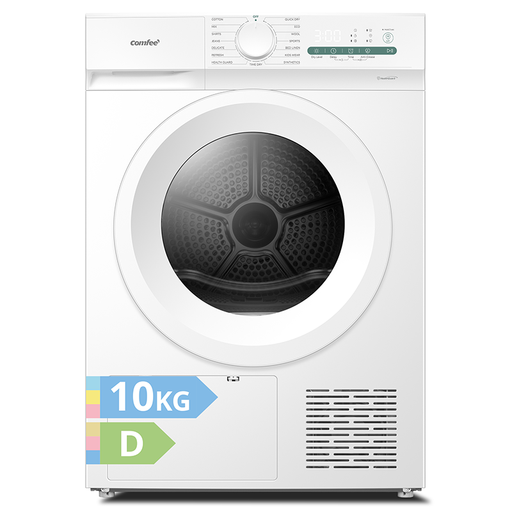 Image unavailable
Worth considering for regular drying, provided this version suits your laundry loads and available space.
Stated energy rating: D. Confirm the exact capacity of this version, as conflicting information is given, along with the kWh/100 cycles, the duration of the eco programme, the dimensions and how the water is managed.
No. According to UFC-Que Choisir, a vented tumble dryer needs an opening to the outside or access to a ventilation duct. If that isn’t possible, consider a condenser model and check its installation instructions.
Not necessarily. Water can be collected in a tank, while the option to connect the dryer to a drain depends on the model and its fittings. Check the technical specifications and the accessories supplied with the model you choose.
Clean the fluff filter as instructed in your appliance’s manual; Electrolux requires it to be cleaned after every cycle on the relevant models. Check the model’s instructions for condenser maintenance too.
It can complement machine drying if you’re happy to make space for it while it’s in use. For indoor drying, ADEME recommends a large, well-ventilated room or one fitted with a mechanical ventilation extractor.