What should you check?
For a flat with no external vent, first make sure the appliance will fit and that you can collect or drain away the condensed water. Then compare models based on how often you dry laundry, the size of your loads and how much maintenance you’re prepared to do.
| Consideration |
What to check |
Who should consider it? |
| Installation and water |
Measure the appliance and the clearance needed to open the door. Check whether the water collects in a tank or can be drained directly using a compatible connection. |
Without an external duct, I want to make sure the appliance will fit and the water will be easy to manage; around 36% of consumers would make this their top priority. |
| Energy consumption |
Compare the energy consumption per cycle or per 100 cycles, along with the corresponding capacity, on labels from the same generation. |
If I dry several loads regularly, running costs are an important part of my decision; around 29% of consumers would put this first. |
| Capacity and duration |
Choose a capacity to suit your laundry loads and check the full-load duration of the Eco programme. Check small-load options separately. |
With large loads or a tight schedule, I don’t want to run extra cycles or be caught out by a longer-than-expected programme; around 21% of consumers would prioritise this drying routine. |
| Maintenance and noise |
Check the manual for guidance on cleaning the filter and condenser, then look at the noise level listed for the model. |
In a small room near living areas, I want to know what needs doing after each cycle and how much noise to expect; around 14% of consumers would make this their top priority. |
Que Choisir distinguishes between condenser dryers, which don’t need a duct to the outside, and vented dryers. A traditional condenser model is still worth considering if you’re looking at an older or second-hand appliance: the European rules for new domestic appliances placed on the market from 1 July 2025 don’t, by themselves, determine the status of these appliances. If you only dry laundry in a machine occasionally, a spin cycle suited to the fabric can also help with indoor drying. However, it won’t replace a tumble dryer if you need quick, predictable results.
Brands to consider
These brands offer examples of features you can compare; they aren’t guaranteed across every model. Always check the exact model number and its installation requirements.
Bosch
Worth a look if water drainage and condenser maintenance are important to you.
- Bosch Électroménager France lists a 9 kg capacity, a self-cleaning condenser and a water drainage hose for the WQG2450SFR.
- These features are specific to this model. Check its depth and how much space it needs in your room.
AEG
Worth considering if you want to compare capacity, energy consumption and the stated care offered to fabrics.
- AEG France’s product information for the TR70DK8CO Série 7000 lists a heat pump, an 8 kg capacity and 119 kWh per 100 cycles.
- AEG says SensiDry dries clothes without unnecessary heat. This is the manufacturer’s claim, so compare the model’s energy label and programmes too.
LG
Consider this brand if you’re looking for a 9 kg capacity and can check the exact dimensions carefully.
- LG France lists a heat pump, a reversible door and a self-cleaning condenser for the RH9V72IXN.
- According to LG France, this model measures 600 × 850 × 660 mm and needs 1 115 mm of clearance with the door open. Remember to measure the available walkway too.
Miele
Explore this brand to compare capacities and options for collecting or draining water across different models.
- Miele France lists tumble dryers with maximum capacities of 7, 8 and 9 kg, depending on the model.
- Check the product information for your chosen appliance to confirm its capacity, connection and maintenance features; these aren’t the same across the range.
Heat-pump tumble dryers on Joybuy
These three heat-pump tumble dryers suit shoppers looking for a condenser dryer without an external exhaust duct. They have different capacities, so before choosing one for your flat, check its dimensions, how it handles water and the details of its Eco programme.
 Image unavailable
Hotpoint CHD84MWBSEE, heat pump, 8 kg
Worth considering if an 8 kg capacity suits your laundry loads and you’re looking for an appliance without an external exhaust duct.
A connection for direct drainage is listed. Check the manual to find out which hose you need, whether it’s supplied and if it’s compatible with your drain.
Measure the space with the door open and check the energy label for consumption and the Eco programme duration.
View on Joybuy
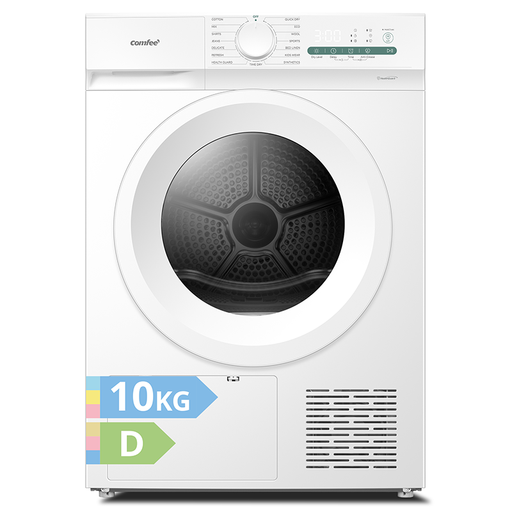 Image unavailable
Comfee' CD10EHP05W-HR, heat pump, 10 kg
Its stated 10 kg capacity is worth comparing with the size of your laundry loads, but don’t assume it will fit your available space.
Check the dimensions and door clearance, then see whether the model collects water in a tank or can drain it away, as stated in its product information.
If you’ll use it often, compare its energy consumption and Eco programme duration on the current energy label.
View on Joybuy
 Image unavailable
Comfee CD08EHP05W-HR, heat pump, 8 kg
Consider this 8 kg model in relation to your usual laundry loads, rather than choosing based on capacity alone.
Before installation, check the dimensions with the door open and how the model collects or drains water.
Also check its energy consumption and Eco programme duration to compare its regular running costs with those of other models.
View on Joybuy
Frequently asked questions
Does a condenser tumble dryer need an external vent?
No. According to Que Choisir, a condenser tumble dryer can be installed without an external air exhaust connection, unlike a vented appliance. However, you’ll need to collect the water in a tank or, if the model and your installation allow it, drain it away.
Can you do without the water tank?
Yes, if the tumble dryer supports direct drainage and you have a compatible drain. Check the manual to see whether a hose or kit is needed and if it’s included. Without a drainage connection, you’ll need to empty the tank as directed in the model’s instructions.
What should you compare on the energy label?
First, compare tumble dryers with labels from the same generation, then look at energy consumption, capacity and the Eco programme duration. For domestic appliances covered by the new A–G label, which applies from 1 July 2025, the European Commission also lists noise levels and condensation efficiency in EPREL.
What maintenance does a heat-pump dryer need?
At the very least, follow the care instructions for your model, even if it has a self-cleaning condenser. Electrolux France and AEG France both highlight the importance of the lint filter and, for the relevant appliances, checking the condenser. A blocked condenser can affect how the appliance works.
Is a room with mechanical ventilation always suitable?
No. Mechanical ventilation doesn’t remove the need to check the tumble dryer’s installation requirements or keep your home’s air passages clear. The French decree of 24 March 1982 on home ventilation provides for air inlets in main rooms and outlets in service rooms. You should also check the manual for the clearances and connections required for your appliance.


