If you dry clothes regularly without an external vent, a heat pump condenser tumble dryer is worth considering if keeping electricity use down matters more to you than a shorter cycle. First check that it will fit in the room, then compare its capacity and the duration of the reference programme. A washer-dryer may be a better option if space is limited, but check its drying capacity separately.
Who are these options for?
Homes without an external vent
If you regularly dry laundry in a room without a vent to the outside, a condenser tumble dryer is worth considering. You’ll need to collect the condensed water and follow the installation requirements for your chosen model, as UFC-Que Choisir points out.
Homes with frequent or large loads of laundry
If you do several loads in a row, choose a drying capacity that suits the amount of laundry you actually wash. The size of your household alone won’t determine the capacity you need: how often you do laundry matters too.
People with space for just one appliance
A washer-dryer could be a good fit if there isn’t room for two separate appliances. However, UFC-Que Choisir points out that its drying capacity is lower than its washing capacity, so you may need to split a full load before drying it.
What should you check before choosing?
For regular drying at home, first check which technology can be installed in your room. Then compare capacity, cycle duration and energy use against your usual laundry loads.
Heat pump condenser
Worth considering: if you dry clothes regularly without an external vent and want to keep electricity use down.
The trade-off: cycles can take longer; depending on the model, condensed water must be collected or drained away.
Standard condenser
Worth considering: if you don’t have an external vent and shorter cycles are a priority.
The trade-off: UFC-Que Choisir says this technology uses more energy than a heat pump; compare the figures for the models you’re considering.
Vented tumble dryer
Worth considering: only if the room allows you to vent moist air outside using a suitable installation.
The trade-off: the vent limits where you can put the appliance; UFC-Que Choisir also notes that this technology uses a lot of energy.
Washer-dryer
Worth considering: if there isn’t enough room for a separate washing machine and tumble dryer.
The trade-off: drying capacity is lower than washing capacity, and drying can take longer than with a separate appliance.
| What to consider |
What to check |
Who is it for? |
| Regular energy use |
Compare kWh per 100 cycles and the duration of the same reference programme for models with similar capacities. |
If I dry clothes often, I want to take account of the electricity used for every cycle, even if a more efficient programme takes longer. Around 27% of consumers put energy use at the top of their list of concerns. |
| Capacity and laundry routine |
Match the drying capacity, in kg, to your usual loads and check how long the reference programme takes. |
If I do laundry frequently or dry bedding, I want to avoid splitting every load and delaying the next one. For around 27% of consumers, handling this volume is their main requirement. |
| Fitting the appliance in the room |
Measure the space and clearances; check whether the technology requires an air vent or a way to manage condensed water. |
If the room has no external vent, I need to choose an appliance that will actually fit before thinking about how quickly it dries. For around 33% of consumers, this compatibility comes before all other criteria. |
| Space taken up |
For a washer-dryer, compare washing and drying capacities, as well as the dimensions with the door included. |
If I only have room for one appliance, I’d rather check how much laundry I can dry than rely on the washing capacity. Around 13% of consumers prioritise this space-saving benefit. |
Mistakes to avoid
-
Choosing a vented dryer without planning for an external vent
A vented tumble dryer sends moist air outside your home, so having a power socket isn’t enough to make the room suitable.
Work out where the vent could go and check the model’s installation requirements before choosing this technology. If there’s no suitable outlet, consider condenser dryers instead.
-
Comparing energy ratings alone
An energy rating on its own doesn’t tell you how much laundry an appliance can dry or how long the programme you’ll use takes. Both matter when comparing two models.
Compare the capacity, kWh per 100 cycles and duration of the same reference programme side by side.
If you use the appliance regularly, its electricity use adds up with every cycle.
-
Confusing washing capacity with drying capacity
A washer-dryer may be able to wash a load that it can’t dry completely in the same cycle. For example, Bosch lists a 10 kg washing capacity but a 6 kg wash-and-dry capacity for the WDU8H500FF.
Size your loads according to the drying capacity listed for the exact model.
-
Assuming condensed water drains away automatically
A condenser dryer may collect water in a tank; whether it can drain directly depends on the model and its fittings.
Check the manual to see whether a hose or kit is included, then make sure the connection you’re planning is compatible.
Brands to consider
These ranges give you a few models to compare. The features mentioned relate to the specific models listed, not every appliance from that brand.
Bosch
Bosch offers heat pump tumble dryers and washer-dryers, two options for different space requirements.
- According to Bosch, the WQG24502FR heat pump tumble dryer has an 8 kg capacity and a stated noise level of 61 dB(A).
- For the WDU8H500FF washer-dryer, Bosch lists a 10 kg washing capacity and a 6 kg wash-and-dry capacity. Compare the figure that matches how you’ll use it.
Electrolux
Electrolux’s heat pump tumble dryer range includes models you can compare by capacity and energy use.
- Electrolux lists an 8 kg capacity and 73 kWh per 100 cycles for the EW9HI783FC.
- These figures apply to the EW9HI783FC. Check the specifications for any other model you’re considering.
Miele
The T1 heat pump range includes models worth considering if you’re looking for a separate 8 kg tumble dryer.
- Miele describes the TWC640WP as an 8 kg T1 heat pump tumble dryer.
- Check the features and water drainage options for the exact model you choose; don’t assume they apply across the whole range.
Beko
Beko offers several drying technologies, making it easier to understand their different installation requirements before comparing models.
- Beko explains that condenser dryers collect the water removed from laundry in a tank.
- According to Beko, direct drainage is only possible on models designed for it. Check the manual for the model you choose.
Tumble dryers available on Joybuy
These separate appliances are suited to regular drying at home without an external air vent. Compare their stated capacities and the installation requirements for each model. Confirm the exact technology used by the Electrolux model before comparing it with the heat pump models.
 Image unavailable
Hotpoint CHD84MWBSEE, 8 kg heat pump tumble dryer
Worth considering if you’re looking for a separate heat pump tumble dryer for loads of up to 8 kg.
Energy rating C. If you want to drain condensed water directly, check the manual for the hose connection requirements.
To compare models for regular use, check the kWh per 100 cycles and the Eco programme duration for this model.
View on Joybuy
 Image unavailable
Electrolux EDH1018CD GentleCare, 8 kg condenser tumble dryer
Worth considering if you need a stated capacity of 8 kg and don’t have an external air vent.
The product name describes it as a condenser tumble dryer and mentions propane refrigerant. Before choosing between a standard condenser and a heat pump model, confirm the technology used by this model in its specifications.
Also compare its energy use in kWh per 100 cycles and the duration of the reference programme.
View on Joybuy
 Image unavailable
Comfee CD08EHP05W-HR, 8 kg heat pump tumble dryer
Worth considering for drying loads of up to 8 kg without an external air vent.
Energy rating D. Before deciding where to put it and how to manage condensed water, check the dimensions and the manual for this model.
Also check its energy use in kWh per 100 cycles and the Eco programme duration so you can compare it with other appliances.
View on Joybuy
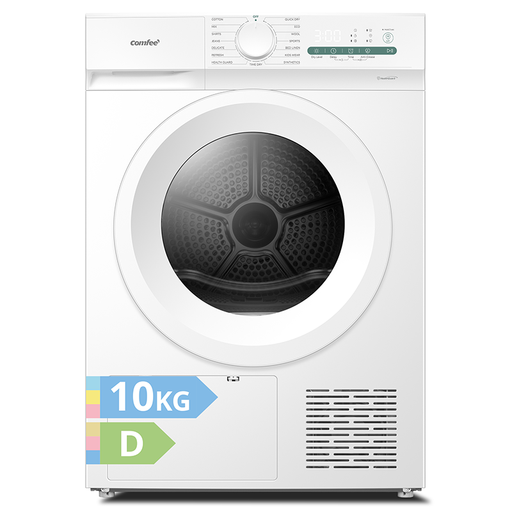 Image unavailable
Comfee' CD10EHP05W-HR, heat pump tumble dryer
Worth considering if you’re looking for a separate heat pump tumble dryer, once you’ve confirmed the capacity of the CD10EHP05W-HR variant.
Capacity details differ, with figures of 8 kg and 10 kg both appearing. Check the capacity of the model on offer before sizing your loads. Energy rating D.
Check the dimensions, condensed water arrangements, kWh per 100 cycles and Eco programme duration before comparing its installation requirements and running costs.
View on Joybuy
Frequently asked questions
Does a heat pump tumble dryer need an external vent?
No, a heat pump condenser tumble dryer doesn’t need an air vent to the outside. UFC-Que Choisir explains that the water removed from your laundry still needs to be collected. Check the manual for the model’s installation requirements and water drainage options.
When can you install a vented tumble dryer?
A vented tumble dryer is an option if your installation allows hot, damp air to be expelled outside. Check the route for the vent and the manual’s requirements before choosing a model; a power socket alone won’t meet this requirement.
Can a washer-dryer dry all the laundry it has just washed?
Not always: its drying capacity may be lower than its washing capacity. For example, Bosch lists a 10 kg washing capacity and a 6 kg wash-and-dry capacity for the WDU8H500FF. Check both figures for the model you’re interested in.
Do you always need to empty the water tank in a condenser tumble dryer?
No, not if the model supports direct drainage and you can connect it in line with the manual. Otherwise, the condensed water collects in a tank that needs emptying. Check exactly what’s included before planning the installation.


