What should you check first?
First, check what the room can accommodate, then compare capacity and cycle times with your laundry routine. The energy label, user manuals and maintenance instructions can then help you choose between models that suit your needs.
| Factor |
What to check |
Your needs |
| Energy use |
Identify the technology, then compare the A to G energy label and the energy use stated for each model. According to Que Choisir, heat pump dryers use less electricity than conventional condenser dryers; how often you use the appliance will also affect your energy use. |
If I often dry laundry in a machine, I want to compare the stated energy use of models suited to my usual load sizes. |
| Installation |
Measure the space and check the manual for clearance, permitted room temperatures and drainage requirements. A vented dryer needs a suitable external air vent; a condenser dryer collects the water or drains it away, depending on its configuration. |
If there’s no external air vent, I need an appliance that can be installed in my room, or an airer if I can make enough space for one. |
| Cycle times |
Compare the capacity, the duration of useful programmes and the permitted load for any quick cycle. Que Choisir says conventional dryers generally dry clothes faster than heat pump models, but check the programmes on the models you’re considering. |
When loads follow one another, a quick cycle is only useful if it can handle the amount of laundry I need to dry. |
| Maintenance |
Check how accessible the filter is, what the instructions say about the condenser and how the water is drained. Electrolux says to clean the filter after every cycle in its maintenance instructions; follow the manual for your chosen appliance for other tasks. |
I want to know what tasks I’ll need to add to my routine, including whether I’ll need to empty the water tank and whether the condenser needs attention. |
| Fabrics |
Check the drying symbol on each care label, then check the programmes and their load limits. As Whirlpool France points out, a delicate programme doesn’t make an item suitable for tumble drying if its care label says otherwise. |
For my delicate items, I need to know which ones can go in the dryer and which will still need to dry on an airer. |
| Indoor air-drying |
Consider how much space an airer takes up and how long you’re willing to wait for your laundry to dry. The Ministry of Ecology recommends ventilating more during and after drying, as this can add moisture to your home. |
If my laundry fits on an airer and I can ventilate the room, I can stick with this option without installing an appliance. |
A closer look at some brands
These examples show the features to check on a specific model; they don’t cover every range from each brand.
Electrolux
On its French website, Electrolux lists the PerfectCare 900 EW9HI783FC heat pump tumble dryer: 8 kg capacity, energy class A and stated energy use of 73 kWh per 100 cycles.
- The product page lists a 5,56 L water tank and a noise level of 60 dB. Compare both figures with your room and preferred drainage method.
- Electrolux gives this model an operating temperature range of 5 °C to 35 °C; check its safety and installation instructions too.
Bosch
The Série 4 WTH83V01FF, listed by Bosch Électroménager France, is an 8 kg heat pump tumble dryer with stated dimensions of 842 × 598 × 613 mm.
- Its product page lists a 40-minute Express programme. Check the manual to see which load size and fabrics it’s suitable for.
- Bosch says this model doesn’t have a self-cleaning condenser. Check its maintenance instructions and drainage method before choosing it.
Beko
Beko France describes heat pump technology as a type of condenser tumble dryer that uses a compressor to heat the air, rather than a heating element.
- This explanation can help you distinguish a heat pump model from a conventional condenser dryer on a product page.
- Beko notes that cycles are longer and maintenance more frequent than with other types of tumble dryer. Check the cycle times and maintenance requirements for the model you’re considering.
Heat pump tumble dryers on Joybuy
These three heat pump models are worth considering if drying laundry on an airer is difficult and you don’t have an external air vent. Compare their stated features with the constraints of your room and your usual load sizes; this selection doesn’t replace checking each model’s manual.
 Image unavailable
Hotpoint CHD84MWBSEE, 8 kg heat pump, class C
For regular laundry loads when air-drying space is limited, this model offers an 8 kg capacity and heat pump technology. Before choosing it, check the duration of the programmes you’ll use, the dimensions, drainage requirements, installation conditions and energy label on the product page.
View on Joybuy
 Image unavailable
Comfee CD08EHP05W-HR, 8 kg heat pump, class D
This model offers an 8 kg capacity and a quick-dry function, which may be useful if you’re doing loads one after another. Check the permitted load and quick-cycle duration, as well as the dimensions, drainage requirements and energy label shown on the product page.
View on Joybuy
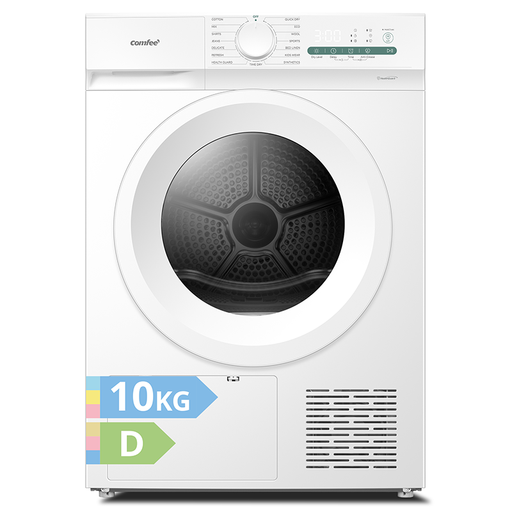 Image unavailable
Comfee CD10EHP05W-HR, heat pump, class D
The product name mentions Refresh and Quick Dry functions. However, descriptions for this model list different capacities: 8 kg and 10 kg. Confirm the exact capacity before comparing it with your usual loads. Also check the quick-cycle load limit, installation requirements and energy label on the product page.
View on Joybuy
Frequently asked questions
Does a heat pump tumble dryer need a vent to the outside?
No. As a condenser dryer, it collects the water removed from your laundry in a tank or, depending on the model, can drain it away. Even so, check the manual for clearance requirements, the permitted room temperature and how the water should be drained.
Can you still compare a conventional condenser dryer with a new heat pump model?
Yes, to understand how they differ in use, but not as if both technologies were subject to the same current rules for being placed on the market. Que Choisir says conventional dryers generally dry clothes faster and use more electricity. According to the European Commission, since 1 July 2025, only heat pump tumble dryers that meet the applicable efficiency requirements can be newly placed on the EU market. This doesn’t mean that appliances already on the market or sold second-hand are no longer available.
Will a delicate programme dry all fabrics?
No. First check the drying symbol on each item’s care label, then choose a programme that follows both the label and the tumble dryer’s instructions. A lower temperature doesn’t override a warning not to tumble dry an item.
What maintenance should you expect?
Clean the filter as directed in the manual. Electrolux says to do this after every cycle in its maintenance instructions. Also check whether your model’s condenser needs attention, how often, and how to empty the water tank or connect a drain hose.
When should you keep an indoor airer instead of buying a tumble dryer?
An airer may still be a good option if you have enough space, the drying time suits your laundry routine and you can ventilate the room. The Ministry of Ecology recommends ventilating more during and after drying laundry indoors, as this can add moisture to your home.


