Homes without an external vent
If the room has no external opening or usable ventilation duct, start by looking at condenser dryers. Then check the installation requirements in the manual for the model you’re considering.


If your home has no suitable external vent, start by considering condenser tumble dryers. A heat pump model is worth a closer look if you dry clothes often and want to keep electricity use down, although cycles are generally longer. A vented dryer is only suitable if the room has an external opening or a usable ventilation duct. Then compare capacity, programmes, the noise level of the specific model and its maintenance requirements.
If the room has no external opening or usable ventilation duct, start by looking at condenser dryers. Then check the installation requirements in the manual for the model you’re considering.
If you regularly put several loads through the tumble dryer, compare the energy use of heat pump models with their programme times and the cleaning they require.
If you run loads back to back or plan to install the appliance near a living area, check the length of the programmes you’ll use and the stated noise level for each model. The type of tumble dryer alone won’t tell you how noisy it is.
First rule out technologies that aren’t suitable for the room, then weigh up energy use against cycle times. Finally, compare capacity, noise and maintenance requirements for the specific models you’re considering, rather than relying on the type of dryer alone.
Worth considering: if you dry clothes regularly without an external duct and keeping electricity use down is a particular priority.
Be prepared for: generally longer cycles. Check the model’s specific filter-cleaning and maintenance requirements too. Beko outlines this trade-off for its heat pump models.
Worth considering: if the room has no external vent and programme times are a bigger factor in your choice.
Be prepared for: generally higher energy use than a heat pump model. Compare the specifications of the models you’ve shortlisted on a like-for-like basis.
Worth considering: only if an external opening or usable ventilation duct allows moist air to be vented outside the home, as UFC-Que Choisir points out.
Be prepared for: this installation requirement, as well as energy use that should be weighed against other technologies.
| Criterion | What to check before buying | What matters to consumers |
|---|---|---|
| Installation | Confirm the drying technology and, for a vented model, check that there is a suitable outlet. Read the model’s installation instructions. | If there’s no usable external vent, I need to choose a model that suits my room before comparing its programmes; around 31% of consumers prioritise this compatibility. |
| Energy use | Compare energy labels and the energy consumption figures for models on a like-for-like basis, taking into account how often you’ll use the dryer. | If I dry several loads frequently, energy use matters more to me than speed alone; around 31% of consumers prioritise this need. |
| Cycle time and capacity | Match the capacity to your washing machine loads, then check the length of programmes that suit your fabrics and preferred level of dryness. | When I have back-to-back loads, I want to dry my usual laundry without running extra cycles or waiting too long; around 23% of consumers prioritise this need. |
| Noise and maintenance | Check the stated noise level in dB and the manual’s instructions for the filters, condenser and water tank. | Near living areas, I want a noise level that suits my routine and cleaning tasks I can keep up with; around 15% of consumers make this their priority. |
A vented tumble dryer sends hot, humid air outside. UFC-Que Choisir says it needs an external opening or access to a ventilation duct.
Check whether this is possible in the room and compare it with the model’s installation requirements before making your choice.
A shorter cycle doesn’t, by itself, tell you how much electricity the dryer uses or how dry your clothes will be.
Compare the programmes you’ll use, how long they take and the energy consumption figures for the models on an equivalent basis.
In a test after 20 cycles without cleaning, UFC-Que Choisir found that some appliances continued to dry clothes, but with longer cycles and higher energy use.
Before you buy, find out which filters, condenser and water tank need maintenance. Once the appliance is installed, follow the manual and heed its alerts.
Noise depends on the specific model and where it’s installed. Electrolux notes that the compressor in some heat pump models may make audible sounds while running.
Check the model’s stated noise level and consider nearby rooms as well as when you plan to use it.
Bosch offers heat pump tumble dryers, including models with AutoClean or EasyClean systems, depending on the specific model.
The DelicateCare range includes heat pump tumble dryers with fabric programmes that vary by model.
Miele’s French heat pump tumble dryer range includes models with stated capacities of 8 kg and 9 kg.
Beko offers heat pump tumble dryers that use condensation, worth considering if your home has no external duct.
These models are for indoor drying without an external vent connection. The selection includes dryers listed as heat pump models and one listed as a condenser model. Compare their capacity with your usual loads, then check the programmes and installation requirements for each model.
 Image unavailable
Worth considering if you regularly dry loads close to 8 kg and don’t have an external vent.
The product name indicates a heat pump, an 8 kg capacity and energy rating C.
Check the manual for programme times and maintenance requirements. Compare the stated noise level with your planned installation location in mind.
 Image unavailable
Worth considering for a room without an external vent if a stated capacity of 8 kg suits your laundry loads.
The product name mentions OptiSense and propane refrigerant. Check the exact technology and energy consumption figures for this model before comparing it with another type of appliance.
Also check the programme times and maintenance instructions for the model.
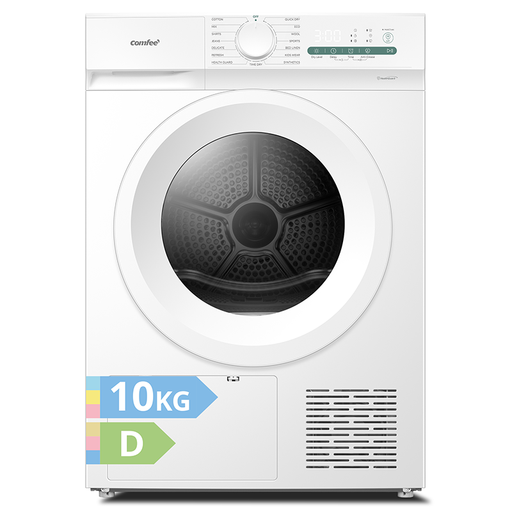 Image unavailable
Worth comparing if your usual loads call for a stated capacity of 10 kg and the room has no external vent.
The product name indicates a heat pump and energy rating D.
Before choosing this capacity, check the programme times for your laundry, the noise level and the maintenance instructions.
 Image unavailable
Worth comparing for loads suited to a stated capacity of 8 kg in a room without an external vent.
The product name indicates a heat pump and energy rating D.
If you plan to use it near living areas, check the noise level, the programme times you’ll need and the cleaning instructions for this model.
According to UFC-Que Choisir, a condenser tumble dryer can run without being connected to an external vent, unlike a vented model. However, follow the requirements for positioning, clearance and connections set out in the manual for your chosen model.
The result depends on factors such as the programme, fabric and load, and can’t be judged by the type of tumble dryer alone. UFC-Que Choisir tests how accurately appliances achieve the selected final moisture level and how evenly they dry clothes. Choose a suitable programme and check these criteria when test results are available.
No. Compare the stated noise level of each model rather than relying on its technology. For example, Electrolux lists 66 dB for its EW7HI6924SD and notes that the compressor in a heat pump model may make some noise while running.
Follow the model-specific instructions for the fluff filter, microfilter, condenser and water tank, where fitted. UFC-Que Choisir found that on some appliances, failing to clean them could lengthen cycles and increase energy use. So even if a model has a self-cleaning feature, it’s still important to read the manual.