Which criteria should you consider first?
Technology is the main difference between buying a new appliance and considering one that is already owned or second-hand: the European Commission states that, since 1 July 2025, new household tumble dryers placed on the EU market must use heat pump technology.
Heat pump condenser
Worth considering: for a new purchase and regular drying without an air duct to the outside.
Bear in mind: cycles may be longer than with older technologies, and the model will have its own maintenance and installation requirements.
Standard condenser
Worth considering: when assessing an appliance you already own or a second-hand one, rather than as the default choice for a new appliance placed on the market since 1 July 2025.
Keep in mind: compare its energy consumption and cycle times on a like-for-like basis before deciding whether it is worth keeping.
Vented
Worth considering: for an existing or second-hand appliance, but only if an appropriate external air outlet can be installed in accordance with its instructions.
Limitation: moist air must be vented outside; simply draining the water does not replace this air outlet.
| Criteria |
What to check before buying |
Which consumers it matters to |
| Space and installation |
Measure the space and check the clearances, ventilation and permitted installation methods in the instructions for the exact model. |
When drying clothes on a line is difficult and the only available space is small or poorly ventilated, I first need to know whether the appliance can operate there as intended. Around 31% of consumers in this situation would put this compatibility first. |
| Energy consumption |
Compare the consumption shown on labels using the same scale, along with the duration of the corresponding eco programme. |
With frequent laundry loads, I want to know how much energy the model uses without overlooking how long drying takes. Around 25% of consumers would prioritise this. |
| Capacity and laundry loads |
Compare the drying capacity in kg with your washing machine’s capacity and the loads you usually dry. |
If I often wash bedding or large loads, I want to avoid having to split every load for drying. Around 25% of consumers would make capacity their top criterion. |
| Cycles and maintenance |
Check how long the programmes you need take for your fabrics, and read the cleaning instructions for the filter and condenser. |
When laundry needs to be done throughout the day, I need to be able to plan cycles and carry out routine maintenance. Around 19% of consumers would put cycle times and maintenance first. |
Brands to consider
These ranges give you options to compare for capacity, installation and maintenance; the features mentioned vary by model.
Bosch
Bosch offers heat pump tumble dryers in France, including models with 8 and 9 kg capacities.
- Some Bosch product listings describe AutoDry or SelfCleaning Condenser and specify the features of the model in question.
- For stacking, check which kit is approved and whether it is compatible with your specific washing machine; a feature listed for one model does not apply across the whole range.
Whirlpool
Whirlpool offers heat pump tumble dryers in several capacities, including 8, 9 and 11 kg, depending on the model.
- The brand lists direct drainage for condensed water on some models. This is worth considering if you want to avoid emptying the tank.
- Drainage, filters and programmes vary by model: check its product listing and instructions before relying on a particular feature.
Miele
Miele offers heat pump tumble dryers with capacities of 8 and 9 kg, among others, which you can compare with your washing machine’s capacity.
- Miele generally recommends choosing a maximum drying load that matches the washing machine’s capacity.
- This guidance does not replace checking the dimensions of your chosen model or the capacity limits for each programme.
Heat pump tumble dryers on Joybuy
These heat pump models are suited to regular drying when drying clothes on a line is impractical. Before choosing, compare their capacity with your laundry loads and check the instructions for your intended installation space.
 Image unavailable
Hotpoint CHD84MWBSEE, heat pump, 8 kg
Worth considering if a stated capacity of 8 kg matches the loads from your washing machine.
Check the dimensions, ventilation requirements, energy label and cycle times for your installation and how you plan to use it.
View on Joybuy
 Image unavailable
Comfee CD08EHP05W-HR, heat pump, 8 kg
Compare it with the Hotpoint if you’re looking for a heat pump tumble dryer rated for 8 kg of laundry.
Check the instructions for installation requirements, then compare the energy label and programme durations on a like-for-like basis.
View on Joybuy
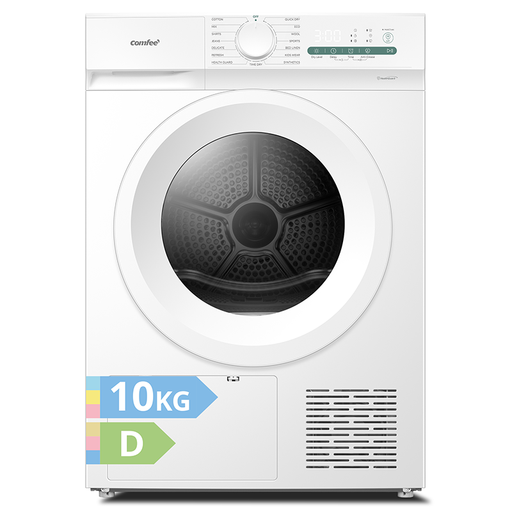 Image unavailable
Comfee CD10EHP05W-HR, heat pump, stated capacity 10 kg
Worth considering for large loads, but confirm its capacity before deciding whether it suits your laundry needs.
The product title states 10 kg, while another description for the same product says 8 kg. Also check the installation instructions and energy label for the exact model.
View on Joybuy
Frequently asked questions
Can you choose a standard condenser tumble dryer when buying new?
For new household tumble dryers placed on the EU market since 1 July 2025, the European Commission states that heat pump technology is required. If a listing is for an older or second-hand appliance, ask the seller to confirm its model and status; this market placement rule does not, by itself, determine what applies to an appliance you already own.
Does a heat pump tumble dryer need a ventilated room?
Yes. Not needing an external air duct does not mean you can ignore the installation requirements in the instructions. Electrolux recommends a sufficiently ventilated room; check the clearances and any model-specific restrictions for the appliance you’re considering.
What capacity should I choose to match my washing machine?
First compare the maximum loads listed for both appliances: Miele generally recommends choosing a drying capacity equal to that of your washing machine to avoid routinely splitting a load. Then check the limits for programmes suited to your fabrics, which may differ from the stated maximum capacity.
Can you connect the condensed water outlet to a drain?
Some models allow this, including certain models offered by Whirlpool, but the feature depends on the appliance. Check its instructions and any accessories you may need; draining water is not the same as venting air.
What maintenance should you expect?
Follow the instructions for cleaning the fluff filter and, where accessible, the condenser. Electrolux notes that insufficient maintenance can contribute to poor drying results; a self-cleaning feature listed by Bosch on some models does not replace other recommended maintenance.


