Households doing several loads of laundry a week
If you dry clothes often, compare electricity use and programme times, as well as the capacity that suits your loads and the maintenance involved.


If you do laundry regularly and don’t have an easy way to dry it, start by looking at a heat pump tumble dryer. According to UFC-Que Choisir, this technology generally uses less electricity, while conventional condenser models usually dry clothes faster. Drying without an appliance is still an option if you have enough space and ventilation. Before buying, also check the space available, the power supply and the maintenance required for your chosen model.
If you dry clothes often, compare electricity use and programme times, as well as the capacity that suits your loads and the maintenance involved.
An appliance can free up the space taken by a clothes airer, provided you can install it properly. If you continue to dry clothes indoors, ADEME highlights the importance of adequate ventilation to limit humidity.
Don’t compare an old A++ or A+++ rating directly with a letter on the new label. The European Commission and Guide Topten France state that the new tumble dryer energy label came into effect on 1 July 2025.
First, check whether an appliance will fit in your home. Then consider how often you do laundry alongside energy use and cycle times.
Worth considering: for regular laundry if keeping electricity use down matters more than how quickly each cycle finishes.
The trade-off: according to UFC-Que Choisir, conventional condenser models usually dry clothes faster.
Worth considering: if generally shorter cycles are a better fit for your household’s routine.
The trade-off: UFC-Que Choisir reports that these models generally use more electricity than heat pump models.
Worth keeping in mind: if you can dry clothes without the airer taking up space for long periods and you have adequate ventilation.
The drawback: ADEME notes that drying clothes indoors adds significantly to the humidity in the air.
| Consideration | What to check | What you need |
|---|---|---|
| Energy use and cycle time | Compare the energy use shown on the current label with the duration of programmes suited to your loads. The European Commission and Guide Topten France state that the new energy label came into effect on 1 July 2025. | I do laundry often and want to take electricity use into account without having clothes tied up for longer than my routine allows. |
| Space | Check the dimensions, the depth with the door open and the clearances specified for the model. Check the required power supply before installation; Promotelec lists tumble dryers among appliances associated with dedicated circuits. | Space is limited at home, so the appliance needs to fit in the space available and remain accessible for loading and maintenance. |
| Loads and programmes | Check the capacity of the exact model variant and the programmes available for the fabrics in your household. Compare cycle times using similar load conditions. | I need to dry my usual loads without choosing a capacity or programme based solely on one advertised cycle. |
| Maintenance | Check the manual for how often to clean the filter and for any other model-specific maintenance. Bosch recommends cleaning the filter in its appliances after every use. | The necessary tasks need to fit into my routine, especially if I use the tumble dryer several times a week. |
| Air-drying | Consider how much space the clothes airer takes up, how long clothes take to dry and how well the room is ventilated. ADEME warns that inadequate ventilation can cause humidity levels to become too high. | If I keep using a clothes airer, I need to be able to dry clothes without blocking the space I need day to day. |
The letters don’t translate directly from one scale to another: according to the European Commission and Guide Topten France, the new tumble dryer energy label has applied since 1 July 2025.
Check the label for the exact model and use its QR code to view the information available in EPREL, the European Commission’s database.
According to UFC-Que Choisir, conventional condenser tumble dryers usually dry clothes faster than heat pump models, but heat pump models generally use less electricity.
For the programmes you use regularly, compare cycle time, energy use and capacity rather than assuming one advertised cycle reflects everyday performance.
The depth with the door open, the required clearances and access for maintenance can all affect whether installation is practical in a small home.
Measure the space, check the model’s manual and have the power supply checked if it isn’t clearly identified. Don’t improvise a connection.
ADEME notes that drying clothes indoors releases moisture into the air, and inadequate ventilation can cause humidity levels in the room to become too high.
Before sticking with this option, check where clothes can be left to dry, how long they’ll be there and how the room will be ventilated.
These three heat pump models are worth considering if you want to dry clothes regularly without using a clothes airer. For each one, check the manual to confirm the installation requirements for your home.
 Image unavailable
The stated 8 kg capacity is worth comparing with your usual loads if you do several loads of laundry a week.
The product title lists a C energy rating, and the description mentions a 2-in-1 Easy Cleaning filter. Check the programme times, the information on the current energy label and the model’s installation requirements.
 Image unavailable
The stated 8 kg capacity and the listed programmes make this model worth considering for regular household loads.
The product title lists a D energy rating. A 30-minute quick-dry cycle is advertised, but check the load size for this cycle, the duration of other programmes and the model’s dimensions.
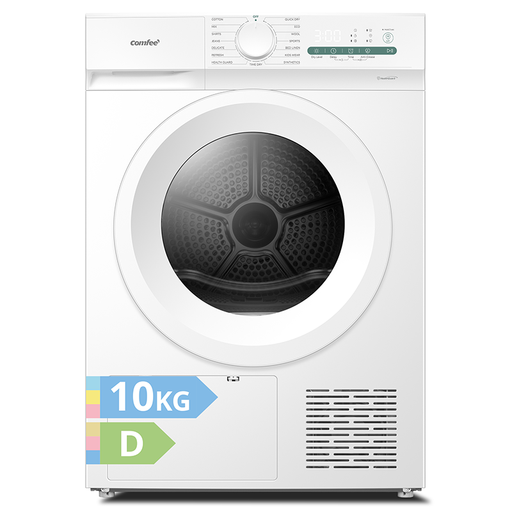 Image unavailable
This heat pump model can be compared with the other options for regular drying, but make sure you confirm its capacity first: the product information lists both 8 kg and 10 kg.
The product title lists a D energy rating. Before deciding whether it suits your home, also check the dimensions, programme times and energy use for the exact model.
Check for the A to G scale on the label for the model you’re considering. The European Commission and Guide Topten France state that the new energy label came into effect on 1 July 2025, so an old A++ or A+++ rating can’t be directly converted to a letter on this scale.
It takes you to information about the model in EPREL, the European Commission’s database. You can check the main details available there to compare specific models, rather than relying on the technology alone.
Don’t assume the socket is suitable. Promotelec lists tumble dryers among appliances associated with dedicated circuits. Check the requirements in the manual and have the power supply checked if its configuration isn’t clearly identified.
Follow the model’s manual for cleaning the filter and any other accessible parts. For example, Bosch recommends cleaning the filter in its tumble dryers after every use; other maintenance tasks depend on the appliance.
Yes, if you have enough space and can ventilate the room while your clothes dry. ADEME says that drying clothes indoors adds significantly to the humidity in the air, particularly when ventilation is inadequate.