For a flat, a heat-pump tumble dryer is often the first option to compare, provided the location meets the instructions in the manual and has sufficient ventilation. UFC-Que Choisir says these models generally use less energy than conventional condenser tumble dryers, but their cycles usually take longer. A conventional model may be suitable if drying time is more important, as long as you check its energy use and A–G energy label. Since 1 July 2025, EU ecodesign rules have applied to new appliances placed on the market, but existing stock is not automatically withdrawn. If no suitable location is available, air-drying also requires a suitable, well-ventilated room.
Who is this choice for ?
People without an external vent
If you cannot install a vent to the outside, a condenser tumble dryer could be an option. However, not needing a vent does not mean you can skip checking the room’s ventilation requirements. UFC-Que Choisir distinguishes between conventional condenser models and heat-pump models.
Households that do laundry frequently
If you run repeated cycles, compare energy use on a like-for-like basis, programme times and capacity to suit your loads. ADEME notes that washing and drying contribute to a household’s energy consumption.
People sharing a small home
You’ll need to balance the appliance’s dimensions with access to the filters and water tank, as well as noise and ventilation in the room. Air-drying may also require enough space and good ventilation, according to ADEME’s advice.
What should you look for before buying ?
| Priority |
What to check |
Who it matters most to |
| Space, installation and ventilation |
Measure the space, door opening and access to the filters. Check the ventilation and instructions in the manual, including for a stacked installation. |
In my flat, I want to know whether the appliance can be installed without blocking the way or trapping moisture. Around 29 % of consumers prioritise an installation that suits their room. |
| Electricity consumption |
Compare kWh per 100 cycles and capacity on the A–G label, then factor in how often you use the appliance. |
If I dry laundry regularly, I look at cumulative energy use rather than just one feature of the appliance. Around 23 % of consumers prioritise reducing electricity use when drying frequently. |
| Cycle time and maintenance |
Compare cycle times for similar loads and programmes. Check the manual to see which filters, tanks and condenser components need maintenance. |
When I have several loads of laundry in a row, I want to know how long drying takes and what maintenance is involved. Around 18 % of consumers prioritise getting through consecutive loads quickly. |
| Capacity and size |
Compare the capacity with your usual loads and check the width, depth and depth with the door open for each model. |
If space is limited, I check that the capacity suits my laundry without restricting movement or access to the drum. Around 18 % of consumers prioritise balancing capacity and size. |
| Noise at home |
Compare the stated noise levels on a like-for-like basis. Check the appliance is stable and consult your building’s rules if the operating times could disturb neighbours. |
If the appliance is near a bedroom or another home, I want to minimise disruption rather than relying only on the stated decibel level. Around 12 % of consumers prioritise reducing noise disturbance. |
Pitfalls to avoid
-
Confusing no external vent with installation in a sealed cupboard
A condenser tumble dryer collects water without a vent to the outside, but a room that is too small or an enclosed, unventilated space can encourage damp. Electrolux advises against installing the appliance in a closed cupboard without ventilation.
Check the model’s manual and the room’s actual ventilation before choosing where to put it. If no suitable installation is possible, consider air-drying in a suitable, well-ventilated room.
-
Comparing energy labels from different generations
Since 1 July 2025, the European energy label for tumble dryers has used the A to G scale. An old A++ or B rating is not directly comparable with the same letter on the new scale.
Check which scale the label uses and compare energy consumption on a like-for-like basis, rather than relying on the letter alone.
-
Choosing a conventional condenser model for speed without considering repeated cycles
UFC-Que Choisir says conventional condenser models generally dry clothes faster than heat-pump models, but usually use more energy. The difference in energy use matters even more if you use the appliance frequently.
Compare how often you dry clothes with energy use on a like-for-like basis and programme times. Also check that the model you’re considering is actually available and suitable for your installation.
-
Assuming ‘self-cleaning condenser’ means ‘no maintenance’
An automatic cleaning function may apply to the condenser on a particular model without removing the need to clean the filters. Electrolux notes that clogged filters can affect drying performance.
Read the manual to see which tasks are automatic and which you still need to do, such as cleaning the filters or emptying the water tank.
Brands to know, based on documented ranges
Bosch
The WQG2450SFR is an example of a 9 kg heat-pump model with a half-load option and automatic condenser cleaning.
- Bosch’s product information gives an energy use of 144 kWh per 100 cycles and a depth of 109,6 cm with the door open for this model.
- Automatic cleaning applies to this model’s condenser and does not remove the need for all maintenance. Bosch says to follow the installation instructions in the manual.
Beko
The D3H28493W is an example of a heat-pump tumble dryer in the brand’s French range.
- Beko states a noise level of 64 dB(A) for this model and describes its double lint filter as helping with condenser maintenance.
- The stated noise level alone cannot predict how loud the appliance will seem in a flat, and having a filter does not mean there is no maintenance to do.
LG
The RH9X76WH is an example of a 9 kg heat-pump model with a self-cleaning condenser.
- LG lists drying modes specific to this model.
- The fast-drying and automatic-cleaning claims come from the brand and depend on the programme and the conditions specified for the model. Don’t assume they apply to the whole range or to a different load.
Miele
The T1 range includes 8 and 9 kg heat-pump tumble dryers, with several configurations depending on the model.
- The range lets you compare different capacities.
- Features vary by model. Check the dimensions and noise level of the model you choose rather than relying on the range name alone.
Whirlpool
The FFTBCM118XBFR is an example of a conventional 8 kg condenser model.
- Whirlpool’s product information gives an energy use of 4,72 kWh per cycle for this model.
- The B rating shown on this product information should not be treated as a B rating on the new A–G scale. Compare the label and energy use on a like-for-like basis.
Joybuy products related to this topic
This selection includes one conventional 8 kg condenser tumble dryer and three 8 or 10 kg heat-pump models. Compare their capacities and stated features with the dimensions, ventilation and instructions in the manual for your home.
 No image available
Electrolux EDH1018CD GentleCare, condenser tumble dryer, 8 kg
Worth considering if you’re looking for an 8 kg capacity and a condenser model that doesn’t need an external air vent.
Capacity: 8 kg. Stated energy use: 235 kWh/year. Stated noise level: 66 dB(A). Reversible door. Stated dimensions: 60 × 65 × 85 cm.
View product
 No image available
Hotpoint CHD84MWBSEE, heat-pump tumble dryer, 8 kg
Worth considering if you’re looking for an 8 kg capacity and want to compare a heat-pump model.
Capacity: 8 kg. Stated energy efficiency class: C. 2-in-1 filter. Stated noise level: 64 dB.
View product
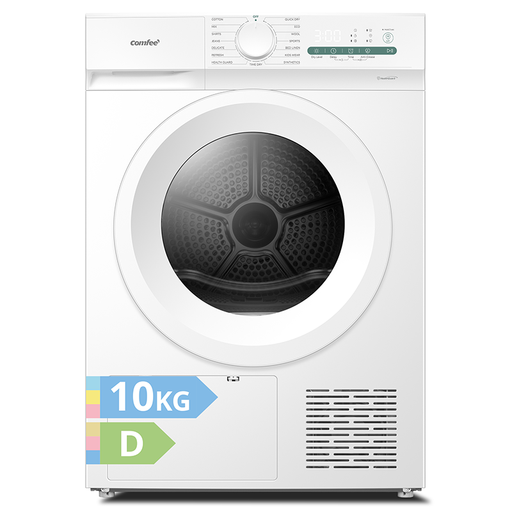 No image available
Comfee' CD10EHP05W-HR, heat-pump tumble dryer, 10 kg
Worth considering if your usual loads make you want to compare a 10 kg capacity with the space available.
Capacity: 10 kg. Stated energy efficiency class: D.
View product
 No image available
Comfee CD08EHP05W-HR, heat-pump tumble dryer, 8 kg
Worth considering if you’re looking for an 8 kg capacity in a heat-pump model.
Capacity: 8 kg. Stated energy efficiency class: D.
View product
Frequently asked questions
Can a condenser tumble dryer work in a room without a window ?
Not necessarily: not needing an external air vent doesn’t guarantee the room is suitable. Check the actual ventilation and the model’s manual. Electrolux, for example, advises against using a closed cupboard without ventilation and warns of a risk of condensation in a room that is too small or poorly ventilated.
Does a condenser tumble dryer need to be connected to a drain ?
Not necessarily: depending on the model and how it is installed, condensed water can be collected in a tank or directed to a drain. Check the manual for the model you choose to see what connection options are available and which accessories are needed.
Why does a cycle take longer than expected ?
The load, spin cycle beforehand, programme and condition of the filters can all affect the time. Electrolux recommends spinning laundry thoroughly before drying. Compare cycle times for equivalent loads and programmes, and follow the maintenance instructions in the manual.
Can I drill through an exterior wall or alter a rented home to install a vent ?
Buying an appliance does not give you permission to alter the property. Article 7 of the law of 6 July 1989 requires the landlord’s written consent to make changes to rented premises or equipment. For work affecting shared areas or the building’s external appearance, ANIL says permission from the co-owners may also be required, depending on the nature of the work.
Can you run a tumble dryer at any time in a shared-ownership building ?
Don’t assume the same permitted hours apply everywhere: check your building’s rules and be considerate of your neighbours. ANIL notes that the building’s co-ownership rules apply to tenants as well as owners.


