Without an outlet to the outside, rule out vented tumble dryers: UFC-Que Choisir says they need a suitable opening or duct. Instead, compare condenser dryers, including heat pump models, based on how often you use them, the space available and the programmes you need. An indoor airer is also an option if you can dry your washing in a large, well-ventilated room or one with mechanical ventilation extraction, as recommended by ADEME.
Who are these options for?
Homes without an external vent
If there’s no suitable opening or duct in the room, look at condenser tumble dryers rather than vented models. That’s the installation distinction made by UFC-Que Choisir. Then check the requirements for the specific appliance and where you plan to put it.
People who often dry their washing in a machine
If you do several loads in quick succession, compare the stated energy consumption and programme times of heat pump and standard condenser models first. The capacity should also suit the loads you actually dry.
Households that prefer an airer
Drying clothes without an electric appliance requires a suitable room. To limit the moisture caused by drying washing indoors, ADEME recommends using a large, well-ventilated room or one with mechanical ventilation extraction.
Which criteria should you consider first?
Start with the room: it needs to fit the appliance or provide the right conditions for air-drying your washing. Next, think about how often you do laundry and the size of each load.
Heat pump
Consider it: if you dry clothes frequently and don’t have an external vent; Whirlpool explains that this is a condenser-dryer technology.
Bear in mind: consider programme times alongside the stated energy consumption. Don’t assume one tells you the other.
Standard condenser dryer
Consider it: if you’re looking for a tumble dryer without an external duct and want to compare the cycle times on offer.
Bear in mind: compare its energy consumption with that of a heat pump model using the same energy-label basis, rather than focusing only on the displayed cycle time.
Indoor clothes airer
Consider it: if you have a large, well-ventilated room or one with mechanical ventilation extraction, in line with ADEME’s recommendations.
Bear in mind: your washing will take up space while it dries and add moisture to the room. A closed, poorly ventilated room isn’t suitable.
| Criterion |
What to check |
Who it matters to |
| Installation in the room |
Measure the space and allow room to open the door. Also check the permitted ambient temperature and read the manual. For stacking, make sure the kit is compatible with both appliances. |
If your room is narrow, you need to be sure you can install and use the tumble dryer; compatible width alone isn’t enough. Around 36% of consumers would prioritise being able to install it. |
| Energy consumption and cycle time |
Compare kWh/100 cycles and the reference programme time using specifications based on the same criteria. A quick programme may only be suitable for a small load. |
If you dry washing frequently, you’ll want to know how much energy the programmes you use consume, even if their times vary. Around 29% of consumers would make managing energy consumption their main concern. |
| Capacity and fabrics |
Compare the capacity in kg with your usual loads and your washing machine. Check the programmes and care labels for your fabrics. |
For large loads or fabrics with different care instructions, you’ll want a suitable capacity and range of programmes without overloading the drum. Around 21% of consumers would put this need first. |
| Air-drying on an indoor airer |
Make sure your washing can dry in a large, well-ventilated room or one with a mechanical ventilation extract vent, in line with ADEME’s recommendations. |
If you’d rather not use a tumble dryer, you’ll need a room with ventilation that can cope with the moisture produced. Around 14% of consumers would make this their priority. |
Mistakes to avoid before choosing
-
Ruling out heat pump models because they use condensation
A heat pump model is a type of condenser tumble dryer, as Whirlpool explains. Don’t confuse it with a vented appliance that needs an external outlet.
First, look at condenser dryers, then compare the technologies and features of the models that will fit in your room.
-
Choosing based only on the time of a quick programme
A short cycle may be designed for a small load or specific fabrics. It won’t necessarily give you an idea of how long your usual laundry takes to dry.
Check the load capacity for that programme, then compare the time and energy consumption of the reference programmes on the same basis.
-
Overlooking access to parts that need maintenance
Maintenance requirements vary by model. For the appliances covered by its instructions, Electrolux says to clean the filter after every cycle and check the condenser at the stated intervals.
Before deciding where to put the appliance, check the manual to see how to access the filter, condenser and water collection tank.
-
Putting an airer in a poorly ventilated room
The ADEME/CSTB study on drying washing describes the moisture that it adds to indoor air. Choosing not to use an electric appliance doesn’t remove the need for suitable room conditions.
Dry your washing on an airer in a large, well-ventilated room or one with mechanical ventilation extraction, as ADEME recommends.
Brands to consider
These ranges offer useful points of comparison for capacity, installation and maintenance. The features mentioned apply to the models named, not every appliance from each brand.
Electrolux
The range includes condenser and heat pump tumble dryers. Compare the installation and maintenance requirements of each model individually.
- Electrolux France says the EDHF2804DC can operate in a room between 5 and 35 °C. Check that this suits the space you have in mind.
- This temperature range doesn’t automatically apply to other models. Check their individual manuals and make sure there’s enough space for maintenance.
Bosch
The WTH83003FF is an example of a heat pump model whose specifications let you check its capacity and dimensions before measuring your room.
- Bosch Home Appliances France lists a maximum capacity of 8 kg and dimensions of 842 × 598 × 613 mm for this model.
- These dimensions don’t tell you how much room you’ll need to open the door, access the appliance or fit it into every alcove.
Whirlpool
The heat pump range helps distinguish this technology from standard condensation without confusing it with a vented appliance.
- Whirlpool France confirms that a heat pump tumble dryer is also a condenser dryer.
- To compare two models, check their individual capacities, energy consumption and programme times rather than relying on the technology type alone.
Miele
Consider the T1 heat pump range if capacity, water collection and the option to stack the appliance are important to you.
- Miele lists the TEA525WP 8kg Active as a heat pump model. Check the water collection or drainage options available for the model you choose.
- To stack it on a washing machine, confirm that both models and the stacking kit are compatible. Capacity alone doesn’t guarantee a suitable fit.
Tumble dryers to compare on Joybuy
These four appliances are options if you’re looking for a tumble dryer without an external duct: three are listed as heat pump models and one as a condenser model. Their capacity is given in the product name. Compare it with your usual loads, then check the installation instructions and energy consumption details for the model you choose.
 Image unavailable
Hotpoint CHD84MWBSEE, heat pump, 8 kg
Worth considering if you want to dry up to 8 kg of washing in a heat pump appliance without an external duct.
The product name lists an energy rating of C. Before choosing it, compare the energy consumption and reference programme time, then check the dimensions, installation requirements and any accessories needed if you want to drain the water.
View on Joybuy
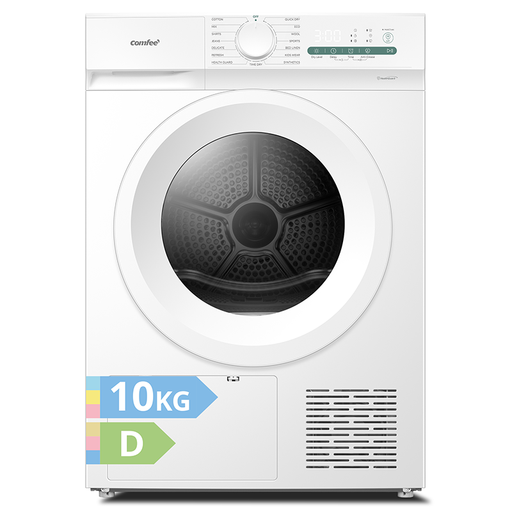 Image unavailable
Comfee' CD10EHP05W-HR, heat pump, 10 kg
The listed 10 kg capacity may suit a household that dries larger loads. Compare it with your washing machine’s capacity and the loads you usually wash.
The product name lists an energy rating of D. Check the energy consumption in kWh/100 cycles, the reference programme time, the space needed for installation and the maintenance instructions in the documentation for this model.
View on Joybuy
 Image unavailable
Comfee CD08EHP05W-HR, heat pump, 8 kg
This 8 kg heat pump model is worth comparing if that capacity suits your laundry loads and your room has no external outlet.
The product name lists an energy rating of D. Check the product information and manual for this model’s energy consumption, programme times, dimensions, water collection system and maintenance requirements.
View on Joybuy
 Image unavailable
Electrolux EDH1018CD GentleCare, condenser, 8 kg
This model is listed as an 8 kg condenser tumble dryer and is worth considering if you need to dry washing without an external duct.
The product name mentions OptiSense and a propane refrigerant, but that alone doesn’t provide a like-for-like energy comparison with the other appliances featured here. Check programme times, comparable energy data and the clearance needed for installation.
View on Joybuy
Frequently asked questions
Can you use a vented tumble dryer without an external outlet?
Not in a home without a suitable opening or duct: UFC-Que Choisir says a vented tumble dryer needs one. Instead, look at condenser appliances, then check the installation requirements for the model you choose.
Does a heat pump tumble dryer need to be connected to an external vent?
No. Whirlpool explains that a heat pump is a condenser-dryer technology. Depending on the model, water may collect in a tank or be routed to a drain as specified by the manufacturer. Any such connection is for water drainage, not an air outlet to the outside.
Do you need to empty a water tank after every drying cycle?
It depends on the model and how it’s installed. Some collect water in a tank, while others may be connected to a drain. Check the manual for how often to empty the tank and what accessories you’ll need for the option you choose.
Can you stack a tumble dryer on top of a washing machine?
Yes, but only if both models and the stacking kit are confirmed as compatible for this installation. Check the required clearances and access too: matching widths alone don’t confirm that they’re compatible.


