Households without a suitable space for drying clothes
You dry laundry in a living room, bedroom or small home, and want to free up the space taken by your airer. ADEME points out that air-drying laundry indoors also adds moisture to the room.


If you’re doing load after load of washing and your airer is taking up valuable space, a heat pump tumble dryer can reduce the time damp laundry spends indoors. Air-drying is still an option if you have a large, well-ventilated room or one with mechanical ventilation extraction, and can wait for your laundry to dry. No tumble dryer is a substitute for effective ventilation.
You dry laundry in a living room, bedroom or small home, and want to free up the space taken by your airer. ADEME points out that air-drying laundry indoors also adds moisture to the room.
You regularly need to dry clothes, bedding or workwear. Choosing a capacity that suits your usual loads and considering programme times matter more than looking at a quick-dry function on its own.
You want to compare energy consumption, noise levels and programmes for your fabrics. Check these features for the specific model rather than assuming they apply across an entire brand.
Choose this if: you do laundry frequently or keeping an airer in your living space is impractical.
Bear in mind: you’ll need space for the appliance, an electrical supply and a way to manage the condensed water, depending on the model.
Stick with this if: you can leave your laundry to dry in a large, well-ventilated room or one with mechanical ventilation extraction, and you’re not in a hurry.
Be prepared for: the airer taking up space and damp laundry adding moisture to your home, as ADEME notes.
If your household regularly dries laundry indoors, first consider the space and ventilation available, then think about how often you do laundry and the practicalities of using an appliance.
| What matters to you | What to check | Who this applies to |
|---|---|---|
| Space and damp laundry | For air-drying, check the room’s ventilation; for an appliance, measure the available space and check its condensation efficiency. | If I dry laundry in a living space, I want to reclaim that room and avoid leaving damp clothes there; around 38% of consumers would make this a priority. |
| How often you do laundry | Compare the capacity in kg with your usual loads and check the Eco programme duration; see whether a small-load option would be useful. | When I have one load after another, I want to get bedding and clothes back into use quickly; this would be the top priority for around 37% of consumers. |
| Energy use, noise and fabrics | Check the model’s weighted energy consumption and noise level, then make sure it has programmes for the fabrics you need to dry. | I want to manage the appliance’s electricity use without overlooking noise near living spaces or the needs of my fabrics; around 25% of consumers would make this their priority. |
Drying less laundry indoors can remove one source of moisture, but it won’t fix poor ventilation or a leak.
If damp or mould persists when you’re not drying laundry, get the underlying problem in your home investigated rather than relying on an appliance to solve it.
The European Commission now rates tumble dryers on a scale from A to G. Ratings from the old scale are not directly comparable.
Compare models with the same version of the energy label, then look at weighted energy consumption, the Eco programme duration and condensation efficiency.
A drum designed for large loads may not be the best choice if you mainly dry small amounts of laundry.
Start with the load size you dry most often, and check for small-load programmes or options if your loads vary.
Water connections, fabric programmes and care features vary between models, even within the same range.
Before you buy, note down the full model number and check its dimensions, noise level, condensate management and the programmes you need.
Heat pump models worth considering if you alternate between regular loads and smaller amounts of laundry.
Heat pump tumble dryers with fabric-care programmes that can help you compare models individually.
A range of heat pump tumble dryers to explore if load size or noise is important to you.
These models are mechanical drying options for households looking to rely less on an airer. Choose a capacity that suits your loads, then check the installation requirements and usage details for the model you’re interested in.
 Image unavailable
Worth considering if an 8 kg capacity suits your regular laundry loads. A white heat pump model with a C energy rating; check its dimensions and condensate management to make sure it suits the space you have in mind.
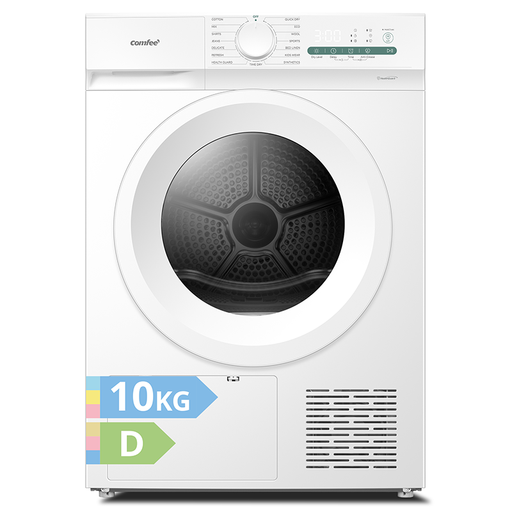 Image unavailable
Worth a look if you regularly dry large loads. A white 10 kg heat pump model with a D energy rating; check that it fits your available space and that its programmes suit your laundry.
 Image unavailable
Compare it with other 8 kg models for regular household laundry. A white heat pump tumble dryer with a D energy rating; check its dimensions, noise level and the conditions for using quick programmes before you choose.
No. It means you won’t need to dry some of your laundry around the home, but it won’t fix inadequate ventilation or a leak. For air-drying, the Q-WASH study supported by ADEME recommends a large, well-ventilated room or one with mechanical ventilation extraction. If signs of damp persist, get your home checked.
No. Condensation refers to how the water is collected, while a heat pump is a drying technology. According to the European Commission, new domestic tumble dryers placed on the EU market since 1 July 2025 must use heat pump technology. This market rule does not necessarily apply to second-hand appliances that were already in use.
Measure the space and any required clearances, then check the noise level and how the model collects or drains condensed water. If you’re considering stacking it, confirm that this is permitted for the appliances in question and find out which stacking kit is required.
Yes, if a professional sells the second-hand tumble dryer to a private individual in France. The French Ministry of the Economy confirms that the legal guarantee of conformity also applies to new and refurbished goods sold under these conditions. Keep the product description and proof of purchase.