What to check before buying
Start by deciding how polished you want the finish to be, then compare the size, heat-up time and tank capacity according to how many garments you need to treat.
| Priority |
What to check |
Your needs |
| Size and set-up |
Compare the weight in your hand, the foldable or compact design and the stated heat-up time. Also check whether the appliance will fit easily in your suitcase or cupboard. |
I want to be able to get the appliance out for a last-minute touch-up without setting up an ironing board. |
| Tank capacity |
Check the volume in ml, whether the tank is removable and how it needs to be filled. Steam output, fabric type and the size of the item affect its actual running time. |
For several garments or a large dress, I would rather avoid interruptions to refill the tank. |
| Level of finish |
Check the compatible fabrics, included accessories and stated limitations for the exact model. A garment steamer smooths light creases; it is not designed to create sharp ones. |
I am looking for quick touch-ups on lightweight clothes, not a replacement for a full ironing session. |
| Reviews and real-world use |
Prioritise reviews that specify the fabric, situation and duration of use. Compare them with the model’s specifications and, where possible, with an independent test. |
I want to know whether the size really suits an outfit taken out of a suitcase, without treating one person’s experience as a guarantee of results. |
Joybuy options for light touch-ups
These Joybuy options are handheld garment steamers designed for touch-ups on clothes hanging up after a journey or storage.
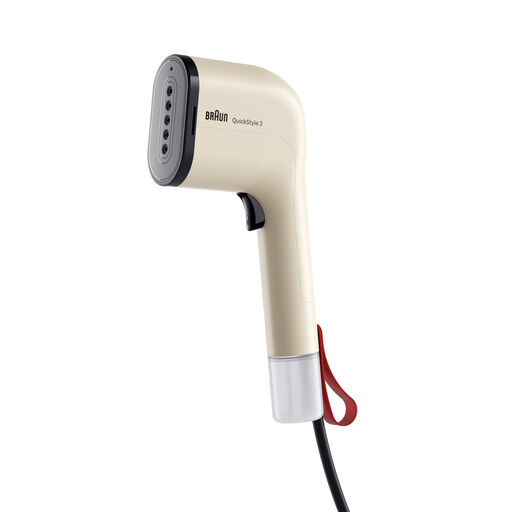 Image unavailable
BRAUN QuickStyle 3 GS3012BG
For touch-ups on hanging clothes without an ironing board, with a design that is easy to store and take with you.
Stated weight: 770 g; stated heat-up time: 30 seconds; stated continuous steam output: 20 g/min; removable 70 ml tank and 2 m cord.
The 70 ml tank may need refilling when treating several garments or a large item. Automatic shut-off is stated to be absent: unplug the appliance after use.
Joybuy
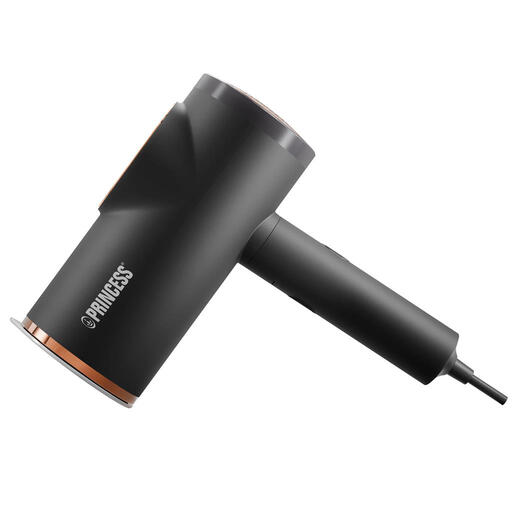 Image unavailable
Princess 332890 foldable garment steamer
This foldable model is suitable for occasional touch-ups after travelling and for use on hanging clothes.
Stated weight: 0,80 kg; stated heat-up time: 30 seconds; removable 0,10 L tank; stated output: 18 g/min and lockable steam button.
The 0,10 L tank may need refilling when treating a large dress or several garments. For sharp creases or difficult fabrics, an iron or steam generator remains more suitable.
Joybuy
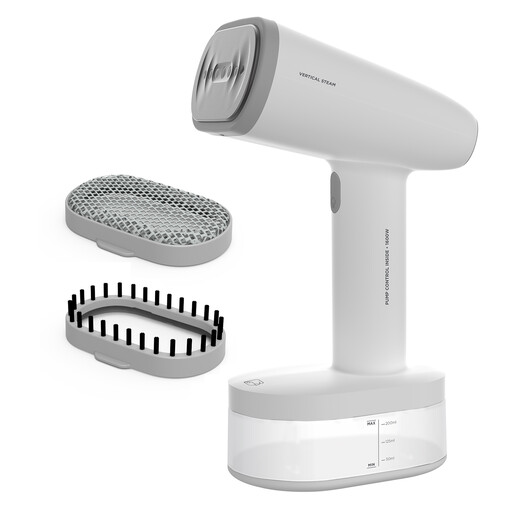 Image unavailable
BLACK+DECKER 1600 W handheld vertical garment steamer
An option for touching up several hanging garments at home, without setting up an ironing board.
Removable 250 ml tank, stated running time of approximately 15 to 20 minutes, stated output of 25 g/min, stated heat-up time of approximately 30 to 45 seconds and continuous steam lock.
Check the weight, dimensions and compatible fabrics if carrying it in a suitcase is important. This type of appliance is still intended for light touch-ups, not sharp creases or intensive ironing.
Joybuy
Frequently asked questions
Can a garment steamer replace an iron for all clothes?
No. For light creases caused by transport or storage, and for fabrics that are easy to steam, it can provide a quick touch-up. It generally cannot create sharp creases or achieve the finish of an iron or steam generator.
Which appliance should you choose for linen, heavy cotton or large quantities of laundry?
A steam generator is better suited if you iron large quantities of laundry or regularly deal with linen, heavy cotton and certain mixed fabrics. A steam iron is a more manoeuvrable and less bulky alternative for less intensive, structured ironing.
What should you check on a handheld garment steamer for your suitcase?
Check the weight you will be carrying, heat-up time, steam output, tank capacity, whether the tank is removable, and the fabrics and accessories listed for the exact model. These figures help you compare models, but they do not guarantee the same results for every fabric or the same number of garments.
Are customer reviews useful after travelling?
Yes, for identifying specific situations such as a lightweight outfit creased in a suitcase, but not for establishing overall performance. Look for reviews that specify the fabric and context, then compare them with the technical specifications and an independent test where available.
What should you do with a garment steamer at the end of its life in the UK?
Do not put it in your household waste. Electrical and electronic equipment can be taken to a recycling centre or collection point, returned to a retailer or passed on to a social enterprise.


