
Livraison le jour même ou le lendemain

Qualité garantie

Débloquez vos offres de bienvenue: Livraison GRATUITE | Jusqu'à -80 % | 30 jours d'essai gratuits à JoyPlus
Téléchargez l'application
Whether you're travelling, closing an international deal, or just chatting with someone from another culture, the language barrier can quickly turn a great opportunity into a frustrating challenge. Wireless translator earbuds promise to shatter these barriers. The problem: the market is flooded with marketing promises that too often lead to disappointing purchases. As a product expert at Joybuy, my mission is to guide you through this tech jungle so you can make the right choice.
Before you buy, let's review the most common pitfalls to avoid investing in a gadget that will end up at the bottom of a drawer.
To avoid these disappointments, here are the technical specifications that truly make a difference in daily use.
The heart of the device is the AI translation engine. The translation quality depends less on the number of languages and more on the sophistication of the AI powering it. Find out which translation engine is used and check if it requires you to use a smartphone app. The Bluetooth version is also a crucial point. A recent standard like Bluetooth 6.0 ensures a more stable, faster connection and reduced latency: a winning combination for truly instant translation.
Good Bluetooth travel earbuds must be versatile. Active Noise Cancellation (ANC) technology is no longer a luxury; it's a necessity. It isolates you from ambient noise (aeroplane engines, the buzz of a café) to ensure clear conversations and an immersive music experience. Prioritise models that specify the level of reduction in decibels (dB) and offer adaptive modes. For audiophiles, Hi-Res Audio certification is a guarantee of superior sound quality.
Battery life is critical, especially when you're on the move. Look at the battery life of the earbuds themselves, but also the total battery life provided by the charging case. Good battery life, combined with fast charging, will save you a lot of hassle. Finally, for worry-free use outdoors or during sports, a waterproof certification like the IPX5 standard is a real bonus.
Rather than an exhaustive list, we've chosen to identify the ideal product for specific needs.
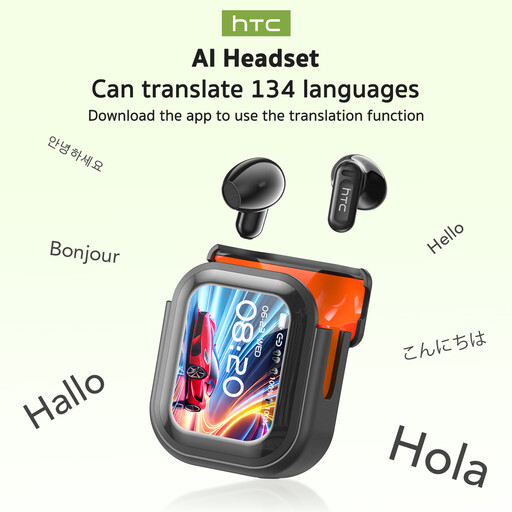
Why we chose it: For the traveller, versatility is king. This model checks all the boxes: AI-powered translation for 135 languages (via the app), effective hybrid active noise cancellation for planes and subways, and a massive 55-hour battery life with the case. The ideal travel companion.
It doesn't fall for the trap of unlimited offline translation; it relies on a connected app to cover a maximum number of languages. Its adaptive ANC technology solves the problem of inaudible conversations in noisy places.
The LED touchscreen on the case, which lets you control certain functions without taking out your smartphone, is a real plus when travelling. Its IPX5 resistance protects it from the elements.
Why we chose it: For a professional, clarity and efficiency are paramount. Here, the 6-mic, AI-enhanced call technology ensures a crystal-clear voice during calls, even in a busy open-plan office. The multipoint connection (Bluetooth 6.0) lets you switch effortlessly between your computer and smartphone—a real productivity booster.
It sidesteps the poor audio quality trap with its advanced microphone system. Its low latency ensures perfectly smooth video conferences and translations, without the awkward delays that can derail a professional exchange.
Its smart noise cancellation offers dedicated modes, like 'Café' mode, which filters out background conversations and noise so you can stay focused. Ideal for remote work on the go.
Discover our full selection of products that meet our demanding selection criteria and current safety standards.
1. How do these translator earbuds work, exactly? Most work in tandem with a smartphone. You connect them via Bluetooth to your phone, which must have a dedicated app installed. When you or the person you're speaking with talks, the earbud microphones capture the voice, the app processes it through its AI translation engine, and sends the translation directly to your ears.
2. Is the translation truly instant? The term 'instant' is a bit of a marketing exaggeration. There's always a micro-latency—the time it takes for the device to capture, send, process, and translate the sentence. On good models, this delay is less than a second, allowing for a nearly natural and fluid conversation.
3. Is an internet connection always required? Yes, for most languages and to get the best translation quality, an internet connection (Wi-Fi or 4G/5G) is essential. Some models offer 'language packs' to download for offline use. Be aware, these packs are often limited to the most common languages, and the translation is less nuanced. Be sure to check this point before buying if you often travel to areas with poor coverage.