
Livraison le jour même ou le lendemain

Qualité garantie

Débloquez vos offres de bienvenue: Livraison GRATUITE | Jusqu'à -80 % | 30 jours d'essai gratuits à JoyPlus
Téléchargez l'application
For a motorhome, caravan, trailer or lorry, checking tyre pressure is less straightforward than with a car. The wheels may be far from the driving position, difficult to access or subject to varying loads. A TPMS tyre pressure monitoring system displays pressure and temperature in real time, while alerting you to the slightest variation.
However, not all models meet the same needs. Here are the criteria to consider to avoid buying the wrong system, along with a selection designed for different uses.
A 4-sensor TPMS kit is generally suitable for a car, small van or certain vehicles towing a light trailer. For a motorhome with a twin rear axle, a caravan or an articulated vehicle, four sensors can quickly prove insufficient.
Before ordering, count all the wheels you need to monitor, including those on the trailer. TPMS configurations with 4, 6, 8 or 10 sensors are designed for very different requirements. Some systems accept additional sensors, but this must be confirmed in the product specifications.
The distance between the wheels and the display is not the only factor to consider. The chassis, metal components, trailer and radio interference can weaken transmission. On a long vehicle, a TPMS signal repeater is therefore highly recommended.
Also check the maximum supported length. Some models are designed for vehicles of around 20 feet, or nearly 6 metres, while others are intended for combinations under 50 feet, or approximately 15 metres.
A monitor capable of displaying values in real time is not necessarily suitable for highly inflated tyres. The Tymate models featured here cover up to 0–8 bar or 116 PSI, according to their product specifications. GUTA systems designed for long vehicles state a range of up to 0–14 bar or 203 PSI.
The recommended pressure remains the pressure specified by the vehicle, trailer or tyre manufacturer. The range covered by the TPMS simply needs to include it, with sufficient margin.
External TPMS sensors screw onto the valves after the original valve caps have been removed. They are easy for anyone to install, and their battery, often a CR1632 or CR2032, can be replaced. On the other hand, they are exposed to splashes, impacts and theft. Product specifications generally recommend metal valves, particularly for heavy vehicles.
Internal sensors are fitted inside the tyre and require professional intervention during installation. A system designed for external sensors should therefore not be presented as compatible with an internal installation.
Complete tyre pressure and temperature monitoring allows you to track several parameters: under-inflation, over-inflation, rapid leaks, excessive temperature and sensor battery level. Thresholds may be fixed or calculated automatically based on a reference pressure.
Several Tymate and GUTA devices state that they offer automatic calibration of the reference pressure, with relative alerts at –15% for low pressure and +25% for high pressure. This function simplifies setup, but does not remove the need to check the pressure when cold with a suitable pressure gauge.
A solar-powered TPMS system can reduce the need to recharge the monitor, provided it also offers a backup power supply or cable charging. Check the battery capacity, charging time and screen readability, particularly if the device is to remain on a dashboard exposed to sunlight.
Also remember to check your vehicle’s voltage. Several kits are designed for 12 V installations. They are not directly suitable for 24 V lorries without an appropriate device, in line with the restrictions stated by the manufacturers.
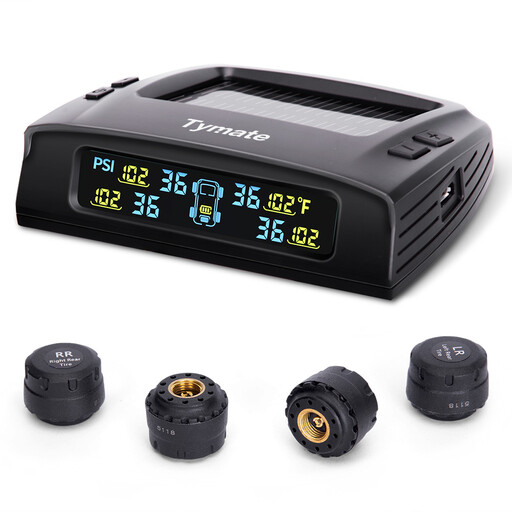
Why this choice suits this profile: This kit is suitable for cars, SUVs and shorter vehicles that need a simple installation on four valves.
The specifications state a range suitable for vehicles up to 20 feet and a range of 0–116 PSI, reducing the risk of incompatibility.
Colour screen, leak and overheating alerts, external CR1632 battery-powered sensors and USB-C monitor charging.
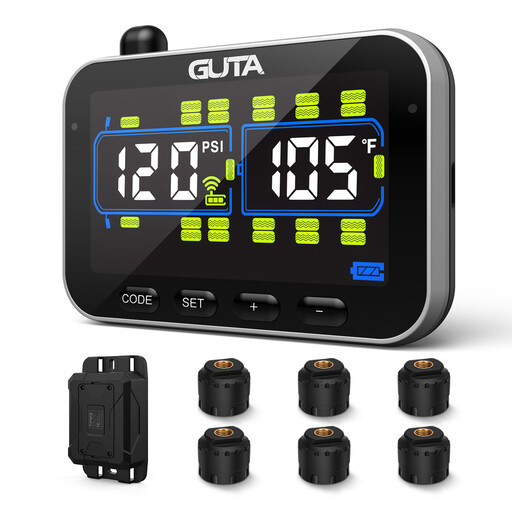
Why this choice suits this profile: It is aimed at motorhome and small caravan owners who want to monitor more wheels on a larger screen.
Its repeater improves transmission across long vehicle combinations, while the stated range reaches 0–203 PSI.
78 × 44.5 mm colour screen, six stated alerts, CR2032 sensors and monitor battery life of up to approximately 15 hours.
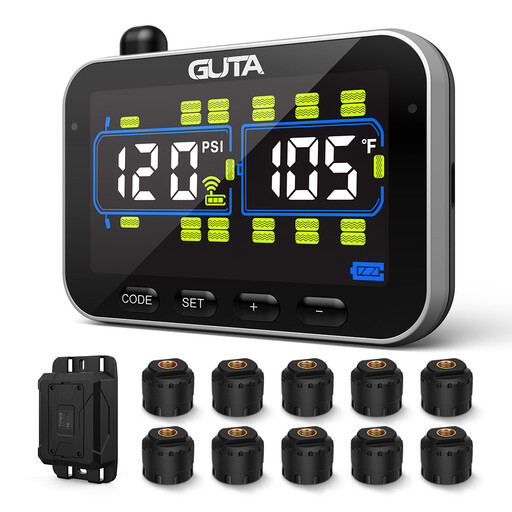
Why this choice suits this profile: This configuration is intended for semi-trailers, lorries, motorhomes and combinations with numerous wheels.
The ten sensors and repeater meet the demands of a long vehicle, provided that 12 V compatibility and the recommended valves are observed.
Stated range of 0–203 PSI, temperature range of –40 to 105 °C according to the specifications, pre-paired sensors and six alert categories.
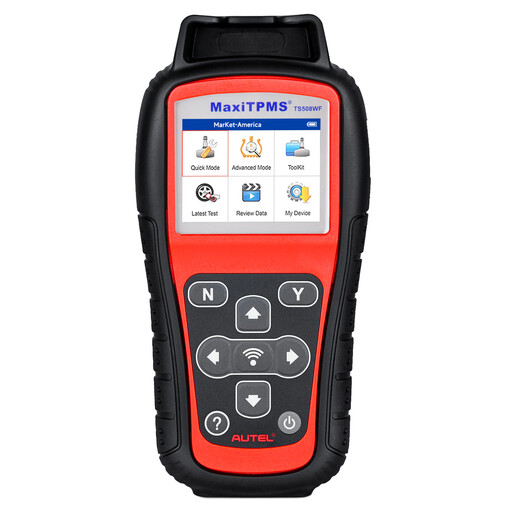
Why this choice suits this profile: This tool is designed for workshops that need to diagnose, activate, programme and relearn TPMS sensors.
This is not just a display unit: the specifications mention data reading, TPMS codes and several relearning procedures.
Wi-Fi connection for the stated updates, support for 315/433 MHz frequencies and programming of Autel MX sensors.
We have brought together a complete, real-time updated selection of products that meet these strict criteria, as well as European safety regulations.
Yes, provided that the kit supports the number of wheels, operating pressure and total length of the combination. For a caravan or trailer that is far from the towing vehicle, a repeater can improve transmission. Metal valves are often recommended for screw-on sensors.
Battery life depends on usage, temperature and the model. The specifications for the featured products state approximately two years for some CR1632 batteries and up to around four years for several CR2032 sensors. This estimate does not remove the need to monitor the low-battery alert.
Not necessarily. A pre-paired kit can be used immediately after installation. However, replacing an original sensor or carrying out work in a workshop may require a TPMS diagnostic tool or a TPMS sensor programming tool, capable of activating, copying, programming or relearning the ID according to the vehicle.