
Livraison le jour même ou le lendemain

Qualité garantie

Débloquez vos offres de bienvenue: Livraison GRATUITE | Jusqu'à -80 % | 30 jours d'essai gratuits à JoyPlus
Téléchargez l'application
A Torx bit set might seem easy to pick: a few sizes, a case and an attractive price. Yet a range that is too limited or poorly suited can complicate a car repair, damage a screw, or leave certain bits gathering dust at the back of a drawer.
The requirements are not the same whether you are maintaining a car, assembling furniture, servicing a machine or repairing a laptop. So before comparing sets, it is worth checking the profiles covered, the type of drive and the quality of the storage.
A set that boasts a high number of pieces is not necessarily comprehensive. Some manufacturers count adapters, bit holders and duplicates separately. You need to look at the detail of the sizes and profiles on offer:
A set of Torx sockets covering several profiles can therefore be suitable for jobs that require more torque than a simple screwdriving bit.
A bit intended for a precision electric screwdriver does not face the same stresses as a Torx socket mounted on a 1/4-inch ratchet. The interface must match the tool you are using, without excessive play.
For automotive or mechanical work, check in particular:
Forcing a small bit onto a seized screw can distort the recess, or even cause premature breakage.
A black or shiny finish does not, on its own, guarantee the durability of a tool. The most revealing information concerns the material and the design. For regular use, S2 steel is commonly used for bits because of its hardness, while Cr-V steel often equips sockets that are subjected to greater forces.
This does not mean you can use each piece outside its intended scope: a precision bit will never replace a socket designed to withstand high torque. A sturdy case with clearly marked slots also helps prevent loss and size errors.
For versatile use, choose a set that covers both the small sizes intended for electronics and the larger formats used in mechanics. A range from T6 to T70, for example, is extensive, but check that the intermediate sizes you need are actually included.
Bits for electronics are generally compact and used with a slim handle or a precision electric screwdriver. For working on a car, motorbike or machine, external sockets and larger sizes will often be more relevant.
The material is an interesting criterion, but it is not enough to determine the lifespan of a set. Also examine:
A surface treatment, such as black phosphate, can protect the piece and make it easier to maintain. After use in a damp or dusty environment, it is still best to wipe the tools clean before storing them.
A truly practical bit set should let you find the right reference in seconds. Sizes engraved on the sockets and clearly identified slots are especially welcome when working on site or in a shared workshop.
For a car repair kit, choose a case that holds the pieces securely and withstands being moved around. For electronics, a compact format organised by small sizes reduces the risk of mixing up bits.
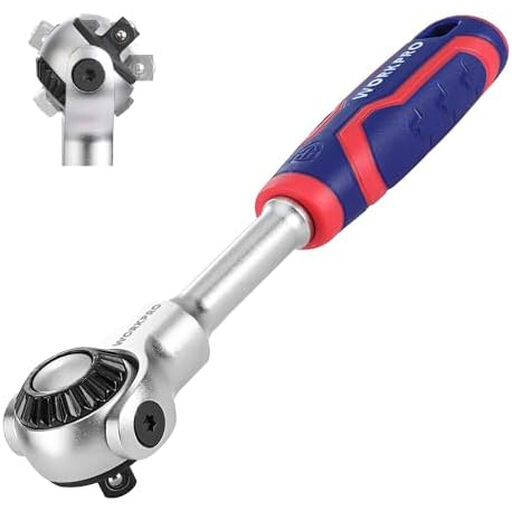
Why this choice suits this profile: This 1/4-inch ratchet handle is ideal for small household tasks and everyday assembly jobs. It lets you start with a handy tool without investing in a bulky set.
Its clearly defined format stops you paying for unnecessary features when your needs are limited to everyday screwdriving tasks.
The product listing mentions a 1/4-inch drive and a 72-tooth mechanism. Its compact handle is practical for everyday DIY.
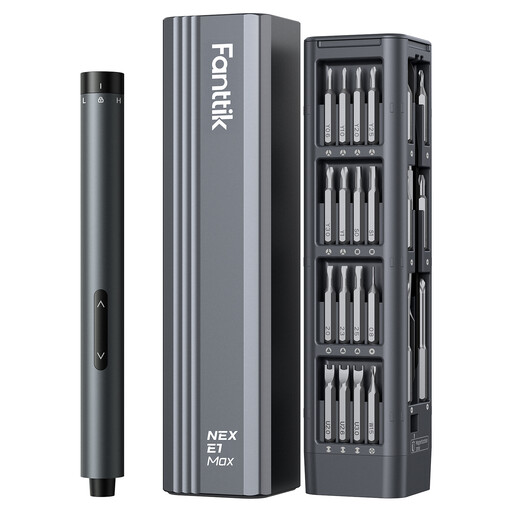
Why this choice suits this profile: This precision electric screwdriver is aimed at those who regularly repair phones, cameras, watches, laptops or circuit boards.
Its 50 magnetic bits and dedicated storage reduce the risk of choosing the wrong small recess or losing a piece during a repair.
The product listing states a 200 rpm motor, two electric torque levels and a 350 mAh rechargeable battery. The bits are made from S2 steel.

Why this choice suits this profile: This set is aimed at mechanics, maintenance technicians and DIYers who move between car repairs, machinery, garden equipment and more varied projects.
The inclusion of standard, security, Torx Plus profiles and external sockets means you do not need to buy multiple sets to cover different types of fasteners.
The set includes 60 pieces, 1/4, 3/8 and 1/2-inch drives, and sizes ranging from T6 to T70, TT6 to TT70, TP8 to TP60 and E4 to E24. The bits are stated to be S2 steel and the sockets Cr-V steel.
We have compiled a comprehensive, real-time selection of products that meet these demanding criteria, while also complying with European safety regulations.
Standard Torx has a six-point star-shaped recess. Security Torx bits usually have a central hole, designed for screws with a pin. Torx Plus is based on a different geometry and is therefore not interchangeable with all standard Torx profiles.
For automotive mechanics, look for a set offering several sizes, external sockets and a drive compatible with your ratchet wrench. The 1/4, 3/8 and 1/2-inch formats can cover different torque levels, but the tool should always be chosen according to the size of the fastener and the manufacturer's recommendations.
Use each bit with the matching recess, keep it well aligned with the screw and avoid improvised extensions. After use, remove dust and moisture, then return each piece to its slot. A well-organised set also makes it easier to spot worn or deformed pieces.