
Livraison le jour même ou le lendemain

Qualité garantie

Débloquez vos offres de bienvenue: Livraison GRATUITE | Jusqu'à -80 % | 30 jours d'essai gratuits à JoyPlus
Téléchargez l'application
Whether you're a seasoned auto mechanic, a weekend motorcyclist, or a meticulous cyclist, you know that precision isn't an option—it's a necessity. Tightening to the correct torque guarantees both your safety and the longevity of your equipment. However, the market for torque wrench sets is a minefield, capable of turning a good investment into a source of endless frustration.
Before you pull out your credit card, it's crucial to read between the lines of product descriptions and focus on what truly matters. Here are the classic mistakes to avoid to make the right choice.
To get a torque wrench kit that's built to last, focus on these three essential points.
Torque, expressed in Newton-metres (Nm), is the rotational force you apply to a bolt or nut. It is imperative to choose a wrench with a range that matches your most common tasks.
The choice of mechanism directly impacts ergonomics and precision.
For professional mechanical tools or serious use, precision is non-negotiable. Aim for a certified tolerance of ±4%, which is a good standard. The best tools go down to ±3% or less. Demand an individual, dated calibration certificate: it's proof that your wrench has been properly tested and adjusted at the factory.
To help you make your choice, here is our selection of sets that check all the right boxes, for three distinct user profiles.
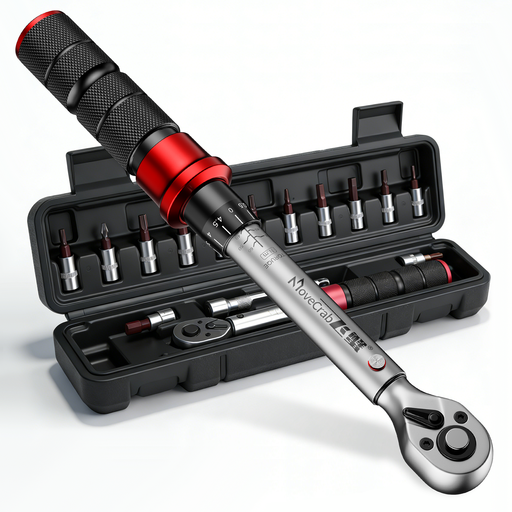
The perfect companion for cyclists who pamper their high-end equipment. Its 2 to 20 Nm torque range is perfectly calibrated for delicate components (stems, seat posts, carbon parts), where the slightest tightening error can be very costly.
This kit doesn't fall into the trap of an overloaded "all-in-one" set. It focuses on a narrow torque range and provides just the essential Hex and Torx bits for bicycles. It doesn't claim to do everything, but what it does, it does perfectly.
Specialised torque range (2-20 Nm) with fine adjustment. Bidirectional torque measurement, useful for rare reverse threads. Robust chrome-vanadium steel construction.
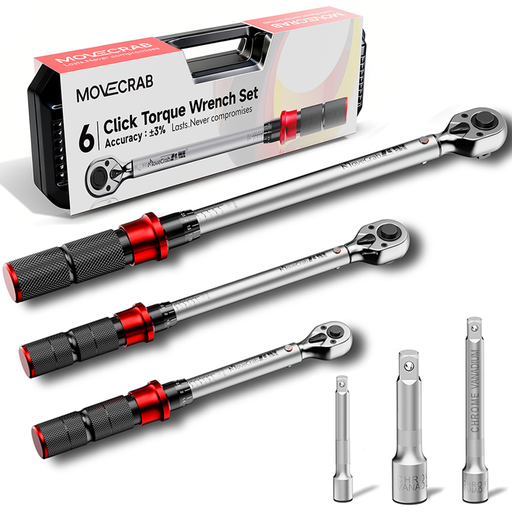
Designed for the do-it-all enthusiast who works on both their car and motorcycle. This three-wrench set covers an ultra-wide torque range (from 5 to 220 Nm), allowing you to perform nearly all common maintenance tasks, always with the right tool for the job.
Instead of a single, inevitably inaccurate "do-it-all" wrench, this kit offers three separate wrenches (1/4", 3/8", 1/2"), each optimised for its own torque range. This ensures precision whether you're tightening a small engine case or a lug nut.
Very wide torque coverage (5-220 Nm). Advertised accuracy of ±3%, with a certificate for each wrench. Robust Cr-V steel design and non-slip handles.
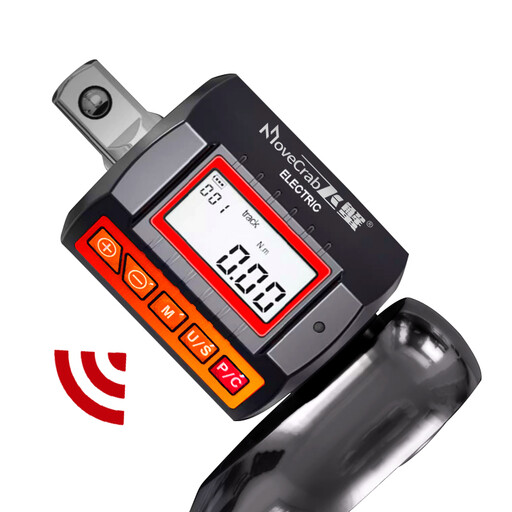
For those who already own a good set of ratchets and want to add digital precision without buying a whole new wrench. It's the perfect solution for surgical accuracy, with clear visual and audible feedback.
This adapter saves you from buying a redundant tool. It upgrades your existing equipment with a high-precision function. It's a much smarter and more cost-effective solution than investing in a full electronic wrench for occasional use.
Very high advertised accuracy of ±2% (clockwise). Audible and light alarm. Multiple measurement units and modes (real-time, peak value). Comes with adapters for 3/8" and 1/4".
Explore our full selection of tools that meet our strictest quality and safety standards.
For hobbyist use, a check every 1 to 2 years or after approximately 5,000 uses is a good rule of thumb. To preserve its accuracy for as long as possible, there's one golden rule: always set your mechanical wrench back to its lowest setting after each use and, of course, never drop it.
Absolutely not! This is a very bad idea with a mechanical click-type torque wrench. Applying force in the reverse direction risks irreversibly damaging its calibration mechanism. For loosening, use a standard ratchet or a lug wrench. Only certain electronic models or adapters allow it, but their primary function is and always will be controlled tightening.
Yes, a high-quality adapter can be just as accurate, if not more so, than many entry-level or mid-range mechanical wrenches. Its key advantage is versatility: it transforms your standard ratchets into high-precision tools. Just make sure its torque range and drive size are compatible with your equipment and needs.