
Livraison le jour même ou le lendemain

Qualité garantie

Débloquez vos offres de bienvenue: Livraison GRATUITE | Jusqu'à -80 % | 30 jours d'essai gratuits à JoyPlus
Téléchargez l'application
Insufficient tightening can create play, while over-tightening risks damaging a thread, an aluminium part or a bike component. A torque wrench allows you to apply precise torque with far more control than a standard wrench. But you still need to choose the right format and know how to use it.
The selection from Joybuy's Product Recommendation Officer is based on the products' stated specifications, without simply repeating their marketing claims. Here are the criteria to consider before buying, along with several models suited to different uses in the UK.
A very wide range does not mean the tool will be suitable for low-torque applications. A wrench covering 5 to 220 N·m may work for cars, but will prove less suited to fitting a bike stem that requires only a few N·m.
Check in particular:
The 1/4-inch square drive is generally intended for low torque and compact sockets. This is the preferred format for a bike torque wrench. The 3/8-inch offers greater versatility for motorbikes, mechanical equipment and some automotive work. The 1/2-inch is for higher torque, particularly for certain jobs on wheels and mechanical components of a car.
An adaptor can broaden the possibilities, but it won't turn a small wrench into a tool capable of handling high torque. The range stated by the manufacturer should always remain your reference.
A mechanical torque wrench left set to a high torque for a long time can gradually lose its consistency. After use, it is generally recommended to return it to the minimum setting specified in the instructions. Electronic models require good batteries and storage away from moisture.
A case, pouch or protective box also helps limit knocks and dust build-up. This is particularly useful in a work van, a shared workshop or a tool box that is regularly transported.
For a road bike, mountain bike or e-bike, a range of 2 to 20 N·m or 2 to 26 N·m covers most component tightening jobs. For a motorbike, aim for a mid-range and check socket compatibility. Car maintenance may require a set covering low torque up to over 100 N·m.
An adjustable mechanical torque wrench is set using a collar and typically emits a click when the selected value is reached. An electronic wrench displays the applied torque directly and can add an audible, visual or vibrating alert.
Before choosing a set of wrenches and sockets, check what is included:
Accessories don't replace a suitable torque range, but they save you from having to buy extra parts for everyday jobs.
On a mechanical model, a legible scale makes all the difference, especially in a poorly lit garage. On an electronic version, check the available units, memory capacity and alert type. In all cases, apply force gradually and stop as soon as the trigger signal is reached.
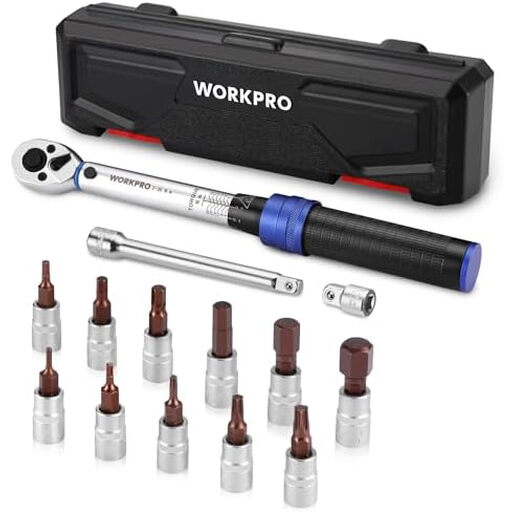
Why this choice suits this profile: Its range of 2 to 26 N·m and 1/4-inch square drive are suitable for everyday bike repairs, small motorbike maintenance and DIY jobs.
The range is clearly defined and the click signals that the set torque has been reached, reducing the risk of tightening blindly.
The case includes hex and Torx bits, a 102 mm extension bar and a 1/4 to 3/8-inch adaptor.
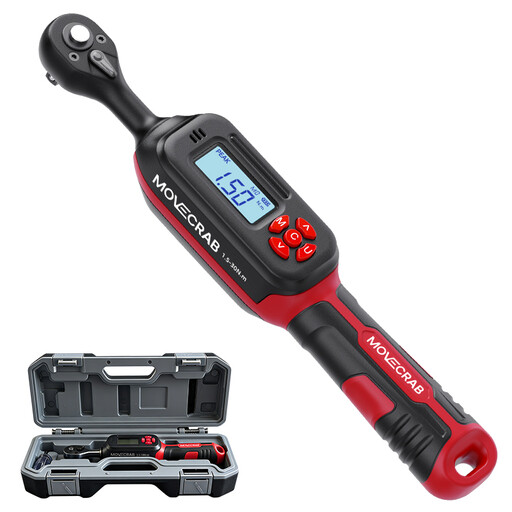
Why this choice suits this profile: Its digital display and tracking or peak measurement modes are ideal for those who want to read the applied torque directly.
Measurement doesn't rely solely on a engraved scale: the screen displays multiple units and alerts signal when the setting is reached.
The spec sheet states an accuracy of ±2% in the clockwise direction, three alerts and memory for 500 readings.
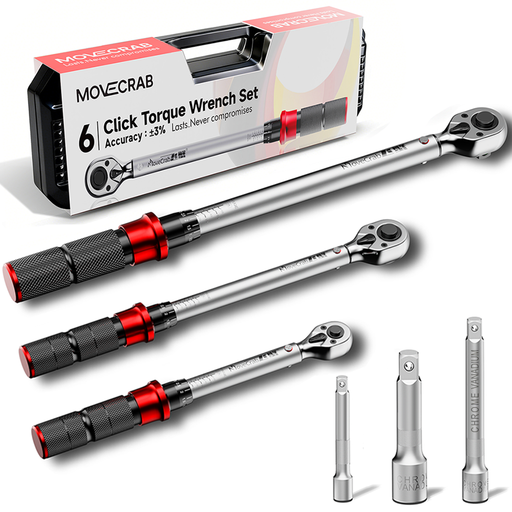
Why this choice suits this profile: The three wrenches cover everything from small parts to automotive tightening or mechanical jobs requiring high torque.
Splitting across three ranges avoids using a single wrench for very different torque levels. The kit also includes adaptors for several drive sizes.
The stated ranges go from 5 to 220 N·m, with 1/4, 3/8 and 1/2-inch drives.
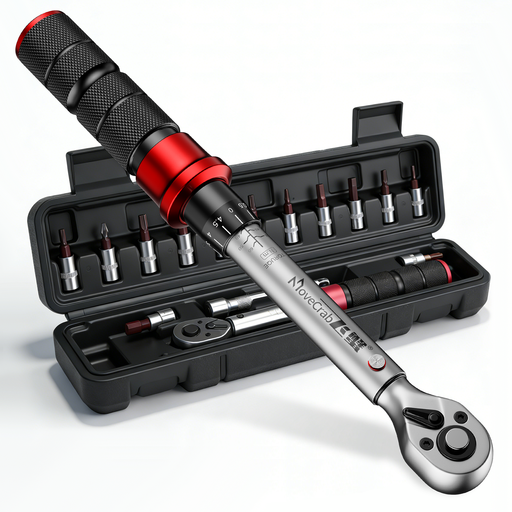
Why this choice suits this profile: This kit combines a bike torque wrench with hex, Torx and cross-head bits for everyday adjustments, at home or on the go.
Its range of 2 to 20 N·m targets low-torque jobs and its 0.2 N·m increments make precise adjustments easy.
The bidirectional ratchet head and 15 included pieces cover several common screw sizes on a bike.
We have put together a comprehensive, regularly updated selection of products that meet these strict criteria and European safety requirements.
Position the socket correctly on the fastener and keep the tool aligned. Pull the handle gradually, without jerking or using an improvised extension. Stop applying force immediately at the click or electronic alert. A torque wrench should not be used to loosen a seized fastener, to strike or to act as a lever.
To preserve measurement accuracy:
A 1/4-inch wrench covering roughly 2 to 20 N·m or 2 to 26 N·m is suitable for many bike components. However, always check the values recommended by the manufacturer of the frame, stem, seatpost and accessories.
It can be justified if you need direct readout, multiple measurement units or value memory. For simple, occasional adjustments, a mechanical wrench will usually do the job with more straightforward operation.
It depends on build quality, frequency of use, storage conditions and staying within the torque range. A tool should never be used beyond its limit. In a professional setting or for frequent use, arrange for periodic checks in line with the manufacturer's recommendations.