
Livraison le jour même ou le lendemain

Qualité garantie

Débloquez vos offres de bienvenue: Livraison GRATUITE | Jusqu'à -80 % | 30 jours d'essai gratuits à JoyPlus
Téléchargez l'application
Whether you're a professional mechanic or a weekend DIY enthusiast, the torque wrench is an absolutely essential tool. Improper tightening—whether on a wheel, an oil pan, or a carbon fibre bike component—can quickly turn into a nightmare, leading to costly material damage or, worse, an accident.
The problem? The market is saturated with models, making it easy to get lost. To avoid disappointment, here are the classic mistakes to steer clear of.
To cut through the noise and select a tool that will become a trusted partner in your workshop, focus on these three fundamental criteria.
This is THE deciding factor. The torque range defines the minimum and maximum tightening force the wrench can apply accurately. Before any purchase, consult your vehicle's service manual to find the recommended torque specifications.
Accuracy is expressed as a tolerance percentage (e.g., ±3%). The lower this number, the more precise the wrench. For mechanical applications, an accuracy of ±4% is the minimum acceptable standard. Higher-quality models often offer ±3% or even ±2% accuracy.
You'll have the choice between two main types:
An interesting alternative is the torque adapter, a small electronic device that fits between your standard ratchet and the socket, turning it into a digital torque measurement tool.
This is the size of the square head that your sockets attach to, which determines their compatibility. The most common sizes are:
Enough theory! To help you choose, we've selected three products that cater to specific profiles and needs.
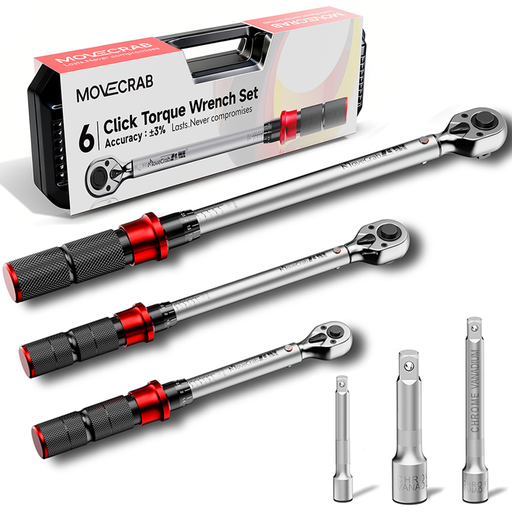
Why it's a great choice: Perfect for routine car and motorcycle maintenance (oil changes, wheel swaps...). This set is an all-in-one solution, without breaking the bank or dealing with digital complexity.
With its three wrenches, the set covers a massive torque range (5-220 N.m). It's impossible to go wrong and buy an unsuitable tool. The Cr-V steel construction ensures excellent durability.
The set handles all three drive sizes (1/4", 3/8", and 1/2") and includes extension bars. Each wrench comes with its own individual calibration certificate (±3% accuracy).
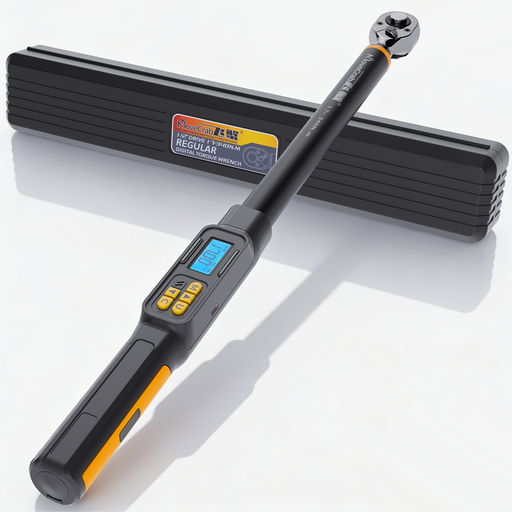
Why it's a great choice: For those who demand precision and efficiency for regular work on their car. Its wide torque range is perfect for wheels, suspension, and chassis components.
Its certified high accuracy (±2%) puts an end to guesswork. The triple-alert system (sound, light, vibration) ensures you never exceed the target torque, even in a noisy workshop.
Peak (max value) and Track (real-time) modes with 500 memory values for perfect quality control. An ergonomic handle and 10 presets save you precious time.
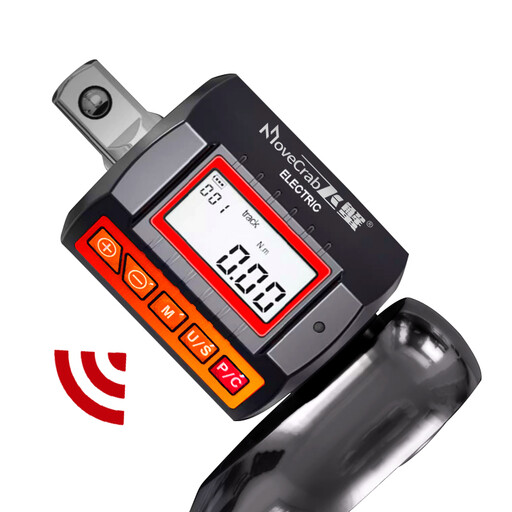
Why it's a great choice: The smart solution for those who already own good ratchets and want to add torque-tightening functionality without buying multiple new wrenches. Ideal for switching between bicycle and car work.
It's flexibility personified. Compatible with 1/4", 3/8", and 1/2" drives (adapters included), it covers a huge range and cost-effectively modernises your existing toolkit. No more risk of having the wrong tool for the job.
Bidirectional accuracy (±2% clockwise, ±2.5% counter-clockwise). Features an audible and light-up alarm, plus a 1000-value memory for professional-grade tracking.
Perfectly torqued fasteners are the secret to reliable and durable mechanical work. To take your setup to the next level, explore our complete selection of tools that meet the same high standards of quality and performance.
Should a torque wrench be recalibrated? Yes, calibration doesn't last forever. It's recommended to have your wrench checked annually or after every 5,000 uses, especially in a professional setting. And if you drop it? A calibration check is mandatory to guarantee its accuracy.
What is the lifespan of a torque wrench? With proper maintenance, a quality mechanical wrench is nearly indestructible. The golden rule: always unwind it and set it to its lowest value after use to preserve the internal spring. For a digital model, the lifespan also depends on the electronics, but they are built to withstand workshop conditions.
Can you use a torque wrench to loosen bolts? Absolutely not! That's the fastest way to ruin its calibration permanently. A torque wrench is a precision measurement instrument, not a high-force tool for loosening. To break a seized nut loose, use a lug wrench or a breaker bar.