Which criteria should you consider first?
Front-loading washing machine
Consider this if: you want to look at capacities beyond those generally available in top-loaders, or need to fit the machine under a worktop.
Bear in mind: measure the space and leave enough room to open the door and load the laundry.
Top-loading washing machine
Consider this if: a narrower machine or top loading works better for your installation. Que Choisir gives a width of 40 to 46 cm for this style.
Check this limitation: Que Choisir gives a capacity range of 5 to 8 kg. Make sure it suits the laundry you want to wash in one go.
Once you’ve chosen a style, compare models based on your usual loads and how you’ll use the machine, rather than looking at capacity alone.
| Criterion |
What to check |
My needs |
| Capacity |
Estimate how much laundry builds up between washes, including bulky items. ADEME gives 7 kg as a general guide that’s usually enough, but you should adjust this to suit your actual loads. |
I want to do fewer washes without choosing a drum that would often be only lightly filled. |
| Installation |
Measure the width and depth, then check access for loading: the space needed to open a front-loader’s door or the clearance above a top-loader. |
The machine needs to fit in its space and still be easy to load. |
| Noise |
Compare the noise information on the energy label. If an independent test covers the exact model, check its noise results too. |
If the machine is near a living area, spin noise is particularly important to me. |
| Water, energy and spin performance |
Compare consumption using the same labelling basis and check the spin information separately. ADEME recommends considering these criteria together. |
I want to keep track of water and electricity use without overlooking spin performance, especially if I dry laundry indoors. |
| Durability |
For a washing machine sold in France, check the model’s durability rating and its breakdown. According to ADEME, reliability and repairability each make up 50% of the score. |
A good capacity or energy rating alone doesn’t tell me how reliable or repairable a machine is. |
Which brands and models should you compare?
The brands below are a starting point for comparing specific models, not a basis for judging their entire ranges in the same way.
Miele
The WCA132WCS and WED385 WCS are among the models mentioned in Que Choisir’s comparison information.
- Compare these two models separately against the criteria that matter to your household.
- Their inclusion in a comparison doesn’t tell you how the entire Miele range performs.
Bosch
WGE03207FR and WGE02201FR are the Bosch models mentioned in Que Choisir’s comparison information.
- Que Choisir’s washing machine test protocol covers washing, rinsing, spinning and noise, among other things.
- Check the specifications and results for the exact model rather than assuming they apply to the whole brand.
Hisense
The WF3S9043BB3 is among the models mentioned for consideration in Que Choisir’s comparison information.
- This model gives you a specific product to compare.
- Its specifications and results can’t be taken as representative of other Hisense washing machines.
Electrolux
EWQ6412B is the Electrolux model mentioned in Que Choisir’s comparison information.
- Check its style, capacity and label information to see whether it suits your installation.
- A model’s inclusion in a comparison doesn’t amount to a general recommendation for the brand.
AEG
The LTR8C7331A top-loader is the AEG model mentioned in Que Choisir’s comparison information.
- This model gives you a point of comparison if you’re considering a top-loader.
- Check its capacity and dimensions: being a top-loader doesn’t automatically mean it will suit your loads.
Washing machines available on Joybuy
These front-loading and top-loading models have capacities from 6 to 10 kg. Compare each one with the amount of laundry your household usually washes, then check the details for the model you’re interested in.
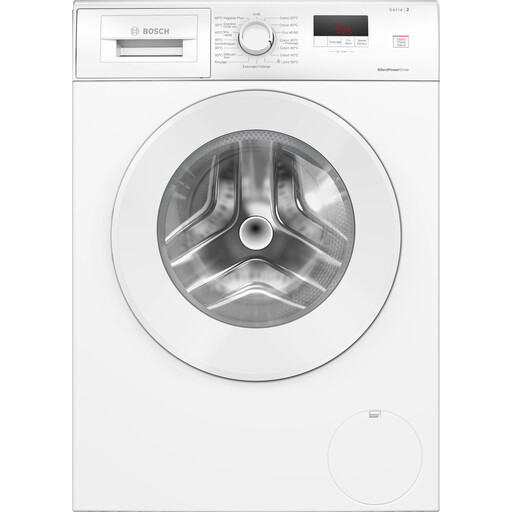 Image unavailable
Bosch WGE02407FR, 7 kg front-loader
Its 7 kg capacity matches ADEME’s general guide for everyday laundry. Check that it suits your loads. The product details list a spin speed of 1 400 tr/min and an A energy rating. Also measure the space needed to open the door and check the durability rating that applies to this model.
View on Joybuy
 Image unavailable
Haier T Series 7 THASN276TM6-S, 7 kg top-loader
Consider this top-loader if space is limited in width and 7 kg suits your loads. The model name lists a spin speed of 1 200 tr/min, an A energy rating and Wi-Fi. Check its dimensions, clearance above the machine, spin noise and durability rating.
View on Joybuy
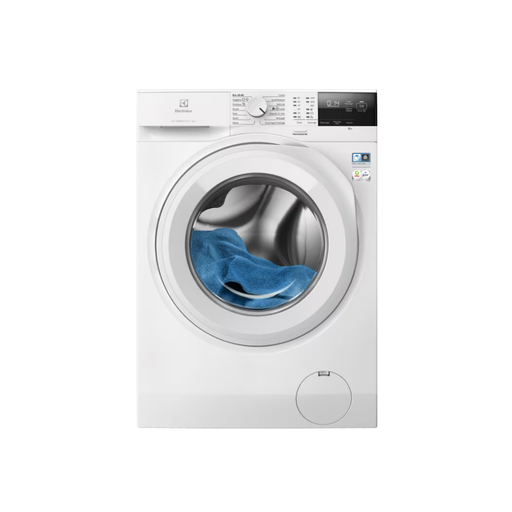 Image unavailable
Electrolux EW6FI4805AW, 8 kg front-loader
Consider its 8 kg capacity if your usual loads call for more than ADEME’s general 7 kg guide. The model name mentions a spin speed of 1 400 tr/min and SensiCare; this alone doesn’t establish how well it washes. Check the dimensions, energy label and French durability rating for this model.
View on Joybuy
 Image unavailable
Candy ProWash 500 TCA464TM4-S, 6 kg top-loader
Consider this 6 kg top-loader if that capacity is enough for the loads you want to wash together. Its name lists a spin speed of 1 400 tr/min, a B energy rating and Wi-Fi. Before choosing, check the clearance above the machine, its spin noise and its durability rating.
View on Joybuy
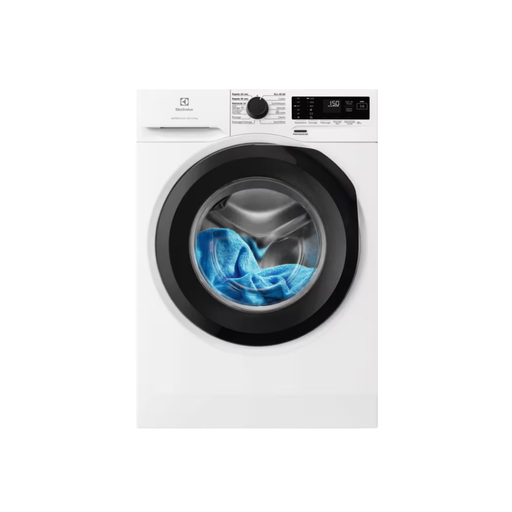 Image unavailable
Electrolux EWF1410N2, 10 kg front-loader
Consider its 10 kg capacity if the amount you regularly wash justifies it, rather than for smaller everyday loads. Check the dimensions and door clearance, then compare the energy label, noise and durability rating for this model.
View on Joybuy
Frequently asked questions
Does the durability rating replace the energy label?
No. For washing machines covered by the scheme in France, the durability rating tells you about reliability and repairability, which ADEME says each account for 50% of the score. The energy label lets you check consumption, spin performance and noise separately. Also make sure you choose the right style and capacity for your needs.
Does a washing machine sold in France have to display a durability rating?
Yes, for washing machines covered by the requirement that came into effect on 8 April 2025, according to the ministry responsible for the ecological transition. The durability rating is gradually replacing the repairability rating for this category. Check the rating that applies to the model you’re considering.
Is a 7 kg capacity enough for a household?
Often, but not always: ADEME says that 7 kg is usually enough for everyday laundry. If you regularly wash bulky items or build up more laundry between cycles, estimate the size of your loads before choosing a different capacity.
When should you consider a top-loader instead of a front-loader?
Consider a top-loader when width is your main constraint or you’d prefer to load the machine from above. Que Choisir gives a width of 40 to 46 cm and a capacity of 5 to 8 kg for this style. Check that both the dimensions and capacity suit your needs.
Why compare spin noise before you buy?
Spin noise may affect your choice if the machine will run near a room you use. Compare the noise information on the energy label and, if an independent test covers the exact model, check its results too. In a May 2025 survey of 4,350 readers of its newsletter, Que Choisir found more mixed opinions on this point, although the sample does not represent all French households.


